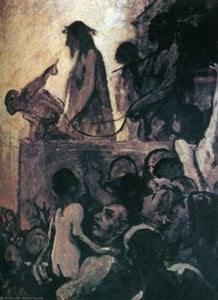
Peter Denouncing Christ (1660) by Rembrandt van Rijn, hand-painted oil painting reproduction by a master artist
Preview AR preview Switch to Print Switch to Digital Image Send
Details Guide Add to favorites Download Similars X-Ray Diaporama Q&A Stats

Peter Denouncing Christ Hand-painted oil painting reproduction

Dimensions
154.0 x 169.0 cm

Experience Rembrandt’s ‘Peter Denouncing Christ’! A dramatic Baroque masterpiece showcasing intense emotion & masterful chiaroscuro. Explore this iconic Dutch Golden Age painting.

A master of chiaroscuro known for The Night Watch. Explore his legendary Dutch Golden Age paintings and etchings today.

Hand Made Oil Reproduction

Hand-painted oil on canvas in your size and frame, made to order by our artists. ( Switch to Print Switch to Digital Image)

Corner sample of the P118B picture frame: moulded polystyrene, 5 cm wide and 3 cm thick
P118B $10
Corner sample of the P118H picture frame: moulded polystyrene, 5 cm wide and 3 cm thick
P118H $10
Corner sample of the P118W picture frame: moulded polystyrene, 5 cm wide and 3 cm thick
P118W $10
Corner sample of the P438Z picture frame: moulded polystyrene, 5.5 cm wide and 3.5 cm thick
P438Z $10
Corner sample of the P508JH picture frame: moulded polystyrene, 7 cm wide and 3.5 cm thick
P508JH $12
Corner sample of the P508YH picture frame: moulded polystyrene, 7 cm wide and 3.5 cm thick
P508YH $12
Corner sample of the P805H picture frame: moulded polystyrene, 5 cm wide and 3.5 cm thick
P805H $10
Corner sample of the P805Z picture frame: moulded polystyrene, 5 cm wide and 3.5 cm thick
P805Z $10
Corner sample of the P919BZ picture frame: moulded polystyrene, 7 cm wide and 3.5 cm thick
P919BZ $10
Corner sample of the P919G picture frame: moulded polystyrene, 7 cm wide and 3.5 cm thick
P919G $10
Corner sample of the P919XJ picture frame: moulded polystyrene, 7 cm wide and 3.5 cm thick
P919XJ $10
Corner sample of the P959ZH picture frame: moulded polystyrene, 5 cm wide and 3 cm thick
P959ZH $10
Corner sample of the P968JZ picture frame: moulded polystyrene, 6 cm wide and 4 cm thick
P968JZ $12
Corner sample of the W106C picture frame: solid wood, 5 cm wide and 3 cm thick
W106C $8
Corner sample of the W218G picture frame: solid wood, 5 cm wide and 3 cm thick
W218G $10
Corner sample of the W218JH picture frame: solid wood, 5 cm wide and 3 cm thick
W218JH $8
Corner sample of the W218Y picture frame: solid wood, 5 cm wide and 3 cm thick
W218Y $10
Corner sample of the W307PJ picture frame: solid wood, 6 cm wide and 3 cm thick
W307PJ $10
Corner sample of the W316G picture frame: solid wood, 6 cm wide and 3 cm thick
W316G $10
Corner sample of the W316PJ picture frame: solid wood, 6 cm wide and 3 cm thick
W316PJ $8
Corner sample of the W316Y picture frame: solid wood, 6 cm wide and 3 cm thick
W316Y $10
Corner sample of the W398PJ picture frame: solid wood, 5 cm wide and 3 cm thick
W398PJ $8
Corner sample of the W4111J picture frame: solid wood, 6.5 cm wide and 3.5 cm thick
W4111J $10
Corner sample of the W500HY picture frame: solid wood, 7 cm wide and 5 cm thick
W500HY $15
Corner sample of the W500JH picture frame: solid wood, 7 cm wide and 5 cm thick
W500JH $15
Corner sample of the W692G picture frame: solid wood, 8 cm wide and 4 cm thick
W692G $12
Corner sample of the W849H picture frame: solid wood, 5 cm wide and 3 cm thick
W849H $8
Corner sample of the W940BG picture frame: solid wood, 7.5 cm wide and 4.5 cm thick
W940BG $15
Corner sample of the W953PJ picture frame: solid wood, 6 cm wide and 3.5 cm thick
W953PJ $8

Standard
custom
CM
INCH

Pick from our preset sizes that match the artwork's original proportions.

width
height

Type the width and the height you need, to fit your frame or your wall. This is hand-painted, so for a size with a different shape the artist can paint a bit more around the picture, or cut a bit — you choose. We send you a digital mockup to approve before the painting starts. The picture shown on this page does not show the real result — only the mockup does.

Examples of what can be changed: Replace face with customer photo; Add pet (e.g., replace cat with dog); Include hidden message in background; Change background landscape or elements.
After order, WahooArt.com team will email client for instructions and provide a mockup preview

Worldwide Delivery () in 3/4 weeks instead of standard 5 weeks. (4 November). No compromise on quality.

Free Worldwide Express Shipping
High-Quality Linen Canvas
Full Shipping Insurance
Customs Tax Refund Guarantee
True Color Matching Guarantee
100-Day Return Policy (Defects Only)
100% Money-Back Guarantee
Bulk Discount Offer

Total Price

$ 422

Peter Denouncing Christ

Reproduction Medium

Reproduction Size

-

Total Price

$ 422

Quick Facts

  • style: Dutch Golden Age painting
  • title: Peter Denouncing Christ
  • artist: Rembrandt van Rijn
  • notable elements: chiaroscuro, birds, cup
  • year: 1660

Art Quiz

There is only one correct answer for each question.

Question 1:
In 'Peter Denouncing Christ,' what artistic technique is most prominently used to create dramatic contrast and emotional intensity?
Question 2:
What pivotal biblical event does Rembrandt depict in this painting?
Question 3:
To what art historical period does 'Peter Denouncing Christ' belong?
Question 4:
What symbolic meaning might be attributed to the birds depicted in the painting?
Question 5:
In what country is the Rijksmuseum, where this artwork is housed, located?

A Moment of Crisis: Unveiling Rembrandt’s “Peter Denouncing Christ”

Rembrandt van Rijn's 1660 masterpiece, *Peter Denouncing Christ*, is a powerful and psychologically complex depiction of a pivotal biblical moment. Housed in the Rijksmuseum, this large-scale oil painting (154 x 169 cm) transcends mere illustration to become a profound exploration of faith, betrayal, and human fallibility.

The Scene: Denial Under Scrutiny

The painting captures the dramatic scene where Saint Peter, one of Jesus’s closest apostles, denies knowing Christ three times before the cock crows – as prophesied by Jesus himself. Rembrandt doesn't focus on grand spectacle; instead, he presents an intensely intimate and emotionally charged confrontation. Peter is shown vehemently pointing away from a calmly resolute Jesus, surrounded by a diverse group of onlookers. Their reactions range from shocked disbelief to indifferent curiosity, creating a palpable sense of tension and moral ambiguity. The composition isn’t about glorifying faith but dissecting the fragility of human conviction under pressure.

Rembrandt's Masterful Technique

This work is quintessential Rembrandt, showcasing his unparalleled mastery of chiaroscuro – the dramatic interplay of light and shadow. Light doesn’t simply illuminate; it *models* form and directs our gaze, highlighting the emotional turmoil etched on each face. The brushwork is loose and expressive, particularly in the drapery and surrounding figures, contributing to a sense of immediacy and realism. Rembrandt's technique isn’t about precise detail but about capturing the essence of emotion and psychological truth. The impasto – thick application of paint – adds texture and physicality, making the scene almost tangible.

Symbolism Woven into the Canvas

Rembrandt subtly imbues the painting with symbolic meaning. Two birds are present: one near the top right corner and another towards the bottom left. These have been interpreted as representing spiritual observers witnessing this crucial moment of human weakness. A cup placed at the lower center is often linked to the Last Supper, a poignant reminder of the events leading up to Peter’s denial and Christ's impending sacrifice. These details aren’t overt but add layers of depth for those who seek them.

Historical Context & Artistic Legacy

Created during the later period of Rembrandt’s life – a time marked by personal tragedy and financial hardship – *Peter Denouncing Christ* reflects a mature artistic vision. It exemplifies the Dutch Golden Age's focus on realism, psychological depth, and religious narrative. Rembrandt moved away from purely idealized depictions towards portraying human figures with all their flaws and vulnerabilities. This painting influenced generations of artists who sought to capture not just what they *saw*, but what they *felt*.

Emotional Resonance & Interior Design

*Peter Denouncing Christ* is more than a historical or religious artwork; it’s a powerful meditation on the human condition. The painting evokes feelings of anxiety, betrayal, and moral conflict, prompting viewers to confront their own beliefs and vulnerabilities. Its dramatic composition and rich color palette make it a striking focal point for any interior space. The somber tones lend themselves well to libraries, studies, or dining rooms seeking an atmosphere of contemplative elegance. A high-quality reproduction would bring the emotional weight and artistic brilliance of Rembrandt’s masterpiece into any home or office.

Exploring Further: Related Works

  • Consider pairing this work with reproductions of Rembrandt's self-portraits to explore his introspective approach.
  • *Rembrandt’s Son Titus in a Monk’s Habit* (1660), also at the Rijksmuseum, offers a contrasting study in quiet contemplation and familial devotion.
  • Exploring other works depicting biblical scenes from the Dutch Golden Age will provide further context for Rembrandt's unique style.
This painting is a testament to Rembrandt’s genius – his ability to transform a biblical narrative into a universal story of human struggle and redemption.

Questions & Answers

How well known is "Peter Denouncing Christ" by Rembrandt van Rijn?

"Peter Denouncing Christ" by Rembrandt van Rijn has an iconic popularity level. This classification reflects how widely the work is recognized.

Is "Peter Denouncing Christ" by Rembrandt van Rijn among the sought-after Baroque artworks?

"Peter Denouncing Christ" is recorded as iconic among the Baroque works in the catalog.

How do I preview a reproduction of "Peter Denouncing Christ" by Rembrandt van Rijn?

The Preview page of "Peter Denouncing Christ" lets you preview the artwork before ordering.


Artist Biography

The Light of Leiden

In the quiet streets of Leiden, Netherlands, a boy named Rembrandt Harmenszoon van Rijn grew up in a house filled with the scent of flour and grain. His father, Harmen, ran a mill, while his mother, Neeltgen, came from a family of bakers. This middle-class stability provided enough for a seat at the Leiden Latin School, where he spent seven years studying classical texts. He later sat in classrooms at the University of Leiden, though his eyes often drifted toward the brush and the plate.

His hands learned their trade through apprenticeships. First, there was Jacob van Swanenburg in Leiden, followed by a short, intense period under Pieter Lastman in Amsterdam. It was from Lastman that he learned to use shadow to create weight. He returned to Leiden to share a studio with Jan Lievens, working alongside a peer who understood the same pull of the dark and the light. By 1631, the pull of Amsterdam, a city of growing trade and heavy commerce, led him to relocate permanently.

Shadow and Substance

The way he applied paint changed as the years passed. In his early years, there was a focus on fine detail and clear lines, much like the style of his teachers. As he matured, the brushwork grew thicker and more textured. He began to use chiaroscuro, not merely as a trick of lighting, but as a way to sculpt faces out of the darkness. He used thick, textured paint to catch the light on a forehead or a cheek, while thin, transparent layers allowed the shadows to recede into deep, velvety blacks.

His subjects were as varied as the people he encountered in the Dutch Republic. He painted:

  • Group portraits of civic militias, such as the 1642 work known as The Night Watch.
  • Intimate self-portraits that tracked the physical changes in his own face over decades.
  • Biblical scenes that used dramatic lighting to highlight human emotion.
  • Etchings where he mastered the use of line and tone to create depth on paper.

A Life of Change

Personal shifts often dictated the mood of his canvases. His marriage to Saskia van Uylenburgh in 1634 brought a period of social connection and initial stability, yet it was also marked by the loss of several children. The death of Saskia in 1642 left a visible mark on his later work, which turned toward more somber, introspective themes. He lived through financial highs and the heavy reality of bankruptcy in 1656, a period that forced him to move from fashionable houses to more modest lodgings.

Despite the loss of wealth, his output remained steady. He continued to find models among the people of Amsterdam, including his son Titus and later Hendrickje Stoffels. His ability to capture the weight of an expression or the texture of a weathered hand ensured that his work remained a central part of the Dutch Golden Age. He died in 1669, leaving behind hundreds of paintings, etchings, and drawings that remain fixed in their study of the human condition.

Rembrandt van Rijn

Rembrandt van Rijn

1606 - 1669 , Netherlands

Quick Facts

  • Artistic Movement Or Style: Dutch Golden Age, Baroque
  • Artists Or Movements Influenced By This Artist: Generations of artists
  • Artists Who Influenced This Artist:
    • Pieter Lastman
    • Jacob van Swanenburg
  • Full Name: Rembrandt Harmenszoon van Rijn
  • Nationality: Dutch
  • Notable Artworks:
    • The Night Watch
    • Anatomy Lesson of Dr. Nicolaes Tulp
    • Belshazzar's Feast
  • Place Of Birth: Leiden, Netherlands
  • Date Of Birth: 1606
  • Date Of Death: 1669
Explore artworks organized by themes, styles, and characteristics.