

 Oil On CanvasWallArtRealistic Portrait Tradition
 185719th Century
 The Abraham Lincoln Foundation of The Union League of Philadelphia
Museum-quality giclée or canvas print with fast production and flexible finish options. ( Buy Hand Made Painting Switch to Digital Image)





























Pick from our preset sizes that match the artwork's original proportions.

You may enter your own dimensions to fit a specific frame or space. If your selected size does not match the original image's proportions, we will either crop the artwork or extend the image with a mirrored or solid-fill edge. A digital mockup will be sent for your approval before production begins.
Please note that the on-screen preview does not reflect the actual cropping or extension. Only the mockup will accurately show the final composition.
While custom sizes are available, we recommend selecting a dimension from the predefined list to preserve the original proportions.
Worldwide Delivery () in 2 weeks instead of standard 4/5 weeks. (25 September)


George Washington
Reproduction Size
In the grand tapestry of American iconography, few images command as much reverence and historical weight as Rembrandt Peale’s portrait of George Washington. This particular rendition serves as more than a mere likeness; it is a window into the soul of a nascent nation. Executed in 1857, this painting transcends the boundaries of simple portraiture to become a carefully crafted testament to American idealism and leadership. While many are familiar with the various iterations of Washington’s image, Peale’s work—meticulously copied from Gilbert Stuart's original masterpiece—seeks to distill the very essence of the man. It is an encounter with a figure who embodies the spirit of a nation’s formative years, captured through a lens of profound respect and monumental gravity.
The portrait presents Washington from the chest up, set against a deep, dark background that serves as a dramatic stage for his presence. This stark contrast draws the eye immediately to the subject's lighter skin tones and the resolute features of his face. He is depicted in formal attire, wearing a dark coat over a crisp white shirt, a choice that underscores the solemnity and dignity appropriate for the first President of the United States. The lighting is masterfully focused on Washington’s countenance, casting subtle shadows that lend a three-dimensional quality to his features. This interplay of light and shadow does more than just define form; it creates an atmosphere of quiet contemplation, inviting the viewer to meet the gaze of a leader who carried the weight of a new republic upon his shoulders.
Peale’s technique is a brilliant embodiment of Romantic Realism, a movement that sought to harmonize scientific accuracy with emotive expression. Rather than pursuing an idealized or fanciful beauty, Peale prioritized the capture of Washington’s true character—his solemn gaze and his dignified posture. Through the skillful application of oil paints on canvas, the artist utilized sophisticated layering techniques to build up tonal values and create a sense of profound depth. Every detail has been treated with meticulous care, from the subtle texture of the skin to the precise rendering of hair strands and the heavy folds of fabric.
This dedication to realism distinguishes Peale's work from the more decorative or whimsical representations prevalent during the Victorian era. The color palette is intentionally subdued, relying on a range of earth tones that contribute to the somber and serious mood of the portrait. This restrained use of color ensures that the focus remains entirely on the subject’s character, fostering a sense of timelessness. For the collector or interior designer, this piece offers a sophisticated anchor for a room, providing a sense of historical weight and intellectual depth that more modern, vibrant works might lack.
To understand this portrait is to understand the historical moment from which it emerged. Peale was working within a lineage of American excellence, being the son of the legendary Charles Willson Peale. His ambition was not merely to replicate a face, but to perpetuate a legacy. By revisiting Stuart's original work, Peale helped solidify Washington’s image as a symbol of American virtue and stability during a period when the nation was constantly redefining itself. The painting acts as a bridge between the revolutionary era and the mid-19th century, carrying the memory of the founding father into a new age.
For those seeking to adorn a space with art that inspires reflection and commands respect, this reproduction offers an unparalleled opportunity. It is a piece that speaks of strength, integrity, and the enduring power of leadership. Whether placed in a stately library, a formal study, or a curated gallery wall, Peale’s George Washington serves as a profound focal point, evoking an emotional response that is both deeply personal and universally historical. It is not just a painting; it is an invitation to contemplate the very foundations of American identity.


1778 - 1860 , United States of America

Explore 25 iconic Georges Seurat paintings & discover the brilliance of Pointillism. From 'La Grande Jatte' to his harbor scenes, delve into art history with WahooArt.com. Find museum-quality reproductions for your home decor. Explore the full collection online!

Explore 25 iconic Georges Braque paintings that revolutionized Cubism & modern art. Discover the stories behind his masterpieces, from Fauvism to Analytical Cubism. Find museum-quality reproductions & elevate your home decor with WahooArt.com.
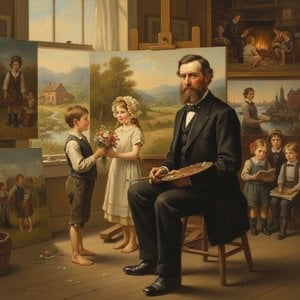
Explore the captivating genre paintings of John George Brown, celebrated for his realistic depictions of 19th-century American life. Discover his legacy & find museum-quality reproductions at WahooArt.

Journey through Rembrandt van Rijn's 25 most iconic paintings & etchings. Explore Dutch Golden Age masterpieces, dramatic chiaroscuro, and timeless portraits. Find museum-quality art reproductions to elevate your home decor on WahooArt.com.

Explore the life & art of Charles Willson Peale – Revolutionary portraitist, scientist, and founder of America’s first museum. Discover his iconic paintings of Washington & the Enlightenment ideals that shaped a nation.

 Preview
 Send
Send Share
Share
 Details
 Guide
Guide

 Download
 Similars
 X-Ray
X-Ray Diaporama
 Stats
Stats Read More







 Glass option is only available in size under 110 CM


