Get a print-ready file that goes far beyond the web preview. Every digital image we sell comes from a high-resolution master in our stock database — usually 5,000 to 15,000 pixels wide — so you can print large, crop tightly, or reproduce fine detail with confidence.
No file leaves our studio untouched. A digital expert checks the colors against the original painting and corrects them if needed, then improves clarity and detail with professional retouching tools — always staying faithful to the artist's brushwork and style. The result is an image that looks like the painting, not like a filtered scan.
You approve before you're done: our expert sends the image by e-mail within 72 hours for your review. Not satisfied? Ask for improvements or corrections, or request a refund if the quality falls short.
This is the quality relied on by publishers, design studios, galleries and print shops.
Download a high-resolution file for personal display, printing, and creative projects. ( Switch to Print Buy Hand Made Painting)
When you choose WahooArt.com, you're not just getting an image - you're receiving a professionally enhanced digital artwork, crafted with precision and backed by a satisfaction guarantee. Here's everything that comes with your order, automatically:
Your high-resolution digital image file will be emailed to you within 72 hours of ordering - ready for immediate use.
Your artwork is professionally optimized using advanced AI tools and manual editing, ensuring maximum detail, clarity, and color accuracy.
Accidentally deleted or lost your file? No worries - we'll resend it to you anytime, free of charge.
Enjoy your artwork instantly with zero customs, duties, or delivery fees - digital downloads are always tax-free.
We ensure your digital image reflects the original colors as closely as possible using professional tools and color management.
If you're not satisfied with your digital image, we'll revise it or refund 100% within 100 days - no questions asked.
Not satisfied? Get a full refund within 100 days of receiving your digital file - no questions asked.
Buy 3 images, save 10% - Buy 5, save 15% - Buy 10+, save 20%. Great for creative projects, galleries, and agencies.
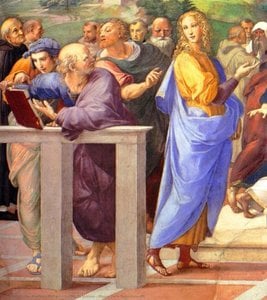
In the hallowed halls of the Vatican, amidst the profound intellectual weight of the Renaissance, lies a fragment of divine serenity known as Stanza Della Segnatura d02. This breathtaking fresco by the master Raphael is far more than a mere decorative element; it is a window into a realm where the earthly and the divine converge in perfect harmony. At its heart, the composition presents three angelic figures suspended amidst soft, billowing clouds, their wings unfurged in a moment of quiet contemplation. These celestial beings are locked in a silent, sacred conversation, their gazes meeting with such tenderness that the viewer feels less like an observer and more like an invited guest to a heavenly assembly. The scene is punctuated by the delicate presence of birds—symbols of wisdom and vigilance—and distant figures that add layers of depth to this luminous, atmospheric sky.
The technique employed by Raphael in this work exemplifies the pinnacle of High Renaissance mastery. Moving away from the heavy, muscular tension often associated with his contemporary Michelangelo, Raphael utilizes a delicate pastel palette dominated by ethereal blues, soft pinks, and warm yellows. This choice of color creates an unmistakable luminescence, as if the light itself is emanating from within the plaster. Through the innovative use of the fresco technique, applied over a fine gesso ground, he achieved a translucent quality that allows light to dance across the surface. His brushwork is meticulous, capturing the weightless texture of clouds and the subtle sheen of angelic wings with an accuracy that feels almost palpable, inviting anyone who views a reproduction to experience the soft, breathing atmosphere of the original.
To understand the profound emotional impact of this piece, one must look to the historical currents of the early 16th century. Commissioned by Pope Julius II, the fresco was part of a larger program designed to celebrate the reconciliation of classical philosophy with Christian theology. Within the Stanza della Segnatura, Raphael sought to illustrate the three pillars of the human spirit: Truth, Goodness, and Beauty. In this specific panel, the angels serve as allegories for the theological virtues of faith, hope, and charity. Yet, there is a subtle, brilliant tension in their posture; while they represent divine grace, their outward gazes suggest an engagement with the intellectual realm of human reason. This reflects the humanist ideal of the era—the belief that through contemplation and the pursuit of knowledge, humanity can ascend toward the divine.
For the discerning collector or interior designer, a high-quality reproduction of this masterpiece offers more than just aesthetic beauty; it brings a sense of intellectual prestige and spiritual tranquility to any space. The painting’s ability to evoke peace through its balanced composition and soft light makes it an ideal centerpiece for rooms designed for reflection, study, or sophisticated entertaining. Whether placed in a sunlit gallery or a quiet library, the Stanza Della Segnatura d02 serves as a timeless reminder of the harmony that can be found when beauty is wedded to profound meaning, making it an incomparable addition to any curated collection of fine art.
Behind "Stanza Della Segnatura d02" stand Raphael and the Renaissance movement.
Among Raphael's recorded themes - classical ideals, humanism, religious allegory, papal patronage, renaissance harmony, influence of michelangelo, stanza della segnatura masterpiece - "Stanza Della Segnatura d02" brings its own focus on renaissance, fresco, angels, philosophy, religion, harmony, classical art, architecture.
"Stanza Della Segnatura d02" by Raphael uses a dark palette, with gray (#9f7579) as the dominant color.

In the quiet, intellectual halls of Urbino, a young boy named Raffaello Sanzio grew up surrounded by the scent of ink and the rhythms of courtly life. His father, Giovanni Santi, was a man of letters and a painter for the Duke, ensuring that the child’s earliest memories were steeped in the humanist traditions of the Italian courts. This environment provided more than just a home; it offered a window into the advanced artistic ideas flowing through central Italy. When tragedy struck and his father passed away when Raphael was only eleven, the boy found himself managing the family workshop. He learned the weight of responsibility alongside the delicate touch of the brush.
His early training led him to the workshop of Pietro Perugino in Perugia. Under this master, he absorbed the Umbrian style, a method defined by soft modeling and serene religious scenes. By the time he was recognized as an independent master around 1500, his hand already showed a certain clarity and ease. He moved through the cities of northern Italy, gathering knowledge like a traveler collecting coins, before the pull of larger artistic centers began to reshape his vision.
When Raphael arrived in Florence in 1504, he entered a city pulsing with the energy of new discoveries. He did not merely observe the works of Leonardo da Vinci and Michelangelo; he studied them with an insatiable hunger. From Leonardo, he learned the subtle gradations of light and shadow known as sfumato. From Michelangelo, he drew an understanding of anatomical precision and the power of dramatic composition. This period was a transformation. His earlier, gentler Madonnas began to take on a new psychological depth and physical presence.
The Florentine influence allowed him to synthesize these diverse techniques into something uniquely his own. He possessed a rare ability to take the scientific shadows of one master and the muscular strength of another, blending them into a style characterized by balance and luminous color. His portraits from this era reflect a growing sophistication, capturing not just the likeness of his subjects but a sense of their inner dignity.
A summons from Pope Julius II in 1508 brought Raphael to Rome, an event that changed the trajectory of his life. The Eternal City offered him the grandest stage imaginable. Tasked with decorating the papal apartments in the Vatican, he began work on the Stanze della Segnatura. It was here that he produced the School of Athens, a vast fresco where he brought together the great thinkers of antiquity—Plato, Aristotle, and Euclid—into a single, harmonious space. This work celebrated human reason through a masterful use of perspective and classical allegory.
His productivity in Rome was immense. Working for successive Popes, including Leo X, he expanded his reach from painting to architecture, even overseeing projects at St. Peter's basilica. His hands decorated the halls of the Vatican with scenes that spoke of justice, prudence, and fortitude. Even as he managed an unusually large workshop to meet these monumental demands, the clarity of his original vision remained intact. He became a central figure in the High Renaissance, a painter whose work embodied the Neoplatonic ideal of human grandeur.
The sudden end of his life in 1520, at only thirty-seven years of age, left the papal court in deep mourning. Though his career was cut short, the foundation he laid was unshakable. His emphasis on order, proportion, and idealized beauty became a standard for European painting for centuries. While later movements would occasionally reject his polished grace, his influence remained a cornerstone of the academic tradition.
The impact of his work can be seen in several key areas:

1483 - 1520 , Italy
 Send
Send Share
Share
 Details
 Guide
Guide

 Download
 Similars
 Diaporama
 Q&A
Q&A Stats
Stats

 Read More