x
PreviewPreview AR previewAR preview Buy Print Buy PrintBuy Image Buy Image SendSend
DetailsDetails Add to favorites Add to favorites DownloadDownload SimilarsSimilars X-RayX-Ray DiaporamaDiaporama

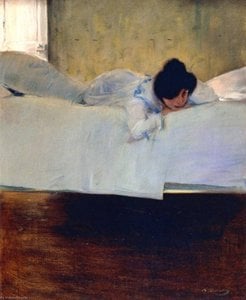
Julia

Discover Ramon Casas’ captivating portrait of Julia, a stunning example of Spanish Modernisme. Explore its vibrant colors, provocative pose & artistic influences.

Explore the captivating world of Ramon Casas i Carbó (1866-1932), a leading Catalan Modernisme artist. Discover his portraits, genre scenes & vibrant depictions of Spanish life.

Hand Made Oil Reproduction

Hand-painted oil on canvas in your size and frame, made to order by our artists. (Buy Print Buy PrintBuy Image Buy Image)

P118B $10
P118H $10
P118W $10
P438Z $10
P508JH $12
P508YH $12
P805H $10
P805Z $10
P919BZ $10
P919G $10
P919XJ $10
P959ZH $10
P968JZ $12
W106C $8
W218G $10
W218JH $8
W218Y $10
W307PJ $10
W316G $10
W316PJ $8
W316Y $10
W398PJ $8
W4111J $10
W500HY $15
W500JH $15
W692G $12
W849H $8
W940BG $15
W953PJ $8

Standard
custom
CM
INCH

Pick from our preset sizes that match the artwork's original proportions.

width
height

You may enter your own dimensions to fit a specific frame or space. If your selected size does not match the original image's proportions, we will either crop the artwork or extend the painting with additional hand-painted elements. A digital mockup will be sent for your approval before production begins.
Please note that the on-screen preview does not reflect the actual cropping or extension. Only the mockup will accurately show the final composition.
While custom sizes are available, we recommend selecting a dimension from the predefined list to preserve the original proportions.

Examples of what can be changed: Replace face with customer photo; Add pet (e.g., replace cat with dog); Include hidden message in background; Change background landscape or elements.
After order, WahooArt.com team will email client for instructions and provide a mockup preview

Worldwide Delivery () in 3/4 weeks instead of standard 5 weeks. (28 August). No compromise on quality.

why_choose_icon
Free Worldwide Express Shipping
why_choose_icon
High-Quality Linen Canvas
why_choose_icon
Full Shipping Insurance
why_choose_icon
Customs Tax Refund Guarantee
why_choose_icon
True Color Matching Guarantee
why_choose_icon
60-Day Return Policy (Defects Only)
why_choose_icon
100% Money-Back Guarantee
why_choose_icon
Bulk Discount Offer

Total Price

$ 272

reproduction

Julia

Reproduction Medium

Reproduction Size

-

Total Price

$ 272

Quick Facts

  • Subject or theme: Portrait of Julia Peraire in Spanish attire
  • Influences: Espagnolade tradition
  • Medium: Oil paint on canvas
  • Title: Julia
  • Notable elements or techniques: Layering, glazing, visible brushstrokes
  • Dimensions: 67 x 85 cm
In Ramon Casas’s extensive pictorial production, female portraits are particularly common and represent the essence of his activity as a poster artist. In the painter’s hands, this kind of portrait took on an essentially sensual and decorative aspect, since the models were almost always depicted in vaguely suggestive and provocative poses.One of his favourite models was Julia Peraire, a beautiful lottery ticket vendor in the Plaza de Cataluña. When Casas met her at a gathering at the Maison Dorée, he was dazzled by the freshness and beauty of her youth – she was twenty-five years younger than him. After living together for several years, they married on 29 September 1922. Julia died some years after Casas, on 17 January 1941.Ramon Casas portrayed his lover in the most varied of poses and attires. The results were generally very attractive in spite of their conventional style, although with great intuition the artist made up for their apparent lack of expressiveness with that special sensitivity he always displayed in his use of colour and his ability to reflect unassumingly but clearly the slightest hint of a woman’s suggestiveness. This was the key to his outstanding success in this genre and a feature he repeated over and over again in the last years of his life. In this portrait, Julia is seated, hands on hips, in a traditionally popular and almost defiant attitude, dressed in the most typical Spanish costume: a bright red matador jacket embroidered in black over a waistcoat with silver threads, in perfect harmony with the colour of the dress, the comb and the flowers in her hair. All of this was in accordance with the characteristic preference for the stereotyped espagnolade, produced by the French and Spanish artists living in Paris in the second half of the 19th century to please their foreign customers. Casas closely followed that trend, and even painted a self-portrait in 1883, in his early youth, wearing traditional Andalusian dress and drinking from a wineskin.Curiously, in this painting there is a definite similarity between Casas’s art and that of some of his contemporaries: his rendering of the skirt by means of parallel brushstrokes recalls Toulouse-Lautrec’s technique and the colour range of the portrait evokes Picasso’s blue period. There is even a trace of Ignacio Zuloaga – in theory so distant from Casas’s artistic approach – particularly in the use of the reds and blacks that offset the pearly whiteness of the model’s complexion, with her soft delicate traits, the almost metallic coldness of the dress and the neutral background, achieved by rubbing the paint on the canvas. The artist added a clearly erotic message in the depiction of his model’s bare neck and generous décolletage, with her fixed, slightly haughty gaze directed at the onlooker and the red of her lipstick. In all likelihood this painting is contemporary (as the features of the model reveal a very similar age) to another entitled

Artist Biography

Ramon Casas i Carbó: A Catalan Modernisme Pioneer

Ramon Casas i Carbó (January 4, 1866 – February 5, 1932) was a prominent Spanish painter and decorator of the Modernisme movement. Born in Barcelona, Spain, he is celebrated for his portraits, genre scenes, and depictions of Catalan life, blending elements of Realism and Impressionism into a distinctive style.

Early Life, Training, and Artistic Beginnings

  • Birth and Family: Casas was born into a wealthy family; his father had amassed considerable fortune in Cuba, while his mother hailed from a well-established Catalan lineage.
  • Artistic Education: Recognizing his artistic inclinations early on, at the age of 11 (in 1877), Casas abandoned formal schooling to study art under Joan Vicens, marking the commencement of his dedicated artistic journey.
  • Early Works and Recognition: His initial works primarily focused on portraits and caricatures of members of the Catalan, Spanish, and French elite. The painting Self-portrait as a Flamenco Dancer (1883) garnered significant attention, leading to an invitation for him to join the Societé d'Artistes Français.
  • Early Successes: Corrida de Toros (1884), showcasing his ability to capture dynamic crowd scenes, further solidified his reputation. His work Intérieur du Moulin de la Galette (1891) earned him a medal at the Berlin International Exposition, demonstrating his growing artistic maturity.

Development and Key Artistic Themes

  • Influence of Impressionism and Realism: Casas’s style was heavily influenced by both Impressionist techniques – evident in his use of light and color – and Realistic portrayals of everyday life and individuals.
  • Catalan Identity: A recurring theme in Casas' work was the depiction of Catalan culture, society, and landscapes. He frequently portrayed scenes of daily life, festivals, and portraits of prominent figures within Catalonia.
  • Collaboration with Santiago Rusiñol: In 1889, Casas embarked on a significant artistic journey alongside fellow artist Santiago Rusiñol, traveling through Catalonia and documenting their experiences in sketches and paintings. This collaboration fostered his understanding of Catalan identity and rural life.
  • Association with the Societé d'Artistes Français: Becoming an associate of this prestigious society allowed Casas to exhibit his work at their salon without undergoing jury selection, providing him with greater exposure and recognition within the Parisian art world.

Major Achievements and Notable Works

  • Portraits: Casas was renowned for his insightful and expressive portraits, capturing not only physical likeness but also the character and personality of his subjects. Examples include Portrait of Mr. Domínguez (1899) which showcases his skill in pencil drawing.
  • Genre Scenes: His genre paintings offered vivid glimpses into Catalan life, depicting scenes from bullfights (Corrida de Toros), cafes, and social gatherings.
  • Self-portrait as a Flamenco Dancer (1883): This early work established his unique style and demonstrated his ability to blend portraiture with theatrical flair.
  • Depictions of Celebrated Figures: Casas created portraits of prominent figures such as composer Isaac Albéniz, poet Jaume Massó, and writer Albert Bernís, solidifying his reputation as a sought-after portraitist.

Legacy and Historical Significance

Ramon Casas i Carbó left an indelible mark on Catalan art and the broader Modernisme movement. His work is celebrated for its vibrant depictions of Catalan life, insightful portraits, and skillful blending of Realism and Impressionism. Today, his paintings are housed in prestigious museums including the Cau Ferrat Museum (Sitges) and the Museu d'Art Contemporani de Barcelona, ensuring that his artistic legacy continues to inspire and captivate audiences.

Ramon Casas i Carbó

Ramon Casas i Carbó

1866 - 1932 , Spain

Quick Facts

  • Artistic Movement Or Style: Catalan Modernisme
  • Date Of Birth: January 4, 1866
  • Date Of Death: 1932
  • Full Name: Ramon Casas i Carbó
  • Nationality: Spanish
  • Notable Artworks:
    • Self-portrait as a flamenco dancer
    • Corrida de toros
    • Intérieur du moulin de la galette
    • Portrait of Mr. Domíngez
  • Place Of Birth: Barcelona, Spain
Explore artworks organized by themes, styles, and characteristics.