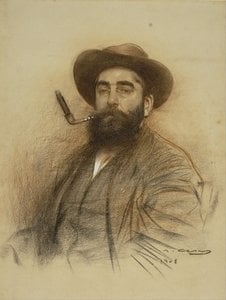
Self-portrait (1908) by Ramon Casas Carbó, hand-painted oil painting reproduction by a master artist
Preview AR preview Switch to Print Switch to Digital Image Send
Details Guide Add to favorites Download Similars X-Ray Diaporama Q&A Presentation Stats

Self-portrait Hand-painted oil painting reproduction

Dimensions
472.0 x 620.0 cm

A detailed black and white drawing capturing a contemplative man with a pipe by Catalan Modernisme master Ramon Casas Carbó, offering a timeless glimpse into the turn of the century for your private collection.

Ramon Casas (1866-1932) was a leading Catalan Modernisme artist known for his striking portraits of Barcelona's elite and evocative genre scenes like 'El garrot.' His work captures the spirit of a turbulent era with Impressionistic brushstrokes and graphic design influence.

The artwork displayed on this page is protected by copyright law, which means we cannot legally create or sell an identical reproduction. This protection is enforced under international agreements such as the Berne Convention and by national laws, including those outlined by the U.S. Copyright Law - Title 17.

As a respectful and legal alternative, we offer custom, hand-painted artworks inspired by the original. Our skilled and professional artists carefully study the original's style, mood, and artistic essence to create a new, unique piece that evokes the same feeling - while remaining an original creation in its own right.

This method fully complies with copyright regulations because it does not involve copying or duplicating the protected artwork. Instead, it is a creative reinterpretation - a new painting that is influenced by the original but not identical to it.

Hand Made Oil Reproduction

Hand-painted oil on canvas in your size and frame, made to order by our artists. ( Switch to Print Switch to Digital Image)

Corner sample of the P118B picture frame: moulded polystyrene, 5 cm wide and 3 cm thick
P118B $10
Corner sample of the P118H picture frame: moulded polystyrene, 5 cm wide and 3 cm thick
P118H $10
Corner sample of the P118W picture frame: moulded polystyrene, 5 cm wide and 3 cm thick
P118W $10
Corner sample of the P438Z picture frame: moulded polystyrene, 5.5 cm wide and 3.5 cm thick
P438Z $10
Corner sample of the P508JH picture frame: moulded polystyrene, 7 cm wide and 3.5 cm thick
P508JH $12
Corner sample of the P508YH picture frame: moulded polystyrene, 7 cm wide and 3.5 cm thick
P508YH $12
Corner sample of the P805H picture frame: moulded polystyrene, 5 cm wide and 3.5 cm thick
P805H $10
Corner sample of the P805Z picture frame: moulded polystyrene, 5 cm wide and 3.5 cm thick
P805Z $10
Corner sample of the P919BZ picture frame: moulded polystyrene, 7 cm wide and 3.5 cm thick
P919BZ $10
Corner sample of the P919G picture frame: moulded polystyrene, 7 cm wide and 3.5 cm thick
P919G $10
Corner sample of the P919XJ picture frame: moulded polystyrene, 7 cm wide and 3.5 cm thick
P919XJ $10
Corner sample of the P959ZH picture frame: moulded polystyrene, 5 cm wide and 3 cm thick
P959ZH $10
Corner sample of the P968JZ picture frame: moulded polystyrene, 6 cm wide and 4 cm thick
P968JZ $12
Corner sample of the W106C picture frame: solid wood, 5 cm wide and 3 cm thick
W106C $8
Corner sample of the W218G picture frame: solid wood, 5 cm wide and 3 cm thick
W218G $10
Corner sample of the W218JH picture frame: solid wood, 5 cm wide and 3 cm thick
W218JH $8
Corner sample of the W218Y picture frame: solid wood, 5 cm wide and 3 cm thick
W218Y $10
Corner sample of the W307PJ picture frame: solid wood, 6 cm wide and 3 cm thick
W307PJ $10
Corner sample of the W316G picture frame: solid wood, 6 cm wide and 3 cm thick
W316G $10
Corner sample of the W316PJ picture frame: solid wood, 6 cm wide and 3 cm thick
W316PJ $8
Corner sample of the W316Y picture frame: solid wood, 6 cm wide and 3 cm thick
W316Y $10
Corner sample of the W398PJ picture frame: solid wood, 5 cm wide and 3 cm thick
W398PJ $8
Corner sample of the W4111J picture frame: solid wood, 6.5 cm wide and 3.5 cm thick
W4111J $10
Corner sample of the W500HY picture frame: solid wood, 7 cm wide and 5 cm thick
W500HY $15
Corner sample of the W500JH picture frame: solid wood, 7 cm wide and 5 cm thick
W500JH $15
Corner sample of the W692G picture frame: solid wood, 8 cm wide and 4 cm thick
W692G $12
Corner sample of the W849H picture frame: solid wood, 5 cm wide and 3 cm thick
W849H $8
Corner sample of the W940BG picture frame: solid wood, 7.5 cm wide and 4.5 cm thick
W940BG $15
Corner sample of the W953PJ picture frame: solid wood, 6 cm wide and 3.5 cm thick
W953PJ $8

Standard
custom
CM
INCH

Pick from our preset sizes that match the artwork's original proportions.

width
height

Type the width and the height you need, to fit your frame or your wall. This is hand-painted, so for a size with a different shape the artist can paint a bit more around the picture, or cut a bit — you choose. We send you a digital mockup to approve before the painting starts. The picture shown on this page does not show the real result — only the mockup does.

Examples of what can be changed: Replace face with customer photo; Add pet (e.g., replace cat with dog); Include hidden message in background; Change background landscape or elements.
After order, WahooArt.com team will email client for instructions and provide a mockup preview

Worldwide Delivery () in 3/4 weeks instead of standard 5 weeks. (10 November). No compromise on quality.

Free Worldwide Express Shipping
High-Quality Linen Canvas
Full Shipping Insurance
Customs Tax Refund Guarantee
True Color Matching Guarantee
100-Day Return Policy (Defects Only)
100% Money-Back Guarantee
Bulk Discount Offer

Total Price

$ 272

Self-portrait

Reproduction Medium

Reproduction Size

-

Total Price

$ 272

Quick Facts

  • Dimensions: 472 x 620 cm
  • Movement: Catalan Modernisme
  • Title: Self-portrait
  • Subject or theme: Man with hat and pipe

A Glimpse into the Soul of Catalan Modernisme

In this evocative 1908 drawing, we are invited into the intimate, smoke-filled atmosphere of a bygone era. The piece serves as a profound window into the life of Ramon Casas Carbó, an artist who did not merely paint the world around him but acted as its visual chronicler. Through the delicate yet commanding use of line and shadow, the work captures a moment of quiet introspection. A man, seated with a poised, crossed-legged stance, anchors the composition; his presence is defined by the rugged texture of his beard and the thoughtful weight of his gaze. As he holds a pipe, a thin trail of implied smoke suggests a pause in time, inviting the viewer to share in this contemplative stillness. The monochromatic palette strips away the distractions of color, forcing an encounter with the raw, structural essence of the subject's character.

The technique employed here speaks to the mastery of draftsmanship that defined the Catalan Modernisme movement. Every stroke of the pencil or charcoal serves a purpose, building volume and depth through meticulous hatching and tonal gradations. The artist’s ability to render the heavy fabric of the clothing against the soft, organic textures of facial hair creates a tactile experience for the eye. While the central figure commands our attention, the subtle presence of others in the background adds a layer of social complexity, suggesting that this private moment is occurring within the vibrant, bustling pulse of Barcelona’s intellectual circles. This interplay between the individual and the collective is a hallmark of Casas's ability to capture both personal identity and societal transformation.

For the discerning collector or interior designer, this work offers more than mere decoration; it provides a sense of historical gravity and intellectual depth. The stark, black-and-white aesthetic makes it a versatile masterpiece, capable of anchoring a contemporary minimalist space with its classic elegance or adding a layer of sophisticated nostalgia to a traditional study. It is a piece that demands conversation, acting as a bridge between the late nineteenth-century's artistic revolution and the modern aesthetic. To possess a reproduction of this self-portrait is to hold a fragment of Catalonia's golden age, bringing an atmosphere of timeless wisdom and artistic prestige into any curated environment.

Questions & Answers

How can I get a digital file of "Self-portrait" by Ramon Casas Carbó?

To get a digital file of "Self-portrait" by Ramon Casas Carbó, order a high-resolution digital image download on its Digital Image page.

Who created "Self-portrait"?

"Self-portrait" is attributed to Ramon Casas Carbó.

What is the dominant color of "Self-portrait" by Ramon Casas Carbó?

The dominant color of "Self-portrait" by Ramon Casas Carbó is espresso (#524128).


Artist Biography

A Chronicler of Catalan Modernisme: The Life and Art of Ramon Casas

Ramon Casas i Carbó, born in Barcelona on January 4th, 1866, was more than just a painter; he was a visual poet of his time, an artist who captured the spirit of a Catalonia undergoing profound transformation. Living through a period marked by both burgeoning artistic freedom and intense political and social upheaval, Casas became synonymous with Catalan Modernisme, a movement that sought to forge a unique cultural identity for the region. His life story is inextricably linked to the vibrant intellectual circles of Barcelona’s late 19th and early 20th centuries, and his art reflects not only his personal aesthetic but also the anxieties and aspirations of a society on the cusp of modernity. From an early age, Casas demonstrated a remarkable aptitude for drawing, initially receiving instruction from his mother, who herself possessed artistic inclinations. He later formally studied at the School of Fine Arts in Barcelona, and subsequently at the Académie Gleyre in Paris – a crucible where he encountered influences that would shape his evolving style.

Early Influences and Artistic Development

Casas’s early work reveals a clear debt to Impressionism, particularly evident in his depictions of Parisian life during his time studying abroad. However, he quickly moved beyond mere imitation, developing a distinctive approach characterized by bold brushwork, a keen eye for capturing fleeting moments, and an increasing focus on portraiture. It was in Barcelona that Casas truly found his artistic voice, drawn to the city’s dynamic energy and its burgeoning bohemian scene. He became a central figure in the *Els Quatre Gats* (The Four Cats), a café-cabaret modeled after Le Chat Noir in Paris, which served as a hub for artists, writers, and intellectuals. This environment fostered a spirit of experimentation and collaboration, profoundly influencing Casas’s artistic direction. His portraits from this period are particularly noteworthy – not simply representations of physical likeness but insightful psychological studies that reveal the character and social standing of his subjects. He didn't shy away from depicting the elite of Barcelona society, yet he infused these commissions with a sense of realism and often subtle critique.

The Power of the Portrait and Beyond

Casas’s mastery of portraiture established him as one of Catalonia’s most sought-after artists. His subjects included prominent figures in politics, literature, and business, but his artistic vision extended far beyond the confines of conventional society. He was equally captivated by scenes of everyday life – bullfights, executions, street riots – capturing the raw energy and often brutal realities of urban existence. El garrot* (The Cudgel), a series of paintings depicting a violent crackdown on Catalan protestors, stands as a powerful testament to his social consciousness and willingness to confront difficult subjects. Beyond painting, Casas was also a gifted graphic designer, creating striking posters and postcards that helped to disseminate the ideals of Modernisme and promote Catalan culture. His poster designs were innovative for their time, employing bold typography and evocative imagery to capture the attention of a rapidly expanding audience. He understood the power of visual communication and used it effectively to shape public opinion and champion his artistic beliefs.

Major Achievements and Lasting Legacy

Throughout his career, Casas exhibited widely both in Spain and internationally, gaining recognition for his unique style and insightful depictions of Catalan life. His work played a crucial role in establishing Barcelona as a major center of Modernist art, influencing generations of artists to come. Estudi d'estiu o Primero pasarás sobre mi cadáver* (Summer Study or First You Shall Pass Over My Body) is perhaps one of his most iconic paintings, showcasing his ability to blend symbolism and realism in a hauntingly beautiful composition. The painting’s ambiguous narrative invites multiple interpretations, reflecting the complexities of Catalan identity during a period of political unrest. Casas's influence extended beyond the realm of fine art; he was also involved in theater design and journalism, demonstrating a remarkable versatility and commitment to artistic expression in all its forms. He died on February 29th, 1932, leaving behind a rich legacy that continues to inspire artists and captivate audiences today. His work remains a vital record of a pivotal moment in Catalan history, offering a glimpse into the soul of a nation grappling with questions of identity, modernity, and social change.

A Symbol of Catalan Identity

Ramon Casas’s art is not merely a reflection of his time; it *is* that time – a vibrant, complex, and often contradictory portrait of Catalonia at the turn of the 20th century. He was a master observer, capable of capturing both the beauty and brutality of urban life with equal skill and sensitivity. His portraits are more than just likenesses; they are windows into the souls of his subjects, revealing their character, social standing, and inner lives.
  • His graphic designs helped to define the aesthetic of Catalan Modernisme.
  • His willingness to confront difficult social issues set him apart from many of his contemporaries.
  • His legacy continues to inspire artists and captivate audiences today.
Casas’s enduring significance lies in his ability to synthesize diverse influences – Impressionism, Realism, Symbolism – into a uniquely Catalan artistic vision. He was a chronicler of his time, a poet of the streets, and a champion of cultural identity, leaving behind a body of work that remains as relevant and compelling today as it was over a century ago.

Quick Facts

  • Artistic Movement Or Style: Catalan Modernisme
  • Date Of Birth: January 4, 1866
  • Date Of Death: February 29, 1932
  • Full Name: Ramon Casas i Carbó
  • Nationality: Spanish
  • Notable Artworks:
    • Self-portrait
    • Estudi d'estiu
    • El garrot
  • Place Of Birth: Barcelona, Spain
Explore artworks organized by themes, styles, and characteristics.