Hand-painted oil on canvas in your size and frame, made to order by our artists. ( Switch to Print Switch to Digital Image)





























Pick from our preset sizes that match the artwork's original proportions.

You may enter your own dimensions to fit a specific frame or space. If your selected size does not match the original image's proportions, we will either crop the artwork or extend the painting with additional hand-painted elements. A digital mockup will be sent for your approval before production begins.
Please note that the on-screen preview does not reflect the actual cropping or extension. Only the mockup will accurately show the final composition.
While custom sizes are available, we recommend selecting a dimension from the predefined list to preserve the original proportions.
Worldwide Delivery () in 3/4 weeks instead of standard 5 weeks. (23 September). No compromise on quality.


Selbst mit gelbem Hut
Reproduction Size
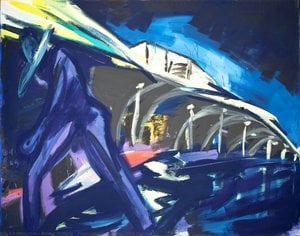
In the vibrant landscape of late 20th-century German art, few works capture the raw, pulsating spirit of West Berlin quite like Rainer Fetting’s Selbst mit gelbem Hut. This striking self-portrait is not merely a likeness of the artist; it is an explosion of color and texture that embodies the restless energy of the "Junge Wilde" movement. Upon first encounter, the viewer is swept up in a whirlwind of saturated yellows, deep blues, and fiery oranges, all applied with a visceral intensity that demands attention. The subject, centered within the frame, gazes out through a bold yellow hat, his presence anchored by thick, rhythmic brushstrokes that transform the canvas into a living, breathing entity.
The technique employed here is a masterclass in the impasto style. Fetting does not simply paint; he sculpts with pigment. Each stroke of the brush leaves behind a raised ridge of oil paint, creating a topographical surface that catches the light and casts subtle shadows across the face and torso. This heavy application of paint lends the work a profound sense of movement, as if the colors themselves are still in the process of colliding on the canvas. The lines are loose and gestural, eschewing the rigid precision of traditional portraiture in favor of an organic, freeform aesthetic that prioritizes emotional truth over anatomical accuracy.
To understand Selbst mit gelbem Hut, one must look to the streets of Berlin in the late 1970s and early 80s. As a pivotal figure in the Neo-Expressionist resurgence, Fetting’s work is deeply intertwined with the urban pulse of a divided city. The painting reflects a rejection of the cool, detached minimalism that dominated much of the previous decade, opting instead for a return to figurative painting characterized by subjectivity and passion. There is an inherent theatricality in the composition—perhaps a nod to Fetting's early training as a stage designer—where the dramatic lighting and flattened perspective create a sense of immediate, almost confrontational, intimacy.
Symbolically, the bright yellow hat serves as more than just a sartorial choice; it acts as a beacon of light amidst the darker, more turbulent tones of the background. It represents a spark of individual identity and defiance within the chaotic urban landscape. While there is an undeniable intensity to the piece, a subtle hint of melancholy lingers in the shadows that contour the face, suggesting the complex emotional duality of life in a burgeoning counter-culture scene. For the collector or interior designer, this artwork offers more than just visual splendor; it provides a profound psychological depth that can serve as a commanding focal point in any sophisticated space.
For those seeking to curate a collection defined by character and movement, a high-quality reproduction of this masterpiece offers an unparalleled opportunity. The painting’s bold palette and tactile quality make it an extraordinary choice for contemporary interiors, where it can breathe life into minimalist settings or add a layer of historical gravity to modern decor. It is a piece that invites conversation, prompting viewers to contemplate the intersection of personal identity and the broader social currents of history.
Owning a tribute to Fetting’s vision means bringing the electric atmosphere of Berlin's most transformative era into one's own home. Whether placed in a sunlit gallery or a moody study, Selbst mit gelbem Hut remains an enduring testament to the power of expressionism—a vivid, textured reminder that art is at its most potent when it dares to be loud, colorful, and unapologetically human.


1949 - , Germany

Explore the raw energy of Jean-Michel Basquiat and Neo-Expressionism. Discover how urban rebellion redefined modern art through a lens of luxury, identity, and profound emotional intensity for the discerning collector.

Delve into the visceral world of German Expressionism. Explore the history, key artists like Kirchner and Kandinsky, and the movement's profound emotional impact through an expert art-history lens. Discover how bold colors and distortion redefined modern aesthetics.

Discover the profound power of Expressionist art. From the raw intensity of Edvard Munch to the visceral textures of Neo-Expressionism, explore how subjective emotion and distorted reality define this movement. An expert guide for discerning collectors seeking depth and soul in fine art.

Explore the raw emotion of German Expressionism through a definitive guide to Ernst Ludwig Kirchner. Discover how his bold colors and distorted forms redefined modern art history, from Berlin street scenes to iconic masterpieces.

 Preview
 Send
Send Share
Share
 Details
 Guide
Guide

 Download
 Similars
 X-Ray
X-Ray Diaporama
 Stats
Stats


 Read More







 Glass option is only available in size under 110 CM