FREE ART CONSULTATION

x
Buy print Buy printBuy Image Buy Image SendSend
DetailsDetails Add to favorites Add to favorites DownloadDownload SimilarsSimilars X-RayX-Ray DiaporamaDiaporama

Abstract

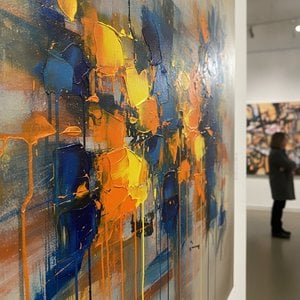
Abstract oil painting by Rafael Ferrer (1998). A surreal, cubist-inspired piece featuring a solitary figure in a geometric landscape. Dark hues & dynamic lines evoke unease & contemplation.

Discover Rafael Ferrer, a renowned Puerto Rican artist known for innovative sculptures, conceptual installations, and vibrant themes of Caribbean culture. Explore his impactful work and artistic legacy today.

Hand Made Oil Reproduction

Hand-painted oil on canvas in your size and frame, made to order by our artists.

Standard
custom
CM
INCH

Pick from our preset sizes that match the artwork's original proportions.

width
height

You may enter your own dimensions to fit a specific frame or space. If your selected size does not match the original image's proportions, we will either crop the artwork or extend the painting with additional hand-painted elements. A digital mockup will be sent for your approval before production begins.
Please note that the on-screen preview does not reflect the actual cropping or extension. Only the mockup will accurately show the final composition.
While custom sizes are available, we recommend selecting a dimension from the predefined list to preserve the original proportions.

Examples of what can be changed: Replace face with customer photo; Add pet (e.g., replace cat with dog); Include hidden message in background; Change background landscape or elements.
After order, WahooArt.com team will email client for instructions and provide a mockup preview

Worldwide Delivery () in 3/4 weeks instead of standard 5 weeks. (3 July). No compromise on quality.

why_choose_icon
Free Worldwide Express Shipping
why_choose_icon
High-Quality Linen Canvas
why_choose_icon
Full Shipping Insurance
why_choose_icon
Customs Tax Refund Guarantee
why_choose_icon
True Color Matching Guarantee
why_choose_icon
60-Day Return Policy (Defects Only)
why_choose_icon
100% Money-Back Guarantee
why_choose_icon
Bulk Discount Offer

Total Price

-

reproduction

Abstract

Reproduction Medium

Reproduction Size

-

Total Price

-

Related Artworks


Artist Biography

Early Life and Artistic Foundations

Rafael Ferrer, born in 1933, embodies a fascinating intersection of cultural currents—a Puerto Rican artist whose journey has been one of constant exploration and reinvention. His formative years were marked by a unique duality: a childhood spent traversing between the vibrant landscapes of his native island and the bustling urban centers of the United States. This early exposure to contrasting environments instilled in him a sensibility attuned to both the lyrical traditions of Caribbean culture and the avant-garde energies of the American art world. Ferrer’s initial studies at Staunton Military Academy were followed by time at Syracuse University, but it was not within the formal confines of academia that his artistic awakening truly began. A passion for Afro-Cuban music took root during these years, a rhythmic undercurrent that would later inform his conceptual approach to sculpture and installation. Visits to New York City, often in the company of his half-brother, the celebrated actor José Ferrer, opened doors to the city’s thriving jazz scene and the hallowed halls of the Museum of Modern Art—experiences that ignited a fervent desire to engage with modern art movements.

Parisian Encounters and Surrealist Influences

A pivotal moment arrived in 1954 when Ferrer joined his friend Eugenio Granell in Paris. This immersion into the European artistic landscape proved transformative, placing him within a circle of Surrealist artists and intellectuals. The city pulsed with post-war energy, challenging conventional notions of art and representation. Ferrer’s encounter with André Breton, the leading theorist of Surrealism, broadened his understanding of automatism, dream imagery, and the power of the subconscious. However, it was his friendship with Wifredo Lam that proved particularly significant. The Cuban artist's masterful fusion of Afro-Cuban religious symbolism with European modernism resonated deeply with Ferrer, providing a model for integrating personal heritage into a sophisticated artistic vocabulary. These Parisian years were not merely about absorbing influences; they were about forging a unique path—a synthesis of Surrealist techniques and the specific cultural narratives of his Puerto Rican identity.

From Percussion to Process: The Emergence of a Sculptural Voice

Returning to New York in 1955, Ferrer initially pursued a career as a professional percussionist, supporting himself through music while gradually dedicating more time to his art. This period was crucial for developing a unique sensibility—a rhythmic approach to form and space that mirrored the improvisational nature of jazz. By the mid-1960s, he began to emerge as a significant voice in the burgeoning conceptual and process art movements. His early installations were often action-based, challenging traditional notions of sculpture as static objects. “3 Leaf Pieces” at the Castelli Warehouse exemplifies this period—a work that prioritized the act of creation over the finished product. However, Ferrer’s artistic trajectory soon shifted towards more narrative-driven works, encompassing elaborate artist-crafted artifacts that evoked journeys and explorations.

Voyages, Artifacts, and Caribbean Themes

Ferrer's mature work is characterized by a captivating blend of sculpture, installation, and conceptual art—often centered around themes of travel, displacement, and the complexities of cultural identity. Recurring motifs such as paper bag faces, kayaks, and maps serve as evocative signifiers, suggesting voyages both real and imagined. These elements are not merely aesthetic choices; they function as potent symbols, reflecting his own experiences navigating between cultures and exploring the historical narratives of the Caribbean. His installations often resemble archaeological sites—carefully constructed arrangements of artifacts that invite viewers to piece together fragmented stories. The sculptures themselves are imbued with a sense of history and memory, crafted from materials that evoke both the natural world and the detritus of human civilization. Works like “Puerto Rican Sun,” commissioned for the South Bronx in 1979, demonstrate his commitment to public art—a monumental steel sculpture embodying the duality of light and darkness within Caribbean culture.

Legacy and Historical Significance

Rafael Ferrer’s contribution to contemporary art lies in his ability to seamlessly integrate personal experience with broader cultural narratives. He challenged conventional boundaries between disciplines, blurring the lines between sculpture, installation, and performance. His work has been exhibited in major museums worldwide—including the Museum of Modern Art, Whitney Museum of American Art, and Stedelijk Museum—solidifying his position as a leading figure in post-war art. Ferrer’s influence extends beyond his own artistic practice; he has inspired generations of artists to explore themes of identity, displacement, and cultural hybridity. His legacy is one of innovation, intellectual rigor, and a profound commitment to the power of art as a means of understanding our complex world. He remains an active artist today, continuing to push boundaries and challenge expectations with his evocative and thought-provoking creations.

Quick Facts

  • Artistic Movement Or Style: Conceptual art, Sculpture
  • Artists Who Influenced This Artist:
    • Eugenio Granell
    • Wifredo Lam
    • André Breton
  • Date Of Birth: 1933
  • Full Name: Rafael Ferrer
  • Nationality: Puerto Rican
  • Notable Artworks:
    • Abstract
    • 50 Cakes of Ice
    • Puerto Rican Sun
    • El Gran Teatro de la Luna
Explore artworks organized by themes, styles, and characteristics.