x


Hand-painted oil on canvas in your size and frame, made to order by our artists. ( Buy Print Buy Image)
Pick from our preset sizes that match the artwork's original proportions.

You may enter your own dimensions to fit a specific frame or space. If your selected size does not match the original image's proportions, we will either crop the artwork or extend the painting with additional hand-painted elements. A digital mockup will be sent for your approval before production begins.
Please note that the on-screen preview does not reflect the actual cropping or extension. Only the mockup will accurately show the final composition.
While custom sizes are available, we recommend selecting a dimension from the predefined list to preserve the original proportions.
Worldwide Delivery () in 3/4 weeks instead of standard 5 weeks. (25 August). No compromise on quality.


Card players
Reproduction Size
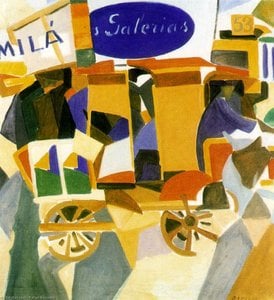
Rafael Barradas, a significant Uruguayan modernist painter and graphic artist, masterfully captures the essence of early 20th-century life in his work "Card Players." Born in Montevideo in 1890, Barradas' artistic journey was shaped by a family steeped in creativity—his sister a pianist and composer, and his brother a poet. His unique style blends traditional Uruguayan elements with the burgeoning modernist influences sweeping across Europe, resulting in a captivating visual experience.
"Card Players" exemplifies Analytical Cubism, a revolutionary art movement pioneered by Pablo Picasso and Georges Braque. This painting isn't about realistic representation; it’s an intellectual exploration of form and perspective. Barradas breaks down the figures of the card players—along with the table, cards, and surrounding space—into geometric shapes: cubes, rectangles, and triangles. These fragments are then reassembled on the canvas in a non-naturalistic way, presenting multiple viewpoints simultaneously. This technique creates a sense of spatial ambiguity and disorientation, challenging traditional notions of depth and perspective.
The color palette employed by Barradas is deliberately restrained yet impactful. Dominated by blues, oranges, browns, and whites, the colors are applied in broad blocks rather than blended smoothly, further emphasizing the fractured appearance of the composition. The contrast between warm and cool tones creates visual tension and draws the viewer's eye across the canvas. The composition itself is dynamic; figures overlap and intersect, creating a loose arrangement within the frame that avoids any sense of static order. A central table dominates the scene, showcasing playing cards—the focal point of this fragmented social gathering.
While "Card Players" lacks overt symbolism, its fractured nature evokes profound feelings of alienation, uncertainty, and intellectual inquiry. The abstracted figures can be interpreted as representing the complexities of human interaction in a rapidly changing world. The painting’s style reflects the anxieties and uncertainties of the early 20th century—a period marked by rapid industrialization, social upheaval, and the questioning of traditional values. Barradas' work invites viewers to contemplate the nature of perception, representation, and the fragmented experience of modern life.
Barradas’ technique involved a systematic deconstruction of forms followed by their reassembly in a non-naturalistic manner—a hallmark of Analytical Cubism. The visible brushstrokes, though not overly emphasized, contribute to the painting's textured surface. The artwork was likely created using oil paint on canvas, a common medium for paintings of this period. This combination of materials and technique allows for a rich depth of color and texture, enhancing the overall visual impact of "Card Players."


1890 - 1929 , Uruguay

Explore the life & art of Rafael Barradas, a pioneering Uruguayan modernist who blended European influences with vibrant local heritage. Discover his unique 'Vibrationism' style and investment potential.

Explore the revolutionary world of Cubism. Discover how Pablo Picasso and Georges Braque dismantled perspective to redefine modern art through geometric innovation and analytical mastery. An essential guide for art students, collectors, and history enthusiasts.

Explore the revolutionary world of Cubism. Discover how masters Pablo Picasso and Georges Braque dismantled reality through geometric abstraction to redefine modern art history.

Explore 10 defining masterpieces of Geometric Abstraction! Discover Kandinsky, Mondrian & Malevich’s iconic works. Find museum-quality art reproductions and curated decor ideas to elevate your home at WahooArt.com.
Journey through 25 iconic artworks by Paul Cézanne – a master of Impressionism and Post-Impressionism. Explore his landscapes, still lifes, and the stories behind these timeless masterpieces. Discover museum-quality reproductions & curated decor at WahooArt.com.


Stay updated with the latest art news, exclusive offers, and decoration ideas.
Tell us about your project and our art experts will provide you with 3 personalized art suggestions.
Let Us Curate 3 Options Just for You - Free!

 Preview
 Send
Send Share
Share
 Details

 Download
 Similars
 X-Ray
X-Ray Diaporama
 Read More




































 Glass option is only available in size under 110 CM