Artist Biography
A Renaissance Soul in the Modern Age: The Life and Art of Pietro Annigoni
Pietro Annigoni, a name synonymous with meticulous realism and a revival of classical techniques, emerged as a powerful artistic force in a 20th century increasingly dominated by abstraction. Born in Milan in 1910, his journey was one of unwavering dedication to representational art—a path often at odds with the prevailing modernist currents. From an early age, Annigoni displayed a remarkable aptitude for drawing and painting, nurtured not within a traditionally artistic family – his father was an engineer – but by an innate passion that propelled him towards Florence and its rich artistic heritage. He enrolled at the Academy of Fine Arts in Florence in 1927, immersing himself in the study of painting under Felice Carena, sculpture with Giuseppe Graziosi, and etching alongside Celestino Celesti. This rigorous academic foundation instilled within him a profound respect for the masters of the Renaissance, shaping his aesthetic sensibilities and technical prowess. Further honing his skills at the Florentine Circolo degli Artisti, focusing on nude drawing, Annigoni laid the groundwork for a career defined by its exacting detail and lifelike portrayals.
Bridging Tradition and Modernity: Artistic Development and Influences
Annigoni’s artistic development was deeply rooted in the Italian Renaissance—a period he revered for its mastery of form, composition, and emotional depth. He wasn't merely replicating the styles of the past; rather, he absorbed their principles and adapted them to his own vision. This influence is readily apparent in his meticulous attention to detail, the subtle modeling of light and shadow, and the psychological insight conveyed through his portraits. His early works showcased a burgeoning talent for both portraiture and fresco painting, gaining recognition through exhibitions in Florence during the 1930s. However, Annigoni wasn’t content to remain solely within the confines of tradition. He actively engaged with the artistic debates of his time, recognizing the need to articulate a counter-narrative to the rising tide of abstract expressionism. In 1947, he co-founded the “Manifesto of Modern Realist Painters,” alongside other artists who championed representational art and sought to reclaim its rightful place within the artistic landscape. This act wasn’t simply a stylistic preference; it was a philosophical statement—a belief in the power of art to connect with viewers through recognizable imagery and enduring values.
Royal Commissions and International Acclaim: A Defining Legacy
Pietro Annigoni's name became internationally recognized, not just within artistic circles but among global audiences, largely due to his iconic portraits of Queen Elizabeth II. Commissioned by the Worshipful Company of Fishmongers in 1954, the first portrait unveiled in 1955 at the Royal Academy’s Summer Exhibition caused a sensation. The sheer realism and regal presence captured on canvas drew record crowds—nearly 300,000 visitors—making it the most popular exhibition in over half a century. The Times quickly produced limited-edition prints that sold out immediately, and Sir Alfred Munnings, then President of the Royal Academy, hailed Annigoni as “the greatest painter of the age.” This success led to further commissions from the British royal family, including portraits of Prince Philip and Princess Margaret. But his talent wasn’t confined to royalty; Annigoni's brush immortalized a diverse array of prominent figures—Pope John XXIII, U.S. Presidents John F. Kennedy and Lyndon B. Johnson, the Shah and Empress of Iran, ballet stars Margot Fonteyn and Rudolf Nureyev, and Indian princess Gayatri Devi of Jaipur, among many others. His selection to paint President Kennedy for the cover of Time magazine in 1962 solidified his reputation as a leading portrait artist of his time, bringing his work into homes across the world.
A Lasting Impression: Style, Significance and Final Years
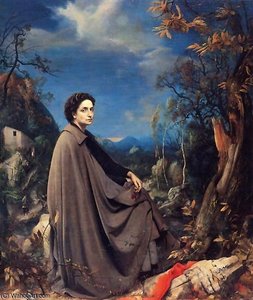
Annigoni’s artistic style was characterized by an unwavering commitment to realism and detail—a meticulous approach that demanded both technical skill and profound observation. He employed traditional techniques, such as oil tempera, to achieve a luminosity and depth of color rarely seen in contemporary painting. His portraits weren't merely likenesses; they were psychological studies, capturing the essence of his subjects with remarkable accuracy and sensitivity. In an era dominated by abstraction, Annigoni’s dedication to representational art was both a challenge and a statement. He represented a bridge between the artistic traditions of the Renaissance and the demands of modern portraiture—a testament to the enduring power of classical techniques. He continued painting and exhibiting throughout his later years, maintaining a devoted following internationally. In 1976 he married Rossella Segreto, who also served as one of his models. Sadly, Annigoni passed away on October 28, 1988, in Florence, succumbing to kidney failure following surgery for a perforated ulcer. He was laid to rest at the Basilica di San Miniato al Monte overlooking the city that had so profoundly shaped his artistic vision—a fitting final resting place for an artist who dedicated his life to preserving and celebrating the beauty of the past while forging his own unique path in the present.


 Buy Hand Made Painting


 Preview
 Send
Send Share
Share
 Details
 Guide
Guide

 Download
 Similars
 X-Ray
X-Ray Diaporama
 Stats
Stats Read More






































 Glass option is only available in size under 110 CM