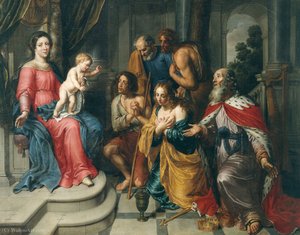
Pieter van Lint: A Flemish Master Bridging Antiquity and Baroque
Pieter van Lint (1609-1690), a name perhaps less familiar than his contemporaries Rubens or Van Dyck, nevertheless stands as a significant figure in the vibrant artistic landscape of 17th-century Antwerp. Born into a family deeply rooted in the art world – his father, Hendrik Frans van Lint, was a celebrated vedute painter in Rome – Pieter inherited not only a legacy but also a profound understanding of artistic technique and a restless spirit for exploration. His career spanned decades, encompassing diverse styles and commissions, reflecting a remarkable adaptability and a constant engagement with the prevailing trends of his time.
Van Lint’s early training under Artus Wolffort in Antwerp laid the foundation for his skill in historical painting and portraiture. Crucially, however, his formative years were spent immersed in the artistic traditions of the Flemish Baroque, particularly through frequent visits to the city's churches. These pilgrimages weren’t merely acts of devotion; they served as invaluable apprenticeships, allowing him to meticulously copy the works of masters like Peter Paul Rubens, Marten de Vos, and the Francken brothers – absorbing their compositional strategies, color palettes, and masterful rendering of texture. This deliberate study of his predecessors is evident in many of his early works, which demonstrate a clear debt to Wolffort’s academic style, itself influenced by Otto van Veen's classical approach.
Roman Influences and the Pursuit of Classicism
In 1633, Van Lint achieved the coveted status of master in the Guild of Saint Luke, marking his transition into independent practice. Shortly thereafter, he embarked on a transformative journey to Rome – a period that fundamentally shaped his artistic development. Unlike many Flemish artists who simply replicated Italian styles, Van Lint embraced the Roman environment with an open mind, actively seeking out and studying the legacy of antiquity. He meticulously sketched ancient sculptures and architectural ruins, absorbing the principles of classical form and composition. This engagement with the antique is powerfully evident in his later works, particularly those produced during his time in Rome (1633-1640), where he developed a distinct style characterized by clear outlines, balanced compositions, and an interest in idealized beauty.
His work for Cardinal Domenico Ginnasi, Bishop of Ostia, exemplifies this shift. He frescoed the Cybo family chapel in the Santa Maria del Popolo with the legend of the True Cross – a monumental undertaking that showcased his burgeoning skills in large-scale painting and his growing command of classical motifs. This period also witnessed him experimenting with the *bamboccianti* genre, producing small, lively scenes depicting everyday life, reflecting a desire to capture human emotion and interaction.
A Master of Copies and Diverse Commissions
Van Lint’s career was marked by a remarkable versatility, encompassing religious paintings, historical narratives, portraits, and even tapestry designs. He skillfully navigated the demands of various patrons, from wealthy families like the Cibos to the Antwerp art trade network. A significant portion of his output consisted of meticulously executed copies of Peter Paul Rubens' oil sketches – a lucrative business that allowed him to refine his technique and gain further insight into the master’s methods. These copies, often produced on copper, were highly prized in Spain and the Spanish colonies for their durability and lustrous finish.
Beyond these commissioned works, Van Lint created numerous devotional paintings, frequently depicting scenes from the life of Mary Magdalene – a subject that resonated deeply with his artistic sensibilities. His ‘Marriage of the Virgin’ (1640), painted in Antwerp Cathedral, is a prime example of this style, showcasing his ability to imbue religious subjects with a sense of drama and emotional intensity. He also designed tapestries for prominent weavers, demonstrating his broader creative talents.
Legacy and Artistic Connections
Van Lint’s influence extended beyond his own creations. He mentored several promising artists, including Caerel de las Cuevas, Jan-Baptista Ferrari, and Godfried Maes, ensuring the continuation of his artistic lineage. His son, Hendrik Frans van Lint, followed in his father's footsteps, establishing himself as a celebrated landscape painter in Rome – further demonstrating the family’s commitment to artistic excellence.
While Pieter van Lint may not be as widely recognized as some of his contemporaries, his work represents a crucial link between the Flemish Baroque and the burgeoning classical influences of the 17th century. His ability to synthesize diverse styles—from the academic traditions of Wolffort to the dynamism of the *bamboccianti* and the ideals of antiquity—solidifies his position as a significant and enduring figure in the history of Antwerp art.



 Preview
 Buy Print
 Send
Send Share
Share
 Details

 Download
 Similars
 X-Ray
X-Ray Diaporama
 Read More






































 Glass option is only available in size under 110 CM