
x


Hand-painted oil on canvas in your size and frame, made to order by our artists. ( Buy Print Buy Image)





























Pick from our preset sizes that match the artwork's original proportions.

You may enter your own dimensions to fit a specific frame or space. If your selected size does not match the original image's proportions, we will either crop the artwork or extend the painting with additional hand-painted elements. A digital mockup will be sent for your approval before production begins.
Please note that the on-screen preview does not reflect the actual cropping or extension. Only the mockup will accurately show the final composition.
While custom sizes are available, we recommend selecting a dimension from the predefined list to preserve the original proportions.
Worldwide Delivery () in 3/4 weeks instead of standard 5 weeks. (27 August). No compromise on quality.


Composition no. 11
Reproduction Size
Piet Mondrian's “Composition No. 11,” painted in 1940-42, isn’t merely a painting; it’s an architectural meditation on the very essence of reality. Born into a Dutch family steeped in artistic tradition – his uncle was already a respected painter – Mondrian initially embraced landscapes and Impressionistic techniques, diligently studying nature and mastering traditional methods. Yet, beneath this surface lay a restless spirit, a yearning to distill the world's complexity into its most fundamental elements. This early exploration is evident in works like “The Red Mill,” showcasing his technical skill but hinting at a deeper ambition: to transcend mere representation and capture something more profound.
This particular piece marks a pivotal shift in Mondrian’s artistic trajectory, a decisive move towards Neoplasticism – his own term for a radical form of abstract art. He abandoned the illusionistic techniques of earlier periods, rejecting the attempt to mimic nature's complexities and instead focusing on pure geometric forms: vertical and horizontal lines, punctuated by primary colors—red, blue, and yellow—and grounded in black and white. “Composition No. 11” embodies this philosophy with remarkable clarity. The canvas is a carefully orchestrated grid of rectangles, each line imbued with significance, creating a visual language that speaks to the underlying structure of existence.
Mondrian’s artistic journey was inextricably linked to the De Stijl movement, a collective of artists and designers he co-founded in 1917. Rooted in Dutch intellectualism, De Stijl sought to create a universal aesthetic based on geometric abstraction and primary colors. The group advocated for a harmonious integration of art, architecture, design, and even fashion – all governed by the same principles of clarity, order, and balance. Mondrian’s work became the visual cornerstone of this movement, representing its core tenets.
The painting's stark simplicity isn’t born from a lack of feeling; rather, it’s an attempt to express fundamental truths about the universe. Mondrian believed that by stripping away all superfluous elements—the curves, shadows, and details of the natural world—he could reveal the underlying order and harmony that governs reality. The deliberate restriction to horizontal and vertical lines symbolizes stability and dynamism simultaneously, reflecting the constant interplay between these opposing forces.
Each color in “Composition No. 11” carries a specific symbolic weight within Mondrian’s system. Red represents masculinity and energy, blue symbolizes femininity and spirituality, and yellow embodies intellect and enlightenment. These colors are not simply decorative; they are integral to the painting's conceptual framework. The careful arrangement of these hues creates a dynamic tension, suggesting an ongoing process of interaction and balance.
The black lines that define the rectangles act as boundaries, delineating space and creating a sense of order. They also represent the fundamental forces that shape reality – the vertical line signifying stability and the horizontal line representing movement and growth. The use of white provides a neutral backdrop, allowing the colors to resonate with maximum impact.
“Composition No. 11” stands as a testament to Mondrian’s revolutionary vision and his profound influence on 20th-century art. His work paved the way for movements like Minimalism and Color Field painting, demonstrating that art could exist independently of representational imagery. Today, its stark beauty and intellectual rigor continue to captivate viewers, offering a glimpse into the artist's quest for universal harmony and his belief in the power of pure abstraction. Reproductions of this iconic piece offer a chance to bring this profound exploration of form and color into any space, inviting contemplation and sparking dialogue about the nature of art and reality itself.


1872 - 1944 , Netherlands
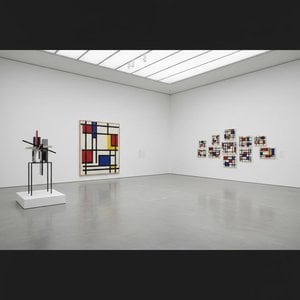
Explore the profound essence of Neoplasticism. Discover how Piet Mondrian and De Stijl masters used pure color and geometric form to redefine modern art. An essential guide for collectors seeking to understand the enduring power of abstract harmony and universal order.

Explore the profound elegance of De Stijl. Discover how Piet Mondrian and the masters of Neoplasticism utilized geometric harmony and primary colors to redefine modern abstraction. An authoritative guide for the discerning collector seeking timeless, structured beauty.

Explore the profound spiritual depth of geometric abstraction. From Malevich's Suprematism to modern masters, our expert guide reveals how pure form and color command presence in fine art collections.


Stay updated with the latest art news, exclusive offers, and decoration ideas.
Tell us about your project and our art experts will provide you with 3 personalized art suggestions.
Let Us Curate 3 Options Just for You - Free!

 Preview
 Send
Send Share
Share
 Details

 Download
 Similars
 X-Ray
X-Ray Diaporama

 Read More







 Glass option is only available in size under 110 CM


