

 Acrylic On CanvasWallArtNeo-Plasticism
 1921Modern
 50.0 x 50.0 cm
 Metropolitan Museum of Art
Hand-painted oil on canvas in your size and frame, made to order by our artists. ( Switch to Print Switch to Digital Image)





























Pick from our preset sizes that match the artwork's original proportions.

You may enter your own dimensions to fit a specific frame or space. If your selected size does not match the original image's proportions, we will either crop the artwork or extend the painting with additional hand-painted elements. A digital mockup will be sent for your approval before production begins.
Please note that the on-screen preview does not reflect the actual cropping or extension. Only the mockup will accurately show the final composition.
While custom sizes are available, we recommend selecting a dimension from the predefined list to preserve the original proportions.
Worldwide Delivery () in 3/4 weeks instead of standard 5 weeks. (4 October). No compromise on quality.


Composition
Reproduction Size
Piet Mondrian's 1921 painting, “Composition,” isn’t merely a visual arrangement of shapes; it’s an invitation to contemplate the very foundations of perception. Born into a Dutch artistic lineage – his uncle was already a painter – Mondrian initially followed a path of landscape work, diligently studying nature and mastering traditional techniques. Yet, beneath this surface lay a persistent yearning for something more fundamental, a distillation of essence rather than mere representation. This early experimentation with Pointillism and Fauvism paved the way for his revolutionary shift towards abstraction, culminating in works like “Composition,” which embodies the core tenets of Neo-Plasticism.

The painting immediately commands attention with its stark simplicity and powerful geometry. Eleven rectangles, defined by thick black lines, dominate the canvas, creating a rigorously ordered space. These aren’t haphazard divisions; they are carefully considered elements that establish a visual hierarchy and suggest an underlying structure. Within these blocks of pure form, Mondrian employs primary shades of red and blue – colors he would later eschew in favor of their unadulterated counterparts – subtly mixing them with white to achieve lighter hues. This deliberate restraint, this commitment to the essential, is characteristic of Neo-Plasticism’s pursuit of universal harmony through reductive abstraction.
Mondrian's “Composition” stands as a pivotal example of Neo-Plasticism, a movement he and Theo van Doesburg championed. The goal wasn’t simply to create abstract art; it was to construct a new universal aesthetic language – a visual vocabulary that could transcend cultural and social boundaries. The magazine *De Stijl*, founded by Mondrian and Van Doesburg, served as the movement's primary vehicle for disseminating its ideas, advocating for a world built on geometric harmony and a rejection of representational art. This ambition extended beyond painting; Neo-Plasticism sought to influence architecture, design, and even social structures, envisioning a postwar world grounded in shared visual references.
The black lines aren’t merely borders; they act as anchors, defining the spatial relationships between the rectangles and creating a sense of dynamic equilibrium. Mondrian believed that these fundamental elements – lines, colors, and shapes – represented the underlying structure of reality itself. By stripping away all superfluous detail, he aimed to reveal this essential order, suggesting a connection between the abstract composition and the spiritual realm.
While seemingly objective in its geometric precision, “Composition” is profoundly imbued with symbolism. The primary colors – red, blue, and yellow – are not chosen arbitrarily; they represent fundamental forces of nature and human experience. Red embodies energy and passion, blue signifies tranquility and spirituality, and yellow represents intellect and clarity. The rectangles themselves can be interpreted as building blocks, suggesting a desire to construct a new world order based on rational principles. The painting’s impact is one of quiet intensity – a sense of contained power and deliberate restraint. It invites the viewer to contemplate not just what they see, but also the underlying structure of perception itself.
Mondrian's influence extends far beyond the realm of fine art. His reductive aesthetic has profoundly shaped modern design, architecture, and fashion. The principles of Neo-Plasticism – clarity, simplicity, and geometric harmony – continue to resonate today, informing everything from graphic design to interior decoration. Reproductions of “Composition,” like this one, offer a tangible connection to this groundbreaking artistic movement, allowing us to experience its timeless beauty and intellectual rigor firsthand. Consider how the painting’s stark contrasts and balanced composition can be incorporated into contemporary spaces – bringing a sense of order, serenity, and visual sophistication.
"Composition" was created by Piet Mondrian. The information on this page describes Piet Mondrian's original work.
A digital image of "Composition" by Piet Mondrian can be purchased on this page: a high-resolution digital image download.
The creation of "Composition" by Piet Mondrian is dated 1921.
The suggested use for "Composition" by Piet Mondrian is geometry. It can serve other purposes as well.
When "Composition" was created in 1921, Piet Mondrian - born in 1872 - was 49 years old.
The overall mood of "Composition" by Piet Mondrian is calm. The mood describes the general atmosphere of the work.
The recommended space for "Composition" by Piet Mondrian is a living room. The suggestion can of course be adapted to your interior.


1872 - 1944 , Netherlands
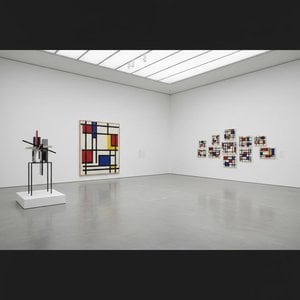
Explore the profound essence of Neoplasticism. Discover how Piet Mondrian and De Stijl masters used pure color and geometric form to redefine modern art. An essential guide for collectors seeking to understand the enduring power of abstract harmony and universal order.

Explore the profound spiritual depth of geometric abstraction. From Malevich's Suprematism to modern masters, our expert guide reveals how pure form and color command presence in fine art collections.

Explore the profound evolution of Neo-Abstract art. Discover how bold geometric forms, vibrant chromatic depth, and tactile textures redefine modern expression for the discerning collector seeking sophisticated, high-impact masterpieces for contemporary interiors.

 Preview
 Send
Send Share
Share
 Details
 Guide
Guide

 Download
 Similars
 X-Ray
X-Ray Diaporama
 Stats
Stats Read More







 Glass option is only available in size under 110 CM


