

 Acrylic On CanvasWallArtNeoplasticism
 1922
1922 55.0 x 53.0 cm
Museum-quality giclée or canvas print with fast production and flexible finish options. ( Buy Hand Made Painting Switch to Digital Image)





























Pick from our preset sizes that match the artwork's original proportions.

Type the width and the height you need, to fit your frame or your wall. A print can only be cut, never made bigger than the picture, so a size with a different shape loses a part of the image. We send you a digital mockup to approve before we print anything. The picture shown on this page does not show the real cut — only the mockup does.
Worldwide Delivery () in 2 weeks instead of standard 4/5 weeks. (20 October)
Composition 2
Reproduction Size
Piet Mondrian's "Composition 2," executed in 1922, isn’t merely a painting; it’s a distilled essence of artistic philosophy. Measuring a modest 55 x 53 cm, this work represents a pivotal moment in the development of Neoplasticism – Mondrian’s radical pursuit of universal harmony through pure abstraction. The canvas presents a deceptively simple arrangement: a stark white background punctuated by precisely delineated black squares and bold red rectangles. Yet, within this apparent austerity lies a profound exploration of form, color, and space, reflecting Mondrian's lifelong quest to strip away the superfluous and reveal the underlying structure of reality.
The genesis of “Composition 2” is deeply rooted in Mondrian’s evolving theories about art. He believed that nature, with its inherent complexity and illusionistic depth, obscured a more fundamental truth – a universal order governed by horizontal and vertical lines, and the primary colors: red, blue, and yellow. Rejecting representational imagery, he sought to create paintings that were self-contained, independent of external reference. This approach was heavily influenced by his studies of Eastern philosophy and spirituality, particularly the concept of ‘De Stijl,’ a movement he co-founded advocating for a new aesthetic based on geometric abstraction and harmonious color combinations. The painting’s restrained palette – primarily white, black, red, and yellow – isn't arbitrary; it’s carefully chosen to evoke a sense of balance and spiritual resonance.
Mondrian’s meticulous approach to composition is immediately apparent. The black squares aren’t randomly placed; they are strategically positioned to create a dynamic equilibrium, suggesting both stability and movement. The varying sizes of the squares contribute to this visual tension, drawing the eye across the canvas. The red rectangles, equally precise in their placement, introduce an element of warmth and energy that counterbalances the coolness of the black. Notice how Mondrian avoids any curves or diagonals – these are banished from his vocabulary, representing a rejection of organic forms and embracing instead the clarity and order of straight lines.
The use of primary colors is central to Neoplasticism. Mondrian believed that these colors possessed inherent spiritual qualities, capable of conveying universal emotions and ideas. Red represents passion and energy, blue signifies tranquility and depth, and yellow embodies intellect and enlightenment. By limiting his palette to these three hues, Mondrian aimed to create paintings that were not merely visually appealing but also imbued with a deeper meaning.
"Composition 2" was created during a period of intense artistic experimentation in the early 20th century. Mondrian’s work emerged alongside movements like Cubism and Futurism, but he ultimately forged his own distinct path – one that prioritized abstraction and universal harmony above all else. The painting reflects the broader cultural shifts taking place at the time, including a growing interest in spirituality, science, and technology. De Stijl, of which Mondrian was a key member, sought to influence not just art, but also architecture, design, and even fashion – aiming for a total aesthetic revolution.
Interestingly, Mondrian’s work gained significant recognition after his death, becoming highly influential in the development of Abstract Expressionism and Minimalism. His emphasis on simplicity, clarity, and spiritual depth continues to resonate with artists and designers today, demonstrating the enduring power of his vision.
WahooArt offers meticulously crafted hand-painted reproductions of “Composition 2,” ensuring that you experience the full impact of this iconic artwork. Our skilled artisans replicate Mondrian’s precise lines and vibrant colors with exceptional attention to detail, capturing the essence of his artistic philosophy. Whether displayed in a modern living room, a contemporary office, or a minimalist bedroom, this reproduction will serve as a striking focal point – a testament to the enduring beauty of geometric abstraction. The high-quality materials used ensure that your reproduction will retain its vibrancy and integrity for years to come.
Consider how “Composition 2”’s inherent balance and clarity can contribute to a sense of calm and order within your space. Its reductive aesthetic offers a refreshing counterpoint to the visual clutter of modern life, inviting contemplation and promoting a feeling of harmony. Explore our range of sizes and framing options to find the perfect way to bring Mondrian's vision into your home.
The color harmony of "Composition 2" is recorded as softly mixed palette.
Considering its neutrals colors, "Composition 2" is suggested for a living room.
"Composition 2", created in 1922, belongs to the Neoplasticism Era of Piet Mondrian's career.

To look at a Mondrian today is to see the blueprint of modern visual culture. We encounter his logic every time we interact with a clean graphic layout or a minimalist building facade. He stripped away the unnecessary until only the essential remained. This was not an act of destruction, but one of extreme distillation. By reducing his vocabulary to straight lines, right angles, and a strict palette of red, blue, and yellow, he removed the distraction of reality to reveal a structural truth.
His early work in the Netherlands followed much more traditional paths. He began with landscapes that captured the windmills and rivers of the Dutch countryside, heavily influenced by the Hague School and Impressionism. Pieces like The Red Mill show an artist focused on naturalistic detail and the soft light of his homeland. However, even in these early years, a drive toward simplification was present. He moved through Pointillism and Fauvism, testing how much color and form could be compressed before the subject disappeared entirely.
The move to Paris in 1912 changed everything. Encountering Cubism forced him to deconstruct objects into geometric components. He stopped trying to depict what he saw and began exploring how he saw it. This period was deeply tied to his interest in Theosophy, a mystical philosophy that sought universal principles beneath surface appearances. He believed art could express these hidden truths through pure abstraction.
By 1917, this search resulted in Neoplasticism, or "pure plastic art." Alongside Theo van Doesburg, he co-founded the De Stijl movement to promote a rigid aesthetic of horizontal and vertical lines. The rules were absolute:
This reduction was a deliberate attempt to manifest spiritual order through visual balance. Works like Composition with Red, Blue and Yellow demonstrate this commitment to geometric purity.
The arrival of World War II forced Mondrian to flee Europe for New York City in 1940. The transition from the organic landscapes of his youth to the rigid grid of Manhattan provided a new, unexpected energy. His late works, such as Broadway Boogie Woogie, show a shift in rhythm. While he maintained his core principles, the lines began to dance with a new, syncopated movement inspired by the city's pulse and jazz music.
His death in 1944 ended a career that had fundamentally altered the trajectory of 20th-century art. He left behind a legacy that moved far beyond the canvas, influencing everything from architecture to fashion, including the famous 1965 collection by Yves Saint Laurent. His work remains a standard for anyone seeking clarity and structural integrity in a chaotic visual age.

1872 - 1944 , Netherlands

Explore the profound evolution of Neo-Abstract art. Discover how bold geometric forms, vibrant chromatic depth, and tactile textures redefine modern expression for the discerning collector seeking sophisticated, high-impact masterpieces for contemporary interiors.

Explore the profound spiritual depth of geometric abstraction. From Malevich's Suprematism to modern masters, our expert guide reveals how pure form and color command presence in fine art collections.

Explore the profound elegance of De Stijl. Discover how Piet Mondrian and the masters of Neoplasticism utilized geometric harmony and primary colors to redefine modern abstraction. An authoritative guide for the discerning collector seeking timeless, structured beauty.
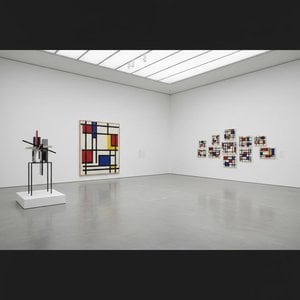
Explore the profound essence of Neoplasticism. Discover how Piet Mondrian and De Stijl masters used pure color and geometric form to redefine modern art. An essential guide for collectors seeking to understand the enduring power of abstract harmony and universal order.

 Preview
 Send
Send Share
Share
 Details
 Guide
Guide

 Download
 Similars
 X-Ray
X-Ray Diaporama
 Stats
Stats Read More









 Glass option is only available in size under 110 CM


