

Hand-painted oil on canvas in your size and frame, made to order by our artists. ( Switch to Print Switch to Digital Image)





























Pick from our preset sizes that match the artwork's original proportions.

You may enter your own dimensions to fit a specific frame or space. If your selected size does not match the original image's proportions, we will either crop the artwork or extend the painting with additional hand-painted elements. A digital mockup will be sent for your approval before production begins.
Please note that the on-screen preview does not reflect the actual cropping or extension. Only the mockup will accurately show the final composition.
While custom sizes are available, we recommend selecting a dimension from the predefined list to preserve the original proportions.
Worldwide Delivery () in 3/4 weeks instead of standard 5 weeks. (24 September). No compromise on quality.


The Bay
Reproduction Size
Pierre-Auguste Renoir's "The Bay" is more than just a landscape; it’s an immersion into the heart of Impressionist philosophy, a testament to the artist’s profound understanding of light and atmosphere. Painted during a pivotal period in his career – roughly around 1885 – this work exemplifies Renoir’s shift towards capturing fleeting moments of beauty rather than meticulously detailed representations. The scene unfolds with a remarkable serenity, depicting a vast expanse of water reflecting the sky above, framed by a gently rolling field dotted with trees and, crucially, a small herd of horses. These aren't merely subjects; they are imbued with a sense of movement and life, contributing to the overall feeling of peaceful contemplation that defines the painting.
Renoir’s masterful technique is immediately apparent in “The Bay.” He employs broken brushstrokes – a hallmark of Impressionism – to capture the shimmering effects of light on water and foliage. Notice how he doesn't blend colors smoothly; instead, he applies them in short, distinct dabs, allowing the viewer’s eye to synthesize the hues. The dominant palette is dominated by soft greens, blues, and ochres, creating a harmonious and luminous effect. This deliberate avoidance of dark shadows – a characteristic of academic painting – further emphasizes the play of light and contributes to the painting's ethereal quality. The artist’s use of complementary colors—particularly the juxtaposition of blue and orange in the reflections—intensifies the visual impact and adds depth to the composition.
"The Bay" was created during a time of immense artistic ferment in Paris. The Impressionist movement, initially met with skepticism by the established Salon, was gaining momentum thanks to exhibitions like those organized by Renoir and his contemporaries. This painting reflects the growing interest in depicting everyday life and landscapes – particularly scenes from the French countryside – rather than historical or mythological subjects. Renoir’s Parisian upbringing profoundly influenced his work; he captured the vibrancy of city life, but also sought refuge in nature, finding inspiration in the beauty of the Seine and its surrounding areas. The presence of the horses, a common motif in Impressionist art, speaks to this fascination with the natural world and the fleeting moments of human interaction within it.
Beyond its technical brilliance, “The Bay” possesses a subtle symbolic depth. The horses, often associated with freedom and nobility, add an element of romanticism to the scene. The figures in the distance – two individuals enjoying the tranquility of the landscape – represent humanity’s connection to nature and our innate desire for peace and solitude. Renoir's ability to evoke such a profound sense of serenity is remarkable. The painting invites viewers to step into this idyllic world, offering a momentary escape from the stresses of modern life. It’s a reminder of the beauty that can be found in simple moments – a quiet afternoon by the water, surrounded by nature and companionship.


1841 - 1919 , France
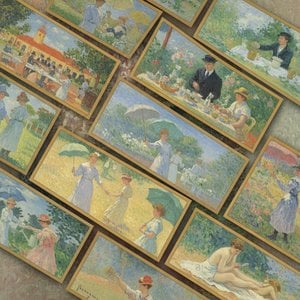
Explore 25 iconic Pierre-Auguste Renoir paintings! Discover the stories behind Impressionist masterpieces like 'Dance at Le Moulin de la Galette' & 'Luncheon of the Boating Party'. Find museum-quality art reproductions and elevate your home decor with WahooArt.com.
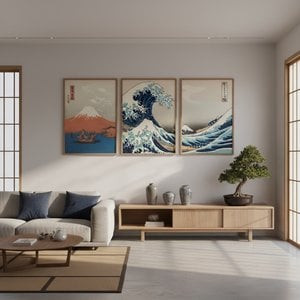
Journey through Katsushika Hokusai’s 25 most iconic artworks, including *The Great Wave*. Explore the ukiyo-e master's history, style & timeless Japanese woodblock prints. Find museum-quality reproductions for your home at WahooArt.com.

Journey into the heart of Impressionism! Explore 10 masterpieces by Monet, Renoir & Degas that revolutionized landscape art. Discover their stories, techniques & find museum-quality reproductions to elevate your home decor on WahooArt.com.
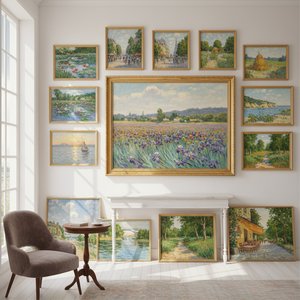
Journey through 10 iconic Impressionist landscapes by Monet, Renoir & Degas. Explore the history, techniques & emotions behind these masterpieces. Find museum-quality reproductions for your home at WahooArt.com – where art comes to life! Discover all masterpieces on WahooArt.com

Journey through John Constable's 25 most celebrated landscapes. Explore Romanticism, Dedham Vale & his masterful use of light in iconic paintings like 'Hay Wain'. Find museum-quality art reproductions and elevate your home decor on WahooArt.com.

 Preview
 Send
Send Share
Share
 Details
 Guide
Guide

 Download
 Similars
 X-Ray
X-Ray Diaporama
 Stats
Stats

 Read More







 Glass option is only available in size under 110 CM


