

Museum-quality giclée or canvas print with fast production and flexible finish options. ( Buy Hand Made Painting Switch to Digital Image)





























Pick from our preset sizes that match the artwork's original proportions.

Type the width and the height you need, to fit your frame or your wall. A print can only be cut, never made bigger than the picture, so a size with a different shape loses a part of the image. We send you a digital mockup to approve before we print anything. The picture shown on this page does not show the real cut — only the mockup does.
Worldwide Delivery () in 2 weeks instead of standard 4/5 weeks. (9 November)
Strawberries
Reproduction Size
Pierre-Auguste Renoir's "Strawberries," painted in 1914, isn’t merely a still life; it’s an invitation to savor the fleeting beauty of everyday moments. Captured during a period of personal reflection and artistic evolution for the Impressionist master, this oil on canvas offers a glimpse into his masterful ability to transform simple subjects – a bowl of fruit – into a vibrant tableau brimming with light, texture, and a subtle undercurrent of nostalgia. The painting immediately draws the eye to the luscious reds and deep greens of the strawberries, arranged artfully within a rustic wooden bowl, their plumpness practically begging to be tasted. Beside them rest two blushing apples and an orange, each contributing to a harmonious composition that speaks volumes about Renoir’s keen observation of nature and his desire to capture its essence on canvas.
“Strawberries” is a quintessential example of the Impressionist movement, a style defined by its emphasis on capturing the transient effects of light and color. Renoir’s technique is remarkably loose and fluid, eschewing precise detail in favor of conveying an immediate impression. Notice how he uses broken brushstrokes—tiny dabs of paint applied with quick, confident movements—to build up layers of color, creating a shimmering effect that mimics the play of sunlight on the fruit's surface. The artist masterfully employs complementary colors – the vibrant reds and oranges juxtaposed against the cool greens and browns – to intensify the visual impact and create a sense of depth and luminosity. He doesn’t simply paint *what* he sees, but rather *how* it appears in a given moment, imbuing the scene with an atmosphere of warmth and vitality.
Painted in 1914, a year marked by significant historical upheaval, “Strawberries” offers a poignant contrast to the turmoil of the time. Renoir was grappling with personal losses and reflecting on his artistic legacy. The still life itself is rich in symbolism. Strawberries, traditionally associated with summer, fertility, and abundance, evoke feelings of joy and pleasure. Their vibrant color represents vitality and sensuality – qualities that were central to Renoir’s artistic vision. The inclusion of the apples and orange further reinforces this theme, suggesting a celebration of nature's bounty. The simple arrangement—a bowl, fruit, and spoon—hints at domesticity and the pleasures of everyday life, offering a moment of respite from the complexities of the world.
Renoir’s “Strawberries” stands as a pivotal work in the development of modern art. His innovative use of color and light paved the way for subsequent movements, including Post-Impressionism and Fauvism. Artists like Matisse and Van Gogh were deeply influenced by Renoir's approach to capturing fleeting moments and conveying emotion through color. The painting’s emphasis on subjective experience—the artist’s personal interpretation of reality—anticipates many of the principles of Expressionism. Furthermore, its enduring appeal lies in its ability to resonate with viewers across generations, reminding us of the simple joys and beauty that can be found in the most ordinary of subjects. For those seeking a piece of this artistic legacy, reproductions by WahooArt offer a beautiful way to bring Renoir’s vision into your home.
To explore more of Renoir's work or similar pieces, consider visiting Pierre-Auguste Renoir: Still life with Strawberries and Edouard Manet: Strawberries, both remarkable examples of still life painting.
For more information about the artist and his collection, visit Staedtische Kunsthalle Mannheim (Germany), which offers a comprehensive guide to its collection. And for further insights, explore Staedtische Kunsthalle Mannheim (Germany) - A Comprehensive Guide.
"Strawberries" by Pierre-Auguste Renoir can be viewed as a slideshow on the artwork's Diaporama page.
The X-Ray view of "Strawberries" by Pierre-Auguste Renoir is on the artwork's X-Ray page: an interactive examination of the image through eleven optical layers.
The recommended use of a print of "Strawberries" is statement.

Born on February 25, 1841, in Limoges, France, Pierre-Auguste Renoir entered a world of practical craftsmanship. His father, Léonard Renoir, worked as a tailor, while his mother, Marguerite Renoir, was a dressmaker. This domestic background of textiles and fine detail would quietly influence his later sensibilities. In 1845, the family moved to Paris, seeking the opportunities offered by the capital. This transition from the provincial quiet of Limoges to the bustling energy of Paris set the stage for a life defined by the pursuit of light and the human form.
His path was not one of immediate ease. Financial necessity often dictated his early movements, steering him toward the disciplined work of a porcelain painter. Yet, even as a young apprentice, his interests drifted toward the galleries of the Louvre. He was a leading French Impressionist artist, a man who eventually helped redefine the boundaries of modern painting. His work often focused on the joy of everyday social gatherings and the soft glow of outdoor light, finding significance in the simple pleasure of a summer afternoon.
Throughout his career, his focus remained on the interplay of light and the warmth of the human experience. He moved through various stages of development, from the loose brushstrokes of his youth to a more structured, classical method in his later years. Even as physical ailments challenged his ability to hold a brush, his commitment to his vision remained constant. He eventually found a permanent home in Cagnes-sur-Mer, France, where he continued to paint until his death in 1919.
Born in Limoges, France, to a tailor and a dressmaker, Renoir’s early years were shaped by the practicalities of a working-class household. When the family moved to Paris in 1845, the necessity of supporting his kin dictated the direction of his youth. At thirteen, he began an apprenticeship as a porcelain painter, a role that required a steady hand and an eye for decorative detail. He eventually found work with Lévy Frères, spending his days applying patterns to fine china. This period of craftsmanship provided a foundation of technical discipline, even as his interests began to drift toward the more expressive possibilities of the canvas.
His formal education began in earnest when he entered the studio of Charles Gleyre. It was here that his artistic sensibilities began to take a more structured shape. While his training was grounded in the academic traditions of the time, Renoir spent much of his free time at the Louvre. He studied the Old Masters with a quiet intensity, absorbing the way they handled light and form. This self-directed study of classical techniques provided a necessary counterweight to his formal instruction, allowing him to develop a personal visual language that was informed by both the precision of his porcelain background and the grandeur of the masters.
His path eventually led him to the Ecole des Beaux-Arts in Paris, where he sought to refine his skills further. This period of study was marked by a tension between the rigid rules of the academy and a growing desire to capture the immediate, fleeting qualities of the world around him. He was a student of the moment, even as he mastered the traditional methods of his predecessors.
By the 1870s, the rigid structures of the art establishment in Paris were beginning to fracture. Renoir was among the group of artists who sought to break away from these academic traditions, eventually becoming a founder of the Impressionist movement. This was not a sudden shift but a steady departure from the formal rules of the time. He sought to capture the immediate sensation of a scene, focusing on the way light and atmosphere interacted with the world around him.
His presence in this new movement was marked by a series of exhibitions that challenged the status quo. In April 1874, he participated in the first Impressionist exhibition, contributing six paintings to the collection. This initial foray was followed by an even larger presence in 1876, when he displayed seventeen paintings and one pastel. By the third exhibition in 1877, his commitment to this new way of seeing was evident as he presented twenty-one paintings to the public.
These years were defined by a shared pursuit of the ephemeral. While the establishment often looked toward grand historical narratives, Renoir and his contemporaries turned their attention to the fleeting moments of modern life. His work during this period focused on the energy of social gatherings and the natural glow of outdoor light, often using broken brushstrokes to mimic the movement of sunlight through leaves.
His early years were defined by a preoccupation with the way light interacts with the physical world. He utilized loose brushstrokes and a palette of saturated colors to capture the fleeting atmosphere of a moment. By employing broken brushstrokes, he successfully mimicked the effect of sunlight filtering through leaves, creating a sense of movement across the canvas. This method relied heavily on the use of complementary colors to achieve a sense of luminosity. His focus often turned toward the human form, where he applied a particular sensitivity to the softness of skin and the play of light across a figure.
As his career progressed, his approach underwent a significant transformation. In the 1890s, he moved away from the loose, blurry edges of his youth. This shift saw him embrace a more structured and classical method, emphasizing volume, contour, and clear lines. He sought to reconcile the modern style of painting with more disciplined, formal traditions. Even as rheumatoid arthritis eventually forced him to paint with a brush attached to his hand, his commitment to his evolving vision remained constant.
The studio of Charles Gleyre provided more than just formal instruction; it offered a gathering place for a generation of artists poised to redefine the visual language of France. Within this creative circle, Renoir formed lasting bonds with fellow students, including Alfred Sisley and Frédéric Bazille. Most significant, however, was his close friendship with Claude Monet. Together, they navigated the shifting tides of the Parisian art scene, often sharing the same landscapes and light-drenched moments that would eventually define the Impressionist movement.
His aesthetic sensibilities were shaped by a dialogue between the immediate present and the weight of tradition. He drew inspiration from the works of Gustave Courbet and Eugène Delacroix, finding a way to reconcile the modern impulse for realism with a more classical sensibility. This tension between the new and the old was a constant presence in his development. He looked toward the masters of the past to inform his understanding of form and grace, finding guidance in the works of Raphael, Titian, and Velázquez. The influence of Rubens and Watteau also left a mark on his approach to the human figure, guiding his hand toward a more sensual and fluid representation of life.
Even as he moved toward a more structured method later in life, the echoes of Ingres remained part of his artistic memory. His ability to balance the spontaneous energy of his peers with the disciplined lines of the Old Masters allowed him to maintain a distinct presence amidst the many voices of the era.
His early output revealed a growing fascination with the interplay of light and the human form. In 1867, Lise with a Parasol demonstrated an emerging interest in the natural world and the soft glow of outdoor light. This period of experimentation led to the lively energy found in Dance at Le Moulin de la Galette, painted in 1876. Here, broken brushstrokes mimic the way sunlight filters through leaves, creating a sense of movement and warmth within a social gathering.
As his reputation grew, Renoir turned his attention toward the intimacy of domestic life and the conviviality of social settings. Madame Georges Charpentier and her Children, from 1878, captured a sense of elegance and family connection. This ability to find beauty in the simple pleasure of a meal or a gathering is perhaps most evident in the undated Luncheon of the Boating Party, which portrays figures bathed in a natural, luminous glow along the Seine.
The final chapter of his career saw a shift toward more structured and classical methods. Even as physical struggle became a constant companion, his dedication to his vision remained. His 1919 work, The Great Bathers (The Nymphs), possesses a sculptural quality that reflects this transition toward volume and contour. This later period emphasized a more disciplined technique, moving away from the loose, blurry edges of his youth toward a more formal style.
The final chapter of Renoir’s life was defined by a quiet retreat to the south of France. In 1907, he settled at the Domaine des Collettes in Cagnes-sur-Mer, a landscape of olive groves and orange trees that offered a different kind of light than the bustling streets of Paris. This period saw a shift toward a more disciplined, formal technique, moving away from the loose edges of his earlier years toward a style that emphasized volume and clear lines.
Physical hardship arrived in the form of rheumatoid arthritis. The condition eventually became so severe that it restricted his movement, forcing him to adapt his method of working by having a brush attached to his hand. Even as his body faltered, his output remained steady. He continued to produce works, including portraits and landscapes, until his death in 1919. He passed away on December 3, 1919, in Cagnes-sur-Mer at the age of 78.
The distribution of his canvases across the globe reflects the widespread reach of his influence. In Paris, the Musée d'Orsay maintains the largest collection, housing 28 of his works. This concentration allows for a close study of his evolution from early Impressionist scenes to his more structured, classical compositions. Across the Atlantic, the National Gallery of Art in Washington holds 18 works, providing a significant presence in American collections. The Sterling and Francine Clark Art Institute in Williamsburg also maintains a substantial presence with 16 paintings.
Other major institutions hold important pieces that illustrate his varied interests in portraiture and landscape. The Detroit Institute of Arts contains 13 works, while the Metropolitan Museum of Art in New York holds 9. These collections offer glimpses into his different stylistic periods, from the loose brushstrokes of his youth to the more defined forms of his later years. Visitors can find specific subjects such as:
His presence in these museums ensures that his specific approach to light and the human form remains accessible to those studying the development of modern painting. Whether observing a quiet portrait or a lively social gathering, the physical reality of his brushwork is preserved within these institutional walls.

1841 - 1919 , France
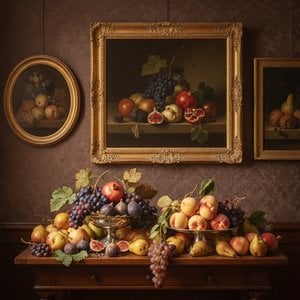
Discover the profound beauty of fruit still life paintings. Explore the rich symbolism, Baroque mastery, and timeless allure of nature's bounty through an art-historical lens, perfect for collectors and enthusiasts of classical fine art.

Explore the profound beauty of fruit arrangement masterpieces. From Dutch Golden Age opulence to Baroque chiaroscuro, discover the art history, symbolism, and timeless elegance of classical still life paintings for the discerning collector.

Discover the luminous world of Pierre-Auguste Renoir. Explore an expert guide to his mastery of light, color, and joy through the lens of Impressionist history, perfect for fine art enthusiasts and collectors seeking timeless elegance.
 Preview
 Send
Send Share
Share
 Details
 Guide
Guide

 Download
 Similars
 X-Ray
X-Ray Diaporama
 Q&A
Q&A
 Stats
Stats

 Read More









 Glass option is only available in size under 110 CM


