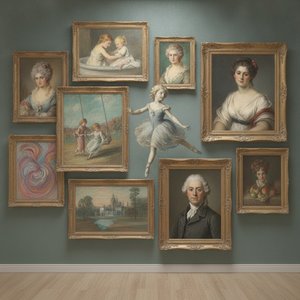
A Childhood of Porcelain and Light
In the provincial streets of Limoges, France, a young boy named Pierre-Auguste Renoir began his life immersed in the delicate precision of craftsmanship. His father was a tailor, and the family eventually moved to Paris in 1845, seeking better prospects in the bustling capital. At thirteen, necessity led him into an apprenticeship as a porcelain painter, a role that demanded a keen eye for detail and a steady hand. This early work with ceramics instilled in him a lasting appreciation for color and texture. While his days were spent decorating fine china, his spirit often wandered toward the galleries of the Louvre. There, he studied the techniques of the Old Masters, absorbing the way they handled light and form.
The path from decorative art to the canvas was paved by a desire for something more expressive than mere reproduction. After leaving the porcelain factory, he sought formal training at the studio of Charles Gleyre. It was within this creative circle that he met fellow students such as Claude Monet, Alfred Sisley, and Frédéric Bazille. These friendships formed the bedrock of a new way of seeing. They shared a common goal to move away from the rigid rules of academic painting, preferring instead to capture the fleeting atmosphere of a moment. His early successes, like Lise with a Parasol in 1867, began to show this emerging interest in the natural world and the soft glow of outdoor light.
The Pulse of Parisian Life
As the years progressed, Renoir became a central figure in the movement known as Impressionism. He participated in the first exhibition of this group in 1874, displaying six paintings that challenged the traditional art establishment. His work during this period focused on the joy found in everyday social gatherings and the lively energy of the city. In works such as Dance at Le Moulin de la Galette, he used broken brushstrokes to mimic the way sunlight filters through leaves, creating a sense of movement and warmth. He did not seek grand historical narratives; rather, he looked for beauty in the simple pleasure of a summer afternoon or a group of friends enjoying a meal.
The subject matter of his canvases often celebrated the human form and the softness of skin. He had a particular talent for portraying feminine beauty, drawing inspiration from the sensual lines of Peter Paul Rubens and Jean-Antoine Watteau. His paintings, such as Luncheon of the Boating Party, captured the conviviality of life on the Seine, with figures bathed in a natural, luminous glow. This period of his life was defined by an embrace of the ephemeral, focusing on how light dances across fabric and settles upon a garden landscape.
A Shift Toward Form and Final Years
In the 1890s, Renoir’s approach to the canvas underwent a significant change. Following travels to Italy, where he studied the works of Raphael and Titian, he began to move away from the loose, blurry edges of his youth. He sought a more structured and classical method, emphasizing volume, contour, and clear lines. This transition toward a more disciplined technique is evident in his later works, such as The Great Bathers, which possess a sculptural quality. Despite the physical struggle of rheumatoid arthritis, which eventually forced him to paint with a brush attached to his hand, his dedication to his vision never wavered.
He eventually settled in Cagnes-sur-Mer, France, at the Domaine des Collettes, a place filled with olive groves and orange trees that provided fresh inspiration. In these later years, his palette remained warm, even as his style became more formal. He continued to produce portraits, landscapes, and still lifes until his death in 1919. His legacy remains tied to his ability to find divinity in the mundane, leaving behind a body of work that continues to reflect the warmth and light of the human experience.



 Preview
 Buy Hand Made Painting
 Send
Send Share
Share
 Details
 Guide
Guide

 Download
 Similars
 X-Ray
X-Ray Diaporama
 Q&A
Q&A Stats
Stats


 Read More






































 Glass option is only available in size under 110 CM