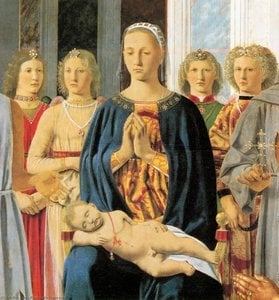
Saint michael by Piero della Francesca, hand-painted oil painting reproduction by a master artist
Preview AR preview Switch to Print Switch to Digital Image Send
Details Guide Add to favorites Download Similars X-Ray Diaporama Q&A Stats

Saint michael Hand-painted oil painting reproduction

Piero della Francesca's "Saint Michael" depicts the powerful angel in a commanding pose, showcasing his mastery of Renaissance style and geometry. This iconic artwork evokes strength and serenity – discover or own this timeless masterpiece.

An Early Renaissance master known for The History of the True Cross. Discover his geometric precision and serene beauty today.

Hand Made Oil Reproduction

Hand-painted oil on canvas in your size and frame, made to order by our artists. ( Switch to Print Switch to Digital Image)

Corner sample of the P118B picture frame: moulded polystyrene, 5 cm wide and 3 cm thick
P118B $10
Corner sample of the P118H picture frame: moulded polystyrene, 5 cm wide and 3 cm thick
P118H $10
Corner sample of the P118W picture frame: moulded polystyrene, 5 cm wide and 3 cm thick
P118W $10
Corner sample of the P438Z picture frame: moulded polystyrene, 5.5 cm wide and 3.5 cm thick
P438Z $10
Corner sample of the P508JH picture frame: moulded polystyrene, 7 cm wide and 3.5 cm thick
P508JH $12
Corner sample of the P508YH picture frame: moulded polystyrene, 7 cm wide and 3.5 cm thick
P508YH $12
Corner sample of the P805H picture frame: moulded polystyrene, 5 cm wide and 3.5 cm thick
P805H $10
Corner sample of the P805Z picture frame: moulded polystyrene, 5 cm wide and 3.5 cm thick
P805Z $10
Corner sample of the P919BZ picture frame: moulded polystyrene, 7 cm wide and 3.5 cm thick
P919BZ $10
Corner sample of the P919G picture frame: moulded polystyrene, 7 cm wide and 3.5 cm thick
P919G $10
Corner sample of the P919XJ picture frame: moulded polystyrene, 7 cm wide and 3.5 cm thick
P919XJ $10
Corner sample of the P959ZH picture frame: moulded polystyrene, 5 cm wide and 3 cm thick
P959ZH $10
Corner sample of the P968JZ picture frame: moulded polystyrene, 6 cm wide and 4 cm thick
P968JZ $12
Corner sample of the W106C picture frame: solid wood, 5 cm wide and 3 cm thick
W106C $8
Corner sample of the W218G picture frame: solid wood, 5 cm wide and 3 cm thick
W218G $10
Corner sample of the W218JH picture frame: solid wood, 5 cm wide and 3 cm thick
W218JH $8
Corner sample of the W218Y picture frame: solid wood, 5 cm wide and 3 cm thick
W218Y $10
Corner sample of the W307PJ picture frame: solid wood, 6 cm wide and 3 cm thick
W307PJ $10
Corner sample of the W316G picture frame: solid wood, 6 cm wide and 3 cm thick
W316G $10
Corner sample of the W316PJ picture frame: solid wood, 6 cm wide and 3 cm thick
W316PJ $8
Corner sample of the W316Y picture frame: solid wood, 6 cm wide and 3 cm thick
W316Y $10
Corner sample of the W398PJ picture frame: solid wood, 5 cm wide and 3 cm thick
W398PJ $8
Corner sample of the W4111J picture frame: solid wood, 6.5 cm wide and 3.5 cm thick
W4111J $10
Corner sample of the W500HY picture frame: solid wood, 7 cm wide and 5 cm thick
W500HY $15
Corner sample of the W500JH picture frame: solid wood, 7 cm wide and 5 cm thick
W500JH $15
Corner sample of the W692G picture frame: solid wood, 8 cm wide and 4 cm thick
W692G $12
Corner sample of the W849H picture frame: solid wood, 5 cm wide and 3 cm thick
W849H $8
Corner sample of the W940BG picture frame: solid wood, 7.5 cm wide and 4.5 cm thick
W940BG $15
Corner sample of the W953PJ picture frame: solid wood, 6 cm wide and 3.5 cm thick
W953PJ $8

Standard
custom
CM
INCH

Pick from our preset sizes that match the artwork's original proportions.

width
height

Type the width and the height you need, to fit your frame or your wall. This is hand-painted, so for a size with a different shape the artist can paint a bit more around the picture, or cut a bit — you choose. We send you a digital mockup to approve before the painting starts. The picture shown on this page does not show the real result — only the mockup does.

Examples of what can be changed: Replace face with customer photo; Add pet (e.g., replace cat with dog); Include hidden message in background; Change background landscape or elements.
After order, WahooArt.com team will email client for instructions and provide a mockup preview

Worldwide Delivery () in 3/4 weeks instead of standard 5 weeks. (2 November). No compromise on quality.

Free Worldwide Express Shipping
High-Quality Linen Canvas
Full Shipping Insurance
Customs Tax Refund Guarantee
True Color Matching Guarantee
100-Day Return Policy (Defects Only)
100% Money-Back Guarantee
Bulk Discount Offer

Total Price

$ 272

Saint michael

Reproduction Medium

Reproduction Size

-

Total Price

$ 272

Quick Facts

  • Movement: Early Renaissance
  • Location: Private Collection
  • Notable elements: Sword, wings, cat
  • Medium: Tempera on panel
  • Artist: Piero della Francesca

A Vision of Celestial Authority: Piero della Francesca’s Saint Michael

Piero della Francesca's depiction of Saint Michael is not merely a religious image; it’s a profound meditation on power, vigilance, and the very nature of divine protection. Painted during the height of the Early Renaissance, around 1460-1465, this work embodies the artist’s meticulous approach to observation and his masterful manipulation of space and light – hallmarks that secured his place as one of the most significant figures in Italian art history. The painting immediately commands attention with its imposing central figure: Saint Michael, rendered with a stoic dignity rarely seen in depictions of angels. He stands poised on a balcony, a classical architectural element subtly integrated into the scene, suggesting both earthly and heavenly realms. The sword he holds isn’t simply a weapon; it represents divine justice and the triumph over evil – a potent symbol that resonates deeply within Christian iconography.

Technical Mastery and Spatial Illusion

Della Francesca's technical skill is immediately apparent in the painting’s remarkably stable and almost photographic quality. He employed his rigorous study of geometry, particularly linear perspective, to create a convincing illusion of depth. The balcony itself seems to recede into an infinite space, drawing the viewer into the scene with an unsettling yet captivating realism. His use of color is restrained – primarily blues, grays, and ochres – contributing to the painting’s solemn mood. Notice how he uses subtle gradations in tone to model the angel's form, creating a sense of volume and weight that belies the figure's ethereal nature. The smooth, polished surfaces achieved through meticulous layering of oil paint are characteristic of della Francesca’s style, resulting in a luminous quality that seems to emanate from within.

Symbolism and Context: A Guardian Against Darkness

The presence of the cat at the bottom left corner is particularly intriguing. While seemingly an incidental detail, it has been interpreted as a symbol of vigilance and protection – qualities associated with Saint Michael. Cats were often seen as guardians against evil spirits in medieval and Renaissance Europe. The balcony itself, a recurring motif in della Francesca’s work, represents a threshold between the earthly and divine, a space where Michael stands guard against demonic forces threatening humanity. This painting reflects the anxieties of the time – the ongoing struggle between good and evil, faith and doubt – prevalent within the Catholic Church and broader society. Della Francesca's approach was deeply rooted in humanist thought, seeking to understand the world through reason and observation, rather than solely relying on theological dogma.

Emotional Impact and Artistic Legacy

Beyond its technical brilliance and symbolic richness, *Saint Michael* possesses a profound emotional impact. The angel’s unwavering gaze and resolute posture evoke a sense of awe and reverence. The painting's stillness and clarity invite contemplation – prompting viewers to consider themes of faith, courage, and the eternal battle against darkness. Piero della Francesca’s influence extends far beyond his own time; his work has inspired generations of artists, including Raphael and Leonardo da Vinci. A hand-painted reproduction of this masterpiece offers a unique opportunity to experience firsthand the genius of one of Italy's greatest Renaissance masters, bringing a timeless vision of celestial authority into your home or studio.

Questions & Answers

Is "Saint michael" by Piero della Francesca a bright or a dark artwork?

Overall, "Saint michael" is recorded as balanced. Perceived brightness describes how light or dark the work appears.

What atmosphere does "Saint michael" have?

"Saint michael" by Piero della Francesca is described as ethereal in mood. This classification can help match the work to a setting.

What orientation does "Saint michael" by Piero della Francesca have?

"Saint michael" by Piero della Francesca has a tall format. The format describes the proportions of the composition.


Artist Biography

The geometry of a quiet life

In the small, sun-drenched town of Sansepolcro, Piero di Benedetto de’ Franceschi lived a life shaped by the precise lines of his surroundings. His father worked with leather and wool, a trade that required a steady hand and an eye for detail. This early environment, far from the crowded workshops of larger cities, provided a foundation of stillness. He learned to see the world through the lens of order. Around 1439, he moved toward Florence, where the air was thick with new ways of seeing. There, he worked alongside Domenico Veneziano and studied the works of Masaccio in the Brancacci Chapel. He did not simply look at these paintings; he measured them. He took the innovations of Brunelleschi and broke them down into mathematical truths.

His hands moved between the brush and the compass. To him, a figure was as much a product of geometry as it was of anatomy. This way of working meant that light did not just fall upon a surface; it defined the volume of every limb and stone. He understood how a single vanishing point could pull a viewer into a deep, constructed space. His mind occupied the space between art and science, treating the canvas as a field for mathematical exploration.

The weight of the fresco

Much of his work remains fixed to the walls of churches in Tuscany. In the Basilica of San Francesco in Arezzo, he spent years working on the cycle of frescoes known as The History of the True Cross. These scenes are not hurried. Each figure possesses a heavy, quiet dignity. He used light and shadow to give weight to the characters, making them feel as solid as the architecture surrounding them. In other works, like the Baptism of Christ, he used a restrained palette to create an atmosphere of clarity. The colors are not loud, yet they possess a luminous quality that seems to come from within the figures themselves.

His approach to composition relied on strict principles:

  • The use of linear perspective to create measurable depth.
  • A focus on balanced, symmetrical arrangements.
  • The application of geometric forms to human anatomy.
  • The use of light to define physical volume and mass.

In the Montefeltro Altarpiece, his skill with oil painting allowed for a meticulous rendering of detail in the portraits of Federico da Montefeltro and Battista Sforza. He captured the texture of skin and the weight of fabric with a scientific precision. Even in his more recent works, such as The Nativity, he placed sacred scenes within a recognizable landscape, using the hills and rivers of the Tuscan countryside to ground the divine in the earthly.

A legacy of measurement

Piero was also a writer, documenting his findings in De Prospectiva Pingendi. This treatise on perspective painting shows that his interest in math was not secondary to his art; it was the core of it. He wrote about how to use geometry to represent the three-dimensional world on a flat surface. His work bridged the gap between the older, more decorative Gothic traditions and the new, rational Renaissance style. He sought beauty through proportion and order.

He died in 1492, leaving behind a body of work that influenced those who followed, including Leonardo da Vinci and Raphael. They looked to his mastery of light and his ability to organize space with mathematical certainty. His paintings remain windows into a world where the spiritual and the rational exist in a state of permanent, quiet balance.

Piero della Francesca

Piero della Francesca

1415 - 1492 , Italy

Quick Facts

  • Artistic Movement Or Style: Early Renaissance
  • Artists Or Movements Influenced By This Artist:
    • Leonardo da Vinci
    • Raphael
  • Artists Who Influenced This Artist:
    • Masaccio
    • Brunelleschi
  • Full Name: Piero di Benedetto de' Franceschi
  • Nationality: Italian
  • Notable Artworks:
    • The History of the True Cross
    • Montefeltro Altarpiece
    • Baptism of Christ
    • The Resurrection
    • The Nativity
  • Place Of Birth: San Sepolcro, Italy
  • Date Of Birth: 1415
  • Date Of Death: 1492
Explore artworks organized by themes, styles, and characteristics.