FrescoDecorRenaissance
 1465Renaissance
 151.0 x 126.0 cm
 Isabella Stewart Gardner Museum
Museum-quality giclée or canvas print with fast production and flexible finish options. ( Buy Hand Made Painting Switch to Digital Image)
Pick from our preset sizes that match the artwork's original proportions.

Type the width and the height you need, to fit your frame or your wall. A print can only be cut, never made bigger than the picture, so a size with a different shape loses a part of the image. We send you a digital mockup to approve before we print anything. The picture shown on this page does not show the real cut — only the mockup does.
Worldwide Delivery () in 2 weeks instead of standard 4/5 weeks. (28 October)
Hercules
Reproduction Size
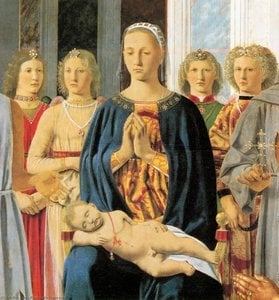
"Hercules" by Piero della Francesca is proportioned as a portrait work of 151 x 126 cm.
"Hercules" is a work of Renaissance. The movement indicates the artistic tradition the work is part of.
Piero della Francesca created "Hercules" within the Renaissance movement.

In the small, sun-drenched town of Sansepolcro, Piero di Benedetto de’ Franceschi lived a life shaped by the precise lines of his surroundings. His father worked with leather and wool, a trade that required a steady hand and an eye for detail. This early environment, far from the crowded workshops of larger cities, provided a foundation of stillness. He learned to see the world through the lens of order. Around 1439, he moved toward Florence, where the air was thick with new ways of seeing. There, he worked alongside Domenico Veneziano and studied the works of Masaccio in the Brancacci Chapel. He did not simply look at these paintings; he measured them. He took the innovations of Brunelleschi and broke them down into mathematical truths.
His hands moved between the brush and the compass. To him, a figure was as much a product of geometry as it was of anatomy. This way of working meant that light did not just fall upon a surface; it defined the volume of every limb and stone. He understood how a single vanishing point could pull a viewer into a deep, constructed space. His mind occupied the space between art and science, treating the canvas as a field for mathematical exploration.
Much of his work remains fixed to the walls of churches in Tuscany. In the Basilica of San Francesco in Arezzo, he spent years working on the cycle of frescoes known as The History of the True Cross. These scenes are not hurried. Each figure possesses a heavy, quiet dignity. He used light and shadow to give weight to the characters, making them feel as solid as the architecture surrounding them. In other works, like the Baptism of Christ, he used a restrained palette to create an atmosphere of clarity. The colors are not loud, yet they possess a luminous quality that seems to come from within the figures themselves.
His approach to composition relied on strict principles:
In the Montefeltro Altarpiece, his skill with oil painting allowed for a meticulous rendering of detail in the portraits of Federico da Montefeltro and Battista Sforza. He captured the texture of skin and the weight of fabric with a scientific precision. Even in his more recent works, such as The Nativity, he placed sacred scenes within a recognizable landscape, using the hills and rivers of the Tuscan countryside to ground the divine in the earthly.
Piero was also a writer, documenting his findings in De Prospectiva Pingendi. This treatise on perspective painting shows that his interest in math was not secondary to his art; it was the core of it. He wrote about how to use geometry to represent the three-dimensional world on a flat surface. His work bridged the gap between the older, more decorative Gothic traditions and the new, rational Renaissance style. He sought beauty through proportion and order.
He died in 1492, leaving behind a body of work that influenced those who followed, including Leonardo da Vinci and Raphael. They looked to his mastery of light and his ability to organize space with mathematical certainty. His paintings remain windows into a world where the spiritual and the rational exist in a state of permanent, quiet balance.

1415 - 1492 , Italy

Discover the timeless art of fresco painting. Explore the profound history, technical mastery of buon fresco, and the enduring legacy of Renaissance masters like Michelangelo in this expert guide to painting on wet plaster.

Explore the profound mastery of fresco painting, from the technical alchemy of buon fresco to the legendary narratives of Renaissance masters like Ghirlandaio. Discover how this timeless medium shaped art history and continues to inspire architectural grandeur today.

Embark on a sophisticated journey through the eternal allure of mythological art. Discover how master painters breathe life into ancient legends, from Greek deities to Baroque masterpieces, and learn to curate these timeless narratives within your own exquisite art collection.

 Send
Send Share
Share
 Details
 Guide
Guide

 Download
 Similars
 Diaporama
 Q&A
Q&A Stats
Stats Read More






































 Glass option is only available in size under 110 CM