Oil On PanelBaroque
 Early Modern
 33.0 x 32.0 cm
 Museo del Prado
Museum-quality giclée or canvas print with fast production and flexible finish options. ( Buy Hand Made Painting Switch to Digital Image)
Pick from our preset sizes that match the artwork's original proportions.

Type the width and the height you need, to fit your frame or your wall. A print can only be cut, never made bigger than the picture, so a size with a different shape loses a part of the image. We send you a digital mockup to approve before we print anything. The picture shown on this page does not show the real cut — only the mockup does.
Worldwide Delivery () in 2 weeks instead of standard 4/5 weeks. (23 October)
Two Horses
Reproduction Size
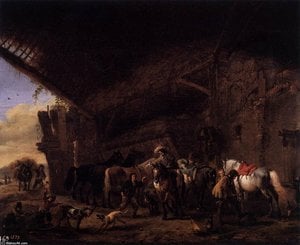
“Two Horses,” painted by Philips Wouwerman, is a captivating representation of 17th-century equestrian life, showcasing the artist's mastery of the Baroque style. Housed within the esteemed Museo del Prado in Madrid, Spain, this oil on panel painting (measuring 33 x 32 cm) transports viewers to a pastoral scene brimming with movement and detail.
Philips Wouwerman (1619-1668), born in Haarlem, Netherlands, was a celebrated Dutch painter renowned for his depictions of horses, hunting scenes, landscapes, and battle scenes. He stands as a significant figure within the artistic landscape of the Dutch Golden Age. Wouwerman’s skill lay in capturing the dynamism and grace of horses, often portraying them in lively action amidst picturesque settings. His works were highly sought after during his lifetime and continue to be admired for their technical brilliance and narrative charm.
The painting “Two Horses” features a pastoral scene with two horses being ridden across a field. The background showcases a landscape with rolling hills and clouds in the sky, adding depth to the scene. In the foreground, a dog runs alongside the horses, contributing to a sense of movement. Wouwerman’s technique is characterized by his attention to detail and skillful use of light and shadow – hallmarks of the Baroque style. The visible brushstrokes contribute to a textured surface, while the diffused lighting suggests an overcast day, casting soft shadows and highlighting the textures of clothing and horse coats. The artist employed impasto techniques, applying thick layers of paint to create a three-dimensional effect, enhancing the realism and vibrancy of the scene.
Beyond its aesthetic appeal, “Two Horses” carries symbolic weight. The horses themselves represent power, freedom, and nobility, while the landscape evokes a sense of tranquility and connection to nature. The inclusion of the dog symbolizes loyalty and companionship. The overall emotional impact is one of gentle movement and quiet observation – a snapshot of everyday life in 17th-century Netherlands. The scene could also be interpreted as representing themes of adventure or travel, inviting viewers to imagine the journey unfolding before them.
“Two Horses” reflects the popularity of equestrian subjects during the Dutch Golden Age, a period marked by economic prosperity and artistic innovation. Wouwerman’s paintings catered to a growing demand for genre scenes depicting everyday life and leisure activities among the burgeoning middle class. The painting's presence in the Museo del Prado underscores its historical significance and enduring appeal as a masterpiece of Baroque art.
"Two Horses" leans toward a golden yellow range tone.
"Two Horses" belongs to the Baroque movement, and its creator worked in the Early-Modern era.
The original "Two Horses" by Philips Wouwerman is held at the Museo del Prado, Madrid, Spain. A reproduction allows the work to be displayed at home.

Philips Wouwerman (baptized May 24, 1619 – died May 19, 1668) was a highly prolific and versatile Dutch painter renowned for his depictions of hunting scenes, landscapes, and battle scenes. He stands as a significant figure within the artistic landscape of the Dutch Golden Age.
Born in Haarlem, Netherlands, Philips Wouwerman was the son of Pouwels Joostsz Wouwerman, also a painter, though less known than his son. Details regarding his early artistic training are somewhat scarce. However, it is believed that he studied under Frans Hals (1581/85–1666), a prominent Haarlem portraitist. While Hals’s distinctive style did not heavily influence Wouwerman's mature work, the foundational training likely proved invaluable. Early in his career, Wouwerman was influenced by the *bamboccianti* tradition, particularly the works of Pieter van Laer (1592/99–after 1642), adopting their focus on everyday life and genre scenes.
Wouwerman’s works were highly sought after during his lifetime and continued to gain popularity in the 18th century. His paintings found their way into prominent collections across Europe, including those of princely houses in Dresden and St. Petersburg, demonstrating widespread admiration for his artistry.
Philips Wouwerman’s contribution to the Dutch Golden Age lies in his ability to capture a wide range of scenes – from bustling marketplaces and hunting expeditions to dramatic battlefields and tranquil landscapes – with remarkable detail and dynamism. His mastery of depicting horses, combined with his keen eye for anecdotal storytelling, solidified his place as one of the most celebrated and influential painters of his time. A retrospective exhibition in Kassel and The Hague (2009/2010) further highlighted his enduring legacy.

1619 - 1668 , Netherlands

Explore the captivating history of horses in painting! Discover Renaissance masterpieces, Baroque grandeur & expert insights for collecting equestrian art. Learn about symbolism, techniques & lasting value with WahooArt.

Journey through 10 Romantic landscape masterpieces by Friedrich, Turner & Cole. Explore emotional art, sublime nature scenes & iconic 19th-century paintings. Find museum-quality reproductions for your home at WahooArt.com – discover the full collection online!

Journey through John Constable's 25 most celebrated landscapes. Explore Romanticism, Dedham Vale & his masterful use of light in iconic paintings like 'Hay Wain'. Find museum-quality art reproductions and elevate your home decor on WahooArt.com.

Master the art of drama with our ultimate guide to Baroque landscapes. Discover the power of chiaroscuro, explore legendary masters, and learn how to curate epic, dark-vibe masterpieces for your collection with expert insights from WahooArt.

Journey through 25 Prado Museum masterpieces! Explore Velázquez, Goya & El Greco's iconic Spanish art. Discover the stories behind these timeless paintings and find museum-quality reproductions for your home at WahooArt.com.

 Preview
 Send
Send Share
Share
 Details
 Guide
Guide

 Download
 Similars
 X-Ray
X-Ray Diaporama
 Stats
Stats Read More






































 Glass option is only available in size under 110 CM