Oil On CanvasWallArtDutch Golden Age
 1665Early Modern
 64.0 x 88.0 cm
 Wallace Collection
Museum-quality giclée or canvas print with fast production and flexible finish options. ( Buy Hand Made Painting Switch to Digital Image)





























Pick from our preset sizes that match the artwork's original proportions.

You may enter your own dimensions to fit a specific frame or space. If your selected size does not match the original image's proportions, we will either crop the artwork or extend the image with a mirrored or solid-fill edge. A digital mockup will be sent for your approval before production begins.
Please note that the on-screen preview does not reflect the actual cropping or extension. Only the mockup will accurately show the final composition.
While custom sizes are available, we recommend selecting a dimension from the predefined list to preserve the original proportions.
Worldwide Delivery () in 2 weeks instead of standard 4/5 weeks. (8 September)


The Horse Fair
Reproduction Size
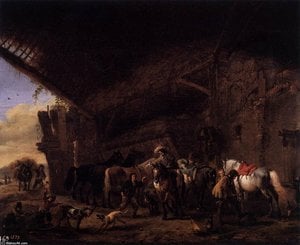
In the heart of the seventeenth century, amidst the burgeoning prosperity of the Netherlands, Philips Wouwerman captured a moment of vibrant, unbridled energy in his masterpiece, The Horse Fair. This expansive oil on canvas, dating from 1665, serves as more than just a depiction of commerce; it is a window into the soul of the Dutch Golden Age. As one gazes upon the scene, the viewer is immediately swept into a bustling open field where the rhythmic pulse of life is palpable. Wouwerman, a master of the genre, orchestrates a complex ballet of equine grace and human industry, creating a composition that feels both spontaneous and meticulously balanced. The sheer variety of horses—ranging from powerful, muscular stallions to more delicate breeds—adds a layer of dynamic tension, suggesting a world in constant motion, where every creature and character plays a vital role in the unfolding drama of the fair.
The technical brilliance of Wouwerman is most evident in his ability to render texture and light with breathtaking precision. Each brushstroke contributes to the tactile reality of the scene, from the shimmering coats of the horses to the heavy, period-specific fabrics worn by the gathered crowd. The artist employs a sophisticated palette that balances earthy, grounded tones with sudden bursts of brilliance, drawing the eye across the canvas in a choreographed journey. Notice how the overcast sky, filled with soft, billowing clouds, provides a diffused light that eliminates harsh shadows, allowing for a subtle interplay of luminosity across the landscape. This mastery of light not only defines the forms within the painting but also imbues the atmosphere with a sense of atmospheric depth, pulling the viewer toward the distant body of water and the quiet silhouettes of trees that anchor the horizon.
Beyond the aesthetic splendor, The Horse Fair functions as a rich social document. The figures scattered throughout the landscape—traders negotiating prices, riders guiding their mounts, and peasants carrying baskets—represent a cross-section of seventeenth-century society. There is a profound sense of narrative potential in every interaction; one can almost hear the low murmur of bartering voices and the heavy thud of hooves against the earth. Wouwering uses these human elements to ground his grander landscapes in a relatable, earthly reality. The inclusion of such detailed character studies elevates the work from a mere landscape to a genre painting of significant psychological depth, where the themes of trade, status, and the shared experience of the marketplace are explored through the lens of animal husbandry.
For the discerning collector or interior designer, this reproduction offers an unparalleled opportunity to introduce a sense of historical grandeur and classical elegance into a contemporary space. The painting’s ability to command attention while maintaining a harmonious presence makes it a versatile centerpiece for any curated collection. It evokes a feeling of timelessness, bridging the gap between the historical splendor of the Haarlem school and the sophisticated tastes of the modern era. To possess such a work is to hold a piece of art history that celebrates the beauty of movement, the dignity of labor, and the enduring allure of the natural world, making it an evocative choice for those looking to inspire awe and contemplation within their homes or galleries.

Philips Wouwerman (baptized May 24, 1619 – died May 19, 1668) was a highly prolific and versatile Dutch painter renowned for his depictions of hunting scenes, landscapes, and battle scenes. He stands as a significant figure within the artistic landscape of the Dutch Golden Age.
Born in Haarlem, Netherlands, Philips Wouwerman was the son of Pouwels Joostsz Wouwerman, also a painter, though less known than his son. Details regarding his early artistic training are somewhat scarce. However, it is believed that he studied under Frans Hals (1581/85–1666), a prominent Haarlem portraitist. While Hals’s distinctive style did not heavily influence Wouwerman's mature work, the foundational training likely proved invaluable. Early in his career, Wouwerman was influenced by the *bamboccianti* tradition, particularly the works of Pieter van Laer (1592/99–after 1642), adopting their focus on everyday life and genre scenes.
Wouwerman’s works were highly sought after during his lifetime and continued to gain popularity in the 18th century. His paintings found their way into prominent collections across Europe, including those of princely houses in Dresden and St. Petersburg, demonstrating widespread admiration for his artistry.
Philips Wouwerman’s contribution to the Dutch Golden Age lies in his ability to capture a wide range of scenes – from bustling marketplaces and hunting expeditions to dramatic battlefields and tranquil landscapes – with remarkable detail and dynamism. His mastery of depicting horses, combined with his keen eye for anecdotal storytelling, solidified his place as one of the most celebrated and influential painters of his time. A retrospective exhibition in Kassel and The Hague (2009/2010) further highlighted his enduring legacy.

1619 - 1668 , Netherlands

Embark on a sophisticated journey through the Dutch Golden Age. Unveil the dramatic brilliance of Rembrandt’s chiaroscuro and the expressive landscapes of 17th-century masters in this authoritative exploration of light, shadow, and enduring artistic legacy.

Explore the breathtaking mastery of Dutch Golden Age landscapes. From Italianate light to atmospheric realism, discover the techniques of 17th-century masters and learn how to bring these timeless, museum-quality masterpieces into your home through expert oil reproductions.

 Preview
 Send
Send Share
Share
 Details

 Download
 Similars
 X-Ray
X-Ray Diaporama
 Stats
Stats Read More







 Glass option is only available in size under 110 CM