

 Abstract Expressionism
 1975
1975 132.0 x 202.0 cm
Hand-painted oil on canvas in your size and frame, made to order by our artists. ( Switch to Print Switch to Digital Image)
Pick from our preset sizes that match the artwork's original proportions.

You may enter your own dimensions to fit a specific frame or space. If your selected size does not match the original image's proportions, we will either crop the artwork or extend the painting with additional hand-painted elements. A digital mockup will be sent for your approval before production begins.
Please note that the on-screen preview does not reflect the actual cropping or extension. Only the mockup will accurately show the final composition.
While custom sizes are available, we recommend selecting a dimension from the predefined list to preserve the original proportions.
Worldwide Delivery () in 3/4 weeks instead of standard 5 weeks. (27 September). No compromise on quality.


The Palette
Reproduction Size
Philip Guston’s “The Palette,” painted in 1975, is a monumental work that offers a raw and unsettling glimpse into the artist's creative process. This large-scale canvas (132 x 202 cm) transcends traditional representation, plunging viewers into a dreamlike studio environment brimming with color, form, and implied narrative. It’s a piece that resonates deeply within the realm of Abstract Expressionism while hinting at later figurative explorations.
The painting depicts what appears to be an artist's workspace—a chaotic jumble of tools, materials, and structures. The foreground is dominated by a tilted table covered in paint splatters, suggesting the immediacy and physicality of artistic creation. Behind this, a collection of wooden easels, frames, and discarded objects creates a sense of disarray. A sign reading "Musa" (likely referring to Guston's wife) adds a personal touch amidst the clutter. The composition lacks clear perspective or a focal point, contributing to a feeling of disorientation and unease. The horizontal format emphasizes the breadth of this imagined space.
“The Palette” firmly resides within the realm of Abstract Expressionism, characterized by its emphasis on spontaneous gesture and subjective emotion. Guston’s technique involves loose brushwork, layering of colors, and impasto application – a thick build-up of paint that creates texture and depth. Lines are gestural rather than precise, further enhancing the feeling of immediacy. However, unlike some purely abstract works, "The Palette" contains recognizable forms—the easels, frames, and even the sign—suggesting a transition towards Guston’s later figurative style. The colors – predominantly pinks, reds, and whites with accents of black, green, and yellow – are applied in broad strokes and washes, creating fluidity and movement.
The chaotic arrangement and muted color palette evoke a complex range of emotions. The disarray can be interpreted as representing the anxieties and struggles inherent in the creative process. The presence of "Musa" suggests inspiration, but its placement within this unsettling context implies that even sources of creativity can exist within a state of confusion or turmoil. The overall effect is introspective and unsettling, prompting viewers to contemplate the psychological landscape of an artist at work. Guston’s use of color contributes significantly to this emotional impact; the dominant pinks and reds create a sense of intensity and perhaps even unease, while the touches of black add weight and darkness.
“The Palette” was created in 1975, during a pivotal period in Guston’s career. Having initially gained recognition as an Abstract Expressionist, he famously abandoned abstraction in the late 1960s to pursue a raw and often satirical figurative style that explored themes of racism, identity, and political satire. While "The Palette" predates his most overtly figurative works, it foreshadows this shift by incorporating recognizable objects within an abstract framework. Born in Montreal, Canada (1913) and later becoming a prominent figure in the New York School, Guston’s artistic journey was marked by tragedy and constant evolution, making him one of the most important American artists of the 20th century.

Philip Guston was a renowned Canadian-American painter and printmaker whose career spanned over four decades. His artistic journey is marked by significant shifts in style and subject matter, blending elements of abstract expressionism and representational art to explore complex themes of racism, antisemitism, fascism, and American identity.
Guston's early life was profoundly impacted by tragedy. His father, a Ukrainian Jewish immigrant, took his own life in 1923. This event deeply affected Guston’s artistic development. He began drawing at a young age and attended Los Angeles Manual Arts High School, where he started painting in 1927. Supported by his mother, he often created art in a small closet with a hanging bulb.
Guston’s artistic career can be broadly divided into two distinct phases. Initially, his work was figurative and representational, showcasing early influences from Renaissance masters like Piero della Francesca. He later embraced abstraction, becoming a prominent figure in the New York School alongside artists like Jackson Pollock and Willem de Kooning.
Guston’s later works are perhaps the most controversial and impactful of his career. These paintings often featured dark, satirical elements, including drawings of Richard Nixon and hooded Klansmen. He explored themes of racism, antisemitism, and American identity with a raw honesty that challenged conventional artistic norms.
Philip Guston's legacy continues to inspire artists and art enthusiasts alike. His unique perspective and artistic style have left an indelible mark on the world of art.

1913 - 1980 , Canada

Explore 10 iconic paintings bathed in captivating light pink tones! From Monet's Impressionism to Renoir’s romance, discover the stories behind these blush-hued masterpieces. Find museum-quality art reproductions & decor inspiration at .

Journey through Wassily Kandinsky's 25 most iconic abstract paintings. Explore his revolutionary use of color, form & spiritual expressionism. Find museum-quality Kandinsky reproductions and elevate your home decor with WahooArt.com. Discover all masterpieces on WahooArt.com!

Explore the complex evolution of Philip Guston's art – from abstraction to raw figuration. Discover his powerful social commentary, lasting influence & collecting insights with WahooArt.
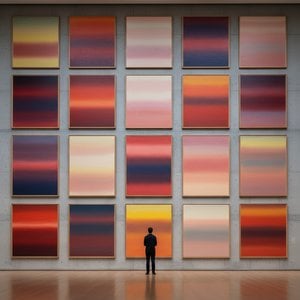
Explore 25 iconic Mark Rothko paintings that define Abstract Expressionism. Discover the stories, colors & emotions behind these masterpieces. Find museum-quality art reproductions and curated decor ideas at WahooArt.com.

Explore 10 defining Abstract Expressionism masterpieces by Pollock, Rothko & de Kooning. Discover the stories behind these iconic paintings and find museum-quality art reproductions to elevate your home decor on .

 Preview
 Send
Send Share
Share
 Details
 Guide
Guide

 Download
 Similars
 X-Ray
X-Ray Diaporama
 Stats
Stats Read More




































 Glass option is only available in size under 110 CM


