
x


Hand-painted oil on canvas in your size and frame, made to order by our artists. ( Buy Print Buy Image)





























Pick from our preset sizes that match the artwork's original proportions.

You may enter your own dimensions to fit a specific frame or space. If your selected size does not match the original image's proportions, we will either crop the artwork or extend the painting with additional hand-painted elements. A digital mockup will be sent for your approval before production begins.
Please note that the on-screen preview does not reflect the actual cropping or extension. Only the mockup will accurately show the final composition.
While custom sizes are available, we recommend selecting a dimension from the predefined list to preserve the original proportions.
Worldwide Delivery () in 3/4 weeks instead of standard 5 weeks. (28 August). No compromise on quality.


The last judgment
Reproduction Size

In the grand tapestry of nineteenth-century German art, few threads shine with as much spiritual intensity and monumental scale as those woven by Peter von Cornelius. A titan of Romantic muralism, Cornelius did not merely paint; he sought to resurrect a lost era of divine clarity. As a leading figure of the Nazarene movement, his work served as a bridge between the classical ideals of antiquity and a fervent, almost mystical, religious devotion. His artistic journey was one of profound purpose, driven by a desire to strip away the perceived decadence of his contemporary academic style in favor of the spiritual purity found in Byzantine iconography and the early Renaissance masters.
The foundations of this monumental career were laid in Düsseldorf, where the shadows of personal hardship met the light of artistic discovery. Following the untimely death of his father in 1799, the young Cornelius faced a future that seemed more suited to the practicalities of goldsmithing than the ethereal realms of fine art. Yet, bolstered by the unwavering support of his mother, he remained tethered to his creative calling. From the age of twelve, his talent was nurtured within the halls of the Düsseldorf Academy, where he began to master the precise, linear style that would become his hallmark. This early discipline provided him with the technical vocabulary necessary to translate complex theological and literary themes into sweeping, visual epics.
Cornelius’s true ascendancy arrived when he turned his gaze toward the monumental task of fresco painting, a medium that demands both physical endurance and a mastery of light. His breakthrough at the St. Quirinus Church in Neuss signaled the arrival of a master capable of transforming architectural spaces into celestial windows. Nowhere is this more evident than in his celebrated works for the Ludwigskirche in Munich. In these frescoes, Cornelius achieved a seamless fusion of classical structure and religious fervor, creating environments where the viewer feels suspended between the earthly and the divine.
Beyond the walls of churches, Cornelius found profound inspiration in the literary giants of his age. His deep engagement with Goethe’s epic poems, particularly Faust and Der Ring des Nibelungen, allowed him to explore the human condition through a lens of mythic grandeur. He possessed a rare ability to capture the psychological depth of these characters, using a distinctive linear approach that emphasized clarity and emotional resonance. Whether interpreting the biblical drama of Joseph in Egypt or the apocalyptic tension of the Riders of the Apocalypse, his work always sought to find the eternal within the temporal.
The technical brilliance of Cornelius lies in his ability to manipulate medium and method to serve his spiritual narrative. In works such as Joseph interpreting Pharaoh’s dreams, he utilized the delicate, translucent layers of tempera to create a luminous quality that breathes life into architectural grandeur. His compositions often employed a classical pyramidal arrangement, a technique designed to direct the eye upward, mirroring the ascent of the soul toward enlightenment. This meticulous application of pigment allowed for a refined, matte texture that evoked the timelessness of ancient mosaics.
The historical significance of Peter von Cornelius extends far beyond his individual masterpieces. He was a catalyst for a movement that redefined German visual culture, influencing generations of artists, including sculptors like August von Kreling. His legacy is defined by several key contributions:
Today, the works of Peter von Cornelius remain as powerful as they were in the nineteenth century. They stand as a testament to a period when art was viewed not just as an aesthetic pursuit, but as a profound vocation—a way to capture the very breath of the divine upon the canvas of history.

1783 - 1867

Explore the profound artistry of The Last Supper through an art historian's lens. From Leonardo da Vinci’s genius to diverse Renaissance interpretations, discover the symbolism and technique behind history's most iconic sacred depictions.

Explore the profound beauty of religious processions in art history. From Baroque drama to spiritual transcendence, discover how masters captured faith. WahooArt.com offers exquisite, hand-painted oil reproductions for discerning collectors seeking timeless grandeur.

Embark on a sophisticated journey through art history with our exploration of Saint Peter's most powerful masterpieces. Discover the profound emotional depth and technical brilliance of Renaissance and Baroque icons, curated for the discerning classic art enthusiast.

Explore the profound power of religious symbolism in art history. From Renaissance masterpieces to sacred iconography, uncover the hidden meanings behind divine details in a deep dive into classical art excellence.
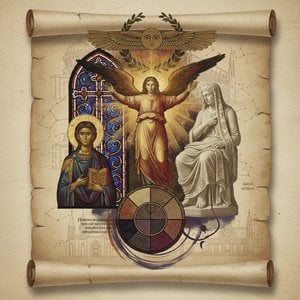
Explore the profound impact of spiritual themes in fine art. From Renaissance iconography to Baroque drama, discover how sacred symbolism and divine visions have shaped art history through a scholarly and reflective lens.


Stay updated with the latest art news, exclusive offers, and decoration ideas.
Tell us about your project and our art experts will provide you with 3 personalized art suggestions.
Let Us Curate 3 Options Just for You - Free!

 Preview
 Send
Send Share
Share
 Details

 Download
 Similars
 X-Ray
X-Ray Diaporama
 Read More







 Glass option is only available in size under 110 CM


