Preview AR preview Buy Hand Made Painting Switch to Digital Image Send
Details Guide Add to favorites Download Similars X-Ray Diaporama Stats

Concrete Cabin

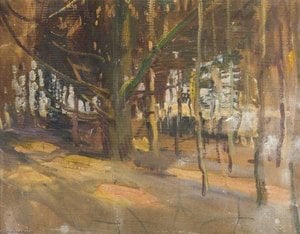
Peter Doig's 'Concrete Cabin' (1992) blends nature & human presence. A forest scene with twisted trees and a stark concrete structure creates an intriguing narrative of memory, landscape, and the transient impact on our environment.

Peter Doig (b. 1959) is a celebrated Scottish painter known for evocative landscapes & figurative work inspired by memory, photography, and art history. His dreamlike scenes of Canada & Trinidad define his contemporary style.

The artwork displayed on this page is protected by copyright law, which means we cannot legally create or sell an identical reproduction. This protection is enforced under international agreements such as the Berne Convention and by national laws, including those outlined by the U.S. Copyright Law - Title 17.

This method fully complies with copyright regulations because it does not involve copying or duplicating the protected artwork. Instead, it is a creative reinterpretation - a new painting that is influenced by the original but not identical to it.

Giclée / Art Print

Museum-quality giclée or canvas print with fast production and flexible finish options. ( Buy Hand Made Painting Switch to Digital Image)

Corner sample of the P118B picture frame: moulded polystyrene, 5 cm wide and 3 cm thick
P118B $10
Corner sample of the P118H picture frame: moulded polystyrene, 5 cm wide and 3 cm thick
P118H $10
Corner sample of the P118W picture frame: moulded polystyrene, 5 cm wide and 3 cm thick
P118W $10
Corner sample of the P438Z picture frame: moulded polystyrene, 5.5 cm wide and 3.5 cm thick
P438Z $10
Corner sample of the P508JH picture frame: moulded polystyrene, 7 cm wide and 3.5 cm thick
P508JH $12
Corner sample of the P508YH picture frame: moulded polystyrene, 7 cm wide and 3.5 cm thick
P508YH $12
Corner sample of the P805H picture frame: moulded polystyrene, 5 cm wide and 3.5 cm thick
P805H $10
Corner sample of the P805Z picture frame: moulded polystyrene, 5 cm wide and 3.5 cm thick
P805Z $10
Corner sample of the P919BZ picture frame: moulded polystyrene, 7 cm wide and 3.5 cm thick
P919BZ $10
Corner sample of the P919G picture frame: moulded polystyrene, 7 cm wide and 3.5 cm thick
P919G $10
Corner sample of the P919XJ picture frame: moulded polystyrene, 7 cm wide and 3.5 cm thick
P919XJ $10
Corner sample of the P959ZH picture frame: moulded polystyrene, 5 cm wide and 3 cm thick
P959ZH $10
Corner sample of the P968JZ picture frame: moulded polystyrene, 6 cm wide and 4 cm thick
P968JZ $12
Corner sample of the W106C picture frame: solid wood, 5 cm wide and 3 cm thick
W106C $8
Corner sample of the W218G picture frame: solid wood, 5 cm wide and 3 cm thick
W218G $10
Corner sample of the W218JH picture frame: solid wood, 5 cm wide and 3 cm thick
W218JH $8
Corner sample of the W218Y picture frame: solid wood, 5 cm wide and 3 cm thick
W218Y $10
Corner sample of the W307PJ picture frame: solid wood, 6 cm wide and 3 cm thick
W307PJ $10
Corner sample of the W316G picture frame: solid wood, 6 cm wide and 3 cm thick
W316G $10
Corner sample of the W316PJ picture frame: solid wood, 6 cm wide and 3 cm thick
W316PJ $8
Corner sample of the W316Y picture frame: solid wood, 6 cm wide and 3 cm thick
W316Y $10
Corner sample of the W398PJ picture frame: solid wood, 5 cm wide and 3 cm thick
W398PJ $8
Corner sample of the W4111J picture frame: solid wood, 6.5 cm wide and 3.5 cm thick
W4111J $10
Corner sample of the W500HY picture frame: solid wood, 7 cm wide and 5 cm thick
W500HY $15
Corner sample of the W500JH picture frame: solid wood, 7 cm wide and 5 cm thick
W500JH $15
Corner sample of the W692G picture frame: solid wood, 8 cm wide and 4 cm thick
W692G $12
Corner sample of the W849H picture frame: solid wood, 5 cm wide and 3 cm thick
W849H $8
Corner sample of the W940BG picture frame: solid wood, 7.5 cm wide and 4.5 cm thick
W940BG $15
Corner sample of the W953PJ picture frame: solid wood, 6 cm wide and 3.5 cm thick
W953PJ $8

Standard
custom
CM
INCH

Pick from our preset sizes that match the artwork's original proportions.

width
height

Type the width and the height you need, to fit your frame or your wall. A print can only be cut, never made bigger than the picture, so a size with a different shape loses a part of the image. We send you a digital mockup to approve before we print anything. The picture shown on this page does not show the real cut — only the mockup does.

Worldwide Delivery () in 2 weeks instead of standard 4/5 weeks. (24 October)

Free Worldwide Express Shipping
High-Quality Linen Canvas
Full Shipping Insurance
Customs Tax Refund Guarantee
True Color Matching Guarantee
100-Day Return Policy (Defects Only)
100% Money-Back Guarantee
Bulk Discount Offer

Total Price

$ 69

Concrete Cabin

Giclée / Art Print

Reproduction Size

-

Total Price

$ 69

Quick Facts

  • Dimensions: 201 x 241 cm
  • Subject or theme: Nature and human habitation
  • Medium: Oil on canvas
  • Title: Concrete Cabin
  • Notable elements or techniques:
    • Twisted tree trunks
    • Dense foliage
    • Contrast of natural/man-made

Concrete Cabin: A Landscape of Memory and Modernity

Peter Doig’s "Concrete Cabin," painted in 1992, is more than just a depiction of a forest scene; it's an exploration of memory, the interplay between nature and human intervention, and the subtle anxieties of modernity. The canvas presents a dense woodland, rendered with a distinctive looseness that evokes both the vibrancy of Impressionism and the unsettling ambiguity of Magic Realism. Towering trees, their trunks twisted and gnarled like ancient sentinels, dominate the foreground, painted in deep browns and blacks punctuated by hints of decay – a visual testament to the relentless passage of time and the forces of nature. The background dissolves into a tapestry of greens, suggesting an impenetrable canopy that stretches far beyond the viewer's gaze. This isn’t merely a representation of a forest; it’s a feeling—a sense of being enveloped by something vast, ancient, and slightly unknowable.

The Intrusion of the Man-Made

What truly sets "Concrete Cabin" apart is its unexpected element: a stark concrete structure nestled amongst the trees. This isn't a rustic log cabin blending seamlessly into its surroundings; it’s a blocky, almost brutalist form that clashes with the organic curves and textures of the forest. The contrast is deliberate, highlighting the uneasy relationship between humanity and the natural world. It speaks to our tendency to impose order and structure onto landscapes, often at the expense of their inherent wildness. Is this a refuge? A symbol of isolation? Or perhaps a commentary on the encroachment of modern life upon pristine environments? Doig offers no easy answers, leaving the interpretation open to the viewer's own experiences and anxieties. The concrete itself is rendered with more rigid lines and solid blocks of color than the surrounding foliage, emphasizing its artificiality and further amplifying the sense of discord.

Doig’s Technique: Evoking Atmosphere Through Paint

Doig’s artistic technique plays a crucial role in conveying the painting's emotional weight. He employs a distinctive layering of paint, allowing brushstrokes to remain visible—a hallmark of his style. This isn’t about meticulous detail; it’s about capturing the *essence* of the scene through texture and color. The loose application of paint creates a sense of movement and vitality, as if the forest itself is breathing. Light filters through the canopy in dappled patterns, adding depth and dimension to the composition. Doig's use of color isn't purely representational; he manipulates hues to evoke specific moods—the somber browns and blacks conveying a sense of mystery and introspection, while the vibrant greens suggest both life and an underlying tension. The overall effect is one of atmospheric immersion – drawing the viewer into the heart of this enigmatic landscape.

A Landscape Rooted in Memory and Place

Born in Edinburgh but shaped by his experiences living in Trinidad and Canada, Doig’s work often draws upon personal memories and a sense of displacement. "Concrete Cabin" can be seen as reflecting these themes—a meditation on the places that linger within us long after we've left them. The painting isn't necessarily about a specific location; it's about the feeling of being both connected to and alienated from one’s surroundings. It resonates with a broader sense of unease about our place in the world, particularly as we grapple with the consequences of environmental change and the relentless march of progress. Ultimately, "Concrete Cabin" is a powerful and evocative work that invites us to contemplate the complex relationship between humanity, nature, and memory—a timeless theme rendered with remarkable skill and sensitivity by one of contemporary art's most compelling voices.

Questions & Answers

How does "Concrete Cabin" balance light and dark?

"Concrete Cabin" is deep_shadow overall, and its luminance is dark.

What is the dominant hue of "Concrete Cabin" by Peter Doig?

The dominant hue of "Concrete Cabin" by Peter Doig is green to violet spectrum. The hue is the underlying tone of the palette.

What subject and atmosphere does "Concrete Cabin" by Peter Doig combine?

"Concrete Cabin" by Peter Doig combines forest, cabin, landscape, trees, concrete, shelter, nature, perspective with a serene atmosphere.


Artist Biography

A Life Painted in Memory: The World of Peter Doig

Peter Doig, born in Edinburgh in 1959, is a painter whose work resonates with a quiet power—a haunting beauty that stems from the delicate balance between memory, landscape, and the evocative potential of paint itself. His life has been one of constant relocation, a nomadic existence that profoundly shaped his artistic vision. Early moves took him from Scotland to Trinidad in 1962, followed by Canada in 1966, each shift imprinting upon his developing sensibility a sense of displacement and a fascination with the way places linger within us long after we’ve left them. These weren't fleeting visits; they were immersive experiences that instilled a deep connection to diverse cultural landscapes—the lush tropicality of Trinidad, the stark, snowy vistas of Canada—both becoming recurring motifs in his art. This early exposure fostered an ability to see beyond the literal, to perceive the emotional weight and psychological resonance embedded within a place. Doig’s formal artistic training began in London, attending Wimbledon School of Art, Saint Martin’s School of Art, and finally Chelsea School of Art where he earned his MA. These years were supplemented by practical work, including a period as a dresser at the English National Opera, experiences that undoubtedly broadened his understanding of performance, narrative, and visual storytelling.

The Alchemy of Influence and Artistic Development

Doig’s artistic journey wasn't one of immediate stylistic declaration but rather a gradual unfolding, an exploration of figurative painting that evolved into the distinctive, dreamlike quality for which he is now celebrated. He doesn’t adhere to any single school or movement; instead, his work feels like a synthesis of diverse influences, absorbed and transformed through the lens of personal experience. The echoes of earlier masters are palpable—the melancholic landscapes of Edvard Munch, the raw intensity of H.C. Westermann, the romantic sublimity of Caspar David Friedrich, the shimmering light of Claude Monet, and the decorative richness of Gustav Klimt all find resonance in his canvases. However, Doig doesn’t simply imitate; he *reinterprets*. He draws inspiration from a wide array of sources—photographs, newspaper clippings, film stills, record album covers—but these aren't used as blueprints for replication. Rather, they serve as catalysts, sparking points for paintings that are less about accurate representation and more about emotional evocation. Doig describes his process as painting “by proxy,” using photographs as starting points but allowing memory and imagination to take over, resulting in images that feel both familiar and strangely distant. This approach allows him to tap into a deeper level of psychological truth, creating landscapes that are not merely seen but *felt*.

Landscapes of the Mind: Themes and Characteristics

At the heart of Doig’s work lies an exploration of what it means to remember a place. His paintings aren't straightforward depictions of specific locations; they are emotional responses, filtered through the haze of memory and imagination. Many evoke a sense of nostalgia, particularly those landscapes reminiscent of his Canadian childhood—snowy forests, frozen lakes, isolated cabins—but these scenes are imbued with an unsettling quality, a hint of mystery that prevents them from becoming overly sentimental. Human figures often appear in his paintings, but they are rarely central or clearly defined. They tend to be solitary, ambiguous, contributing to the overall mood of introspection and quiet contemplation. Doig’s technique is equally crucial to the impact of his work. His canvases are characterized by complex layering of paint and color, creating a sense of depth and atmosphere. He skillfully blends abstraction and figuration, allowing forms to dissolve into washes of color or emerge from textured surfaces. This creates a visual tension that invites viewers to engage with the work on multiple levels—to appreciate both its formal qualities and its emotional resonance. The result is paintings that feel simultaneously grounded in reality and suspended in a dreamlike state.

Recognition and Lasting Legacy

Doig’s talent was recognized early in his career, culminating in winning the prestigious Whitechapel Artist Prize in 1991 and a solo exhibition at the Whitechapel Art Gallery. However, it was the sale of “White Canoe” at Sotheby’s in 2007 for $11.3 million—a record for a living European artist at the time—that brought him widespread attention. This was followed by another significant auction success with "The Architect's Home in the Ravine" selling for $12 million in 2013, solidifying his position as one of the most sought-after contemporary painters. Major solo exhibitions have been held at prominent institutions worldwide, including Tate Britain, Musée d’Art Moderne de la Ville de Paris, Schirn Kunsthalle Frankfurt, Dallas Museum of Art, and the Scottish National Gallery, demonstrating the global reach of his influence. Today, Peter Doig is considered one of the most important figurative painters working today. His work has had a profound impact on contemporary art, inspiring a new generation of artists to explore the possibilities of painting as a means of expressing personal experience and emotional truth. As critic Jonathan Jones aptly observed, he is “a jewel of genuine imagination, sincere work and humble creativity” in a world often dominated by pretension. Doig continues to live and work in Trinidad, maintaining a studio at the Caribbean Contemporary Arts Centre and teaching at the Fine Arts Academy in Düsseldorf, Germany, ensuring his ongoing exploration of memory, landscape, and figuration will continue to shape the course of art history for years to come.
Peter Doig

Peter Doig

1959 - , United Kingdom

Quick Facts

  • Full Name: Peter Doig
  • Nationality: Scottish
  • Date Of Birth: 1959
  • Place Of Birth: Edinburgh, United Kingdom
  • Notable Artworks:
    • White Canoe
    • Ski Jacket
    • Border House
  • Artistic Movement Or Style: Figurative painting
  • Artists Who Influenced This Artist:
    • Edvard Munch
    • Caspar David Friedrich
    • Claude Monet
  • Artists Or Movements Influenced By This Artist: Contemporary painting
Explore artworks organized by themes, styles, and characteristics.