
x


Museum-quality giclée or canvas print with fast production and flexible finish options. ( Buy Hand Made Painting Buy Image)
Pick from our preset sizes that match the artwork's original proportions.

You may enter your own dimensions to fit a specific frame or space. If your selected size does not match the original image's proportions, we will either crop the artwork or extend the image with a mirrored or solid-fill edge. A digital mockup will be sent for your approval before production begins.
Please note that the on-screen preview does not reflect the actual cropping or extension. Only the mockup will accurately show the final composition.
While custom sizes are available, we recommend selecting a dimension from the predefined list to preserve the original proportions.
Worldwide Delivery () in 2 weeks instead of standard 4/5 weeks. (30 August)


Unframed #3
Reproduction Size
Pedro Cabrita Reis’s “Unframed #3,” created in 2008, isn't merely an installation; it’s a carefully orchestrated meditation on space, light, and the very nature of representation. The artwork presents a deceptively simple composition: two stark white panels mounted on a neutral wall, their surfaces mirroring each other with unsettling precision. Yet, within this apparent austerity lies a profound depth, inviting viewers to contemplate the interplay between emptiness and presence, silence and form.
The piece emerged from Reis’s ongoing exploration of minimalism, a movement he embraces not as an end in itself, but as a rigorous framework for stripping away extraneous elements. The panels themselves, likely constructed from polished metal or perhaps even glass, reflect the surrounding environment with startling clarity, blurring the boundaries between artwork and its context. The deliberate use of negative space—the vast areas of wall visible between the panels—becomes almost sculptural in its effect, demanding attention and prompting questions about what is *not* there.
Reis’s approach to “Unframed #3” is characterized by a fascinating dialogue between industrial precision and an underlying sense of organic form. The panels, with their smooth, reflective surfaces, suggest a manufactured origin—a testament to the artist's engagement with contemporary materials and processes. However, the subtle variations in tone – slight shifts in reflectivity caused by lighting – hint at a more nuanced, almost tactile quality. Cables, running from the base of each panel to the floor, introduce an element of mechanical complexity, grounding the piece in a world of infrastructure and connection.
The installation’s execution speaks to Reis's meticulous attention to detail. The panels are positioned with exacting accuracy, creating a sense of balance and symmetry that is both visually arresting and subtly unsettling. The use of fluorescent lights behind the panels casts a soft, diffused glow, further enhancing the sense of depth and highlighting the reflective surfaces. This careful orchestration of light and material contributes significantly to the artwork’s overall impact.
“Unframed #3” can be understood within the broader context of minimalist art, a movement that emerged in the 1960s as a reaction against the excesses of Abstract Expressionism. Minimalist artists sought to reduce art to its essential components—form, color, and space—rejecting narrative content and emotional expression. Reis’s work aligns with this tradition while simultaneously pushing beyond it, exploring the philosophical implications of minimalism through a carefully considered installation.
The late 20th century witnessed a significant shift in the role of art within society. Artists began to question traditional notions of artistic value and authorship, engaging with issues of institutional critique and public space. “Unframed #3” reflects this broader cultural dialogue, inviting viewers to reconsider their relationship to art and its place in the world.
Despite its apparent simplicity, “Unframed #3” is rich in symbolic meaning. The blank panels can be interpreted as representations of potentiality—empty canvases awaiting definition—or perhaps as a reflection on the absence of inherent meaning. The mirrors create an unsettling sense of self-awareness, forcing viewers to confront their own reflections and consider their role within the artwork’s composition.
Ultimately, “Unframed #3” is not intended to provide answers but rather to provoke questions. It's a space for contemplation—a quiet invitation to engage with the fundamental elements of art and our understanding of the world around us. The piece evokes feelings of calmness, introspection, and perhaps even a subtle sense of unease, prompting viewers to consider the beauty and complexity that can be found in simplicity.


1956 - , Portugal

Embark on a sophisticated journey through art history's most captivating masterpieces of reflection. Explore how legendary artists used mirrors to explore identity, surrealism, and the soul through expert art historical analysis.
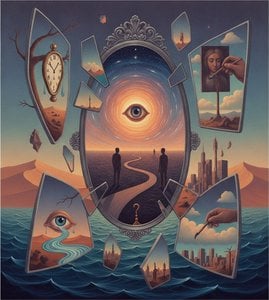
Explore the profound symbolism of mirror art through a journey of Surrealist mastery. From Dalí's fractured realities to technical brilliance, discover how reflections redefine art history and inspire sophisticated modern collections.

Explore the profound symbolism of mirrors in fine art history. From Surrealist distortions to Vanitas themes, discover how masters use reflections to capture reality and the metaphysical soul.

Explore the profound elegance of minimalist art. Discover how the precision of a single line transforms simple geometry into timeless masterpieces for the discerning collector seeking sophistication and depth in fine art acquisitions.

Explore the profound symbolism of mirror images in fine art. From Surrealist distortions to classical self-portraits, discover how masters use reflections to explore reality, identity, and the infinite through a sophisticated art-historical lens.


Stay updated with the latest art news, exclusive offers, and decoration ideas.
Tell us about your project and our art experts will provide you with 3 personalized art suggestions.
Let Us Curate 3 Options Just for You - Free!


 Send
Send Share
Share
 Details

 Download
 Similars
 Diaporama


 Read More




































 Glass option is only available in size under 110 CM


