Artwork Description
The Haunting Stillness of “The Diving Stage”
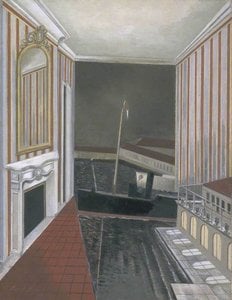
Paul Nash’s “The Diving Stage,” painted in 1928, isn't merely a depiction of a seaside structure; it’s a meticulously crafted tableau of isolation, anticipation, and the unsettling beauty of suspended time. Emerging from the British Council Collection, this work transcends its subject matter to become a profound meditation on human presence within a vast, indifferent landscape. The painting immediately commands attention with its monochromatic palette – a symphony of greys, whites, and muted blues that evokes both the cold expanse of the sea and the melancholic atmosphere of a forgotten place. This restrained color scheme isn’t limiting, however; it amplifies the subtle textures and layering techniques employed by Nash, creating an illusion of depth and surface detail that draws the viewer into the scene. The composition is dominated by the stark verticality of the diving platform, a geometric intrusion upon the blurred, amorphous background – a visual metaphor for humanity's attempt to impose order on the chaotic nature of existence.
A Surrealist Echo in Modernism
Nash’s artistic lineage is complex and fascinating, drawing heavily from both the traditions of British landscape painting and the burgeoning currents of Surrealism. Influenced by the Romantic landscapes of J.M.W. Turner and the visionary poetry of William Blake, Nash sought to capture not just the outward appearance of a place but also its underlying emotional resonance. This is particularly evident in his early works depicting ancient hill forts and burial mounds – sites imbued with layers of history and myth. “The Diving Stage,” however, moves beyond simple representation, embracing a distinctly modernist sensibility. The flattened perspective, simplified forms, and deliberate ambiguity align it with the principles of Surrealism, while simultaneously retaining a grounding in the formal concerns of Modernist painting. Nash’s use of strong, angular lines to define the diving platform contrasts sharply with the softer, more diffused lines that suggest the distant landscape, creating a dynamic tension between structure and atmosphere. The absence of any human figures further reinforces this sense of detachment and isolation.
Technique and Materiality: A Layered Masterpiece
The painting’s power lies not only in its conceptual depth but also in the skillful execution of its technique. Nash masterfully employed layering washes and dry brushstrokes to build up subtle tonal variations and textures, giving the surface a remarkable richness and complexity. The rough wood of the diving deck is suggested through carefully applied strokes, while the smooth surface of the water receives a delicate glazing that captures its reflective qualities. The choice of watercolor or gouache – materials known for their transparency and ability to create nuanced color effects – contributes significantly to the painting’s ethereal quality. Close examination reveals a meticulous attention to detail, from the subtle shifts in tone on the platform's surface to the atmospheric perspective used to render the distant landscape. This combination of technical skill and artistic sensitivity elevates “The Diving Stage” beyond a simple depiction of a seaside scene; it becomes a testament to Nash’s mastery of his chosen medium.
Symbolism and Emotional Resonance
“The Diving Stage” is rich in symbolic meaning, inviting multiple interpretations. The diving platform itself can be seen as a metaphor for human ambition – our desire to conquer the unknown, to reach beyond the limitations of our earthly existence. Yet, the stage remains unfinished, abandoned, suggesting a sense of thwarted potential or perhaps even a recognition of the futility of such endeavors. The solitary figure on the edge of the platform embodies vulnerability and anticipation, poised on the brink of an uncertain future. The muted color palette and desolate landscape contribute to a pervasive feeling of isolation and melancholy, while the geometric precision of the structure hints at a longing for order in a world that often feels chaotic and unpredictable. Ultimately, “The Diving Stage” is not simply a painting; it’s a poignant exploration of the human condition – our aspirations, our anxieties, and our relationship to the vastness of the natural world. It leaves the viewer with a lingering sense of quiet contemplation, prompting reflection on themes of solitude, uncertainty, and the enduring power of art to capture the complexities of the human experience.