
Preview AR preview Switch to Print Switch to Digital Image Send
Details Guide Add to favorites Download Similars X-Ray Diaporama Stats

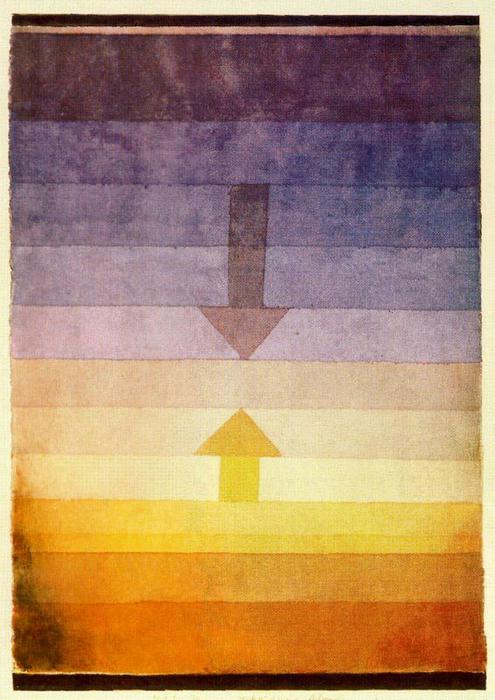
Evening separation

Experience the vibrant hues of Paul Klee's 'Evening Separation,' a mesmerizing sunset landscape rendered in bold blues, oranges, and yellows—a testament to his masterful use of color and form.

Paul Klee blended Expressionism and Cubism in works like Ships in the Dark. Discover his vibrant world of color and form today.

Hand Made Oil Reproduction

Hand-painted oil on canvas in your size and frame, made to order by our artists. ( Switch to Print Switch to Digital Image)

Corner sample of the P118B picture frame: moulded polystyrene, 5 cm wide and 3 cm thick
P118B $10
Corner sample of the P118H picture frame: moulded polystyrene, 5 cm wide and 3 cm thick
P118H $10
Corner sample of the P118W picture frame: moulded polystyrene, 5 cm wide and 3 cm thick
P118W $10
Corner sample of the P438Z picture frame: moulded polystyrene, 5.5 cm wide and 3.5 cm thick
P438Z $10
Corner sample of the P508JH picture frame: moulded polystyrene, 7 cm wide and 3.5 cm thick
P508JH $12
Corner sample of the P508YH picture frame: moulded polystyrene, 7 cm wide and 3.5 cm thick
P508YH $12
Corner sample of the P805H picture frame: moulded polystyrene, 5 cm wide and 3.5 cm thick
P805H $10
Corner sample of the P805Z picture frame: moulded polystyrene, 5 cm wide and 3.5 cm thick
P805Z $10
Corner sample of the P919BZ picture frame: moulded polystyrene, 7 cm wide and 3.5 cm thick
P919BZ $10
Corner sample of the P919G picture frame: moulded polystyrene, 7 cm wide and 3.5 cm thick
P919G $10
Corner sample of the P919XJ picture frame: moulded polystyrene, 7 cm wide and 3.5 cm thick
P919XJ $10
Corner sample of the P959ZH picture frame: moulded polystyrene, 5 cm wide and 3 cm thick
P959ZH $10
Corner sample of the P968JZ picture frame: moulded polystyrene, 6 cm wide and 4 cm thick
P968JZ $12
Corner sample of the W106C picture frame: solid wood, 5 cm wide and 3 cm thick
W106C $8
Corner sample of the W218G picture frame: solid wood, 5 cm wide and 3 cm thick
W218G $10
Corner sample of the W218JH picture frame: solid wood, 5 cm wide and 3 cm thick
W218JH $8
Corner sample of the W218Y picture frame: solid wood, 5 cm wide and 3 cm thick
W218Y $10
Corner sample of the W307PJ picture frame: solid wood, 6 cm wide and 3 cm thick
W307PJ $10
Corner sample of the W316G picture frame: solid wood, 6 cm wide and 3 cm thick
W316G $10
Corner sample of the W316PJ picture frame: solid wood, 6 cm wide and 3 cm thick
W316PJ $8
Corner sample of the W316Y picture frame: solid wood, 6 cm wide and 3 cm thick
W316Y $10
Corner sample of the W398PJ picture frame: solid wood, 5 cm wide and 3 cm thick
W398PJ $8
Corner sample of the W4111J picture frame: solid wood, 6.5 cm wide and 3.5 cm thick
W4111J $10
Corner sample of the W500HY picture frame: solid wood, 7 cm wide and 5 cm thick
W500HY $15
Corner sample of the W500JH picture frame: solid wood, 7 cm wide and 5 cm thick
W500JH $15
Corner sample of the W692G picture frame: solid wood, 8 cm wide and 4 cm thick
W692G $12
Corner sample of the W849H picture frame: solid wood, 5 cm wide and 3 cm thick
W849H $8
Corner sample of the W940BG picture frame: solid wood, 7.5 cm wide and 4.5 cm thick
W940BG $15
Corner sample of the W953PJ picture frame: solid wood, 6 cm wide and 3.5 cm thick
W953PJ $8

Standard
custom
CM
INCH

Pick from our preset sizes that match the artwork's original proportions.

width
height

Type the width and the height you need, to fit your frame or your wall. This is hand-painted, so for a size with a different shape the artist can paint a bit more around the picture, or cut a bit — you choose. We send you a digital mockup to approve before the painting starts. The picture shown on this page does not show the real result — only the mockup does.

Examples of what can be changed: Replace face with customer photo; Add pet (e.g., replace cat with dog); Include hidden message in background; Change background landscape or elements.
After order, WahooArt.com team will email client for instructions and provide a mockup preview

Worldwide Delivery () in 3/4 weeks instead of standard 5 weeks. (21 October). No compromise on quality.

Free Worldwide Express Shipping
High-Quality Linen Canvas
Full Shipping Insurance
Customs Tax Refund Guarantee
True Color Matching Guarantee
100-Day Return Policy (Defects Only)
100% Money-Back Guarantee
Bulk Discount Offer

Total Price

$ 272

Evening separation

Reproduction Medium

Reproduction Size

-

Total Price

$ 272

Quick Facts

  • Medium: Watercolor and gouache on paper
  • Subject or theme: Landscape
  • Location: Private Collection
  • Notable elements or techniques: Arrow motif, Color layering
  • Movement: Expressionism

A Symphony of Color and Emotion: Exploring Paul Klee’s “Evening Separation”

Paul Klee's "Evening Separation" stands as a testament to the artist’s singular vision—a mesmerizing blend of abstraction and lyrical expression that continues to captivate audiences decades after its creation. Painted sometime between 1937 and 1940, during his prolific period in Murnau, Bavaria, this artwork embodies Klee's unwavering commitment to distilling emotion into visual form, prioritizing feeling over precise representation. The painting’s deceptively simple composition belies a profound depth of artistic intention, inviting viewers to contemplate its layered meanings and masterful execution.

The Visual Language of Surrealism

Klee firmly established himself as a pioneer of Surrealist aesthetics without ever formally affiliating with the movement. “Evening Separation” exemplifies this stylistic approach through its dreamlike quality—a landscape rendered in muted hues dominated by yellows, blues, purples, and oranges that coalesce into an ethereal glow. The artist eschews traditional perspective, opting instead for flattened planes and overlapping shapes that create a sense of spatial ambiguity. This deliberate distortion serves not to deceive but to liberate the imagination, encouraging contemplation of subconscious associations and emotional resonance. The prominent arrow pointing upwards—a recurring motif in Klee’s work—acts as a visual anchor, guiding the eye upward while simultaneously symbolizing aspiration and transcendence.

Technique and Material Considerations

Klee employed his signature technique – watercolor and gouache on paper – to achieve remarkable luminosity and textural variation. Watercolor provides an initial wash of color, establishing the foundational hues of the sunset backdrop, followed by layers of gouache that add depth and solidity to certain areas, particularly around the central arrow. The artist’s meticulous brushwork contributes to a surface finish characterized by subtle gradations and delicate hatching marks, enhancing the painting's tactile quality. This careful attention to material—the porousness of the paper itself—allowed Klee to manipulate light and color in ways that would have been impossible with more rigid mediums.

Historical Context: Murnau and Expressionist Influences

“Evening Separation” was conceived during Klee’s time in Murnau, Bavaria, a region profoundly impacted by the burgeoning Expressionist movement. The desolate landscape of Murnau—characterized by stark mountainsides and muted autumnal tones—provided inspiration for artists grappling with anxieties surrounding impending war and societal upheaval. Klee's exploration of color and form reflects this broader artistic preoccupation, mirroring the Expressionists’ desire to convey inner emotional states through visual imagery. However, unlike many Expressionist painters who sought to depict suffering directly, Klee focused on capturing a mood—a serene yet melancholic contemplation of twilight—suggesting an underlying awareness of existential concerns.

Symbolic Resonance and Emotional Impact

Beyond its formal qualities, “Evening Separation” resonates with symbolic significance. The sunset itself represents closure, transition, and the inevitable passage of time – themes central to Klee’s philosophical outlook. The arrow upward symbolizes hope and spiritual yearning, offering a counterpoint to the pervasive gloom of the surrounding landscape. Ultimately, the painting evokes a feeling of quiet contemplation—a meditative invitation to embrace beauty amidst uncertainty. Its enduring appeal lies in its ability to communicate profound emotional truths without resorting to explicit narrative or didactic pronouncements. It’s a piece that lingers in the mind long after viewing, prompting reflection on themes of solitude, resilience, and the transformative power of art.

Questions & Answers

In which movement and which era is "Evening separation" by Paul Klee placed?

"Evening separation" belongs to the Abstract Expressionism movement, and its creator worked in the Modern era.

Who is the author of "Evening separation", and in which movement?

Paul Klee created "Evening separation" within the Abstract Expressionism movement.

Who sells hand-painted copies of "Evening separation" by Paul Klee?

"Evening separation" is available as a hand-painted oil reproduction on linen canvas. The order can be placed on its Hand-Painted Reproduction page, with a choice of sizes.


Artist Biography

A Life of Line and Lyricism

Born in Münchenbuchsee, Switzerland, on December 18, 1879, Paul Klee entered a world shaped by the rhythms of music. His father, Hans Wilhelm Klee, was a German music teacher, and his mother, Ida Marie, was a Swiss singer. This early immersion in sound provided a foundation for a visual language that often mirrored musical arrangement. While he initially pursued the violin with great talent, eventually deciding that modern music lacked the creative pull he craved, he turned his focus toward the Academy of Fine Arts in Munich. His studies there between 1898 and 1901 were marked by an early mastery of drawing, though he famously struggled with color during those first cold winters.

The transition from a draftsman to an abstract thinker was not immediate. Klee’s early years involved exploring the boundaries of Symbolism and Art Nouveau, often working in black and white or through experimental techniques like needle drawing on blackened glass. A significant shift occurred in 1914 during a visit to Tunisia. The intense light of North Africa allowed him to detach color from physical description, using it instead as an independent force. This period provided the necessary push toward abstraction, moving his work away from mere representation and toward a more personal, symbolic vocabulary.

The Bauhaus Years and Political Shadows

Klee’s career reached a period of intense theoretical and creative activity during his time at the Bauhaus. From 1920 to 1930, he joined the faculty of this influential school of design and architecture, working alongside figures like Wassily Kandinsky. It was here that much of his prolific output occurred, particularly small-scale watercolors and drawings on paper. His teaching allowed him to explore the relationship between color and form with scientific precision, a subject he documented extensively in his notebooks. These writings, which examined the mechanics of design, are now regarded as essential texts for understanding modern composition.

The stability of this era was abruptly interrupted by the rise of National Socialism. In 1933, Klee was dismissed from his position at the Academy of Fine Arts in Düsseldorf because the Nazi regime classified his work as “degenerate.” Forced to return to his native Bern, his later years were marked by a shift in tone. As political turmoil grew and his own health declined, his lines became heavier, turning into black bars, and his forms grew more generalized. The whimsicality of his earlier years gave way to a more somber, melancholic perspective, reflecting the gravity of the era.

A Lasting Visual Language

The breadth of Klee’s output is immense, totaling some 10,000 works that range from delicate sketches to larger, more structured compositions. His ability to blend influences from Cubism, Expressionism, and Surrealism resulted in a style that felt both childlike and deeply intellectual. He utilized a variety of media, including:

  • Zinc-plate etchings
  • Watercolor on gauze and paper
  • Lithographs
  • Charcoal and pencil drawings

His work remains a study in balance, where titles often provided the necessary context for his often cryptic imagery. Whether through the use of simple stick figures or complex, colorful grids, he sought to express the inner world of ideas rather than the surface of reality. He died on June 29, 1940, in Muralto, Switzerland, leaving behind a body of work that bridged the gap between the figurative and the abstract.

Paul Klee

Paul Klee

1879 - 1940 , Switzerland

Quick Facts

  • Artistic Movement Or Style:
    • Expressionism
    • Cubism
    • Surrealism
  • Artists Who Influenced This Artist:
    • Pablo Picasso
    • Georges Braque
    • Robert Delaunay
    • Vincent van Gogh
    • Paul Cézanne
  • Full Name: Paul Klee
  • Nationality: German and Swiss
  • Notable Artworks:
    • Hammamet with Its Mosque
    • Ships in the Dark
    • Walpurgis Night
    • The Protector
  • Place Of Birth: Münchenbuchsee, Switzerland
  • Date Of Birth: 1879
  • Date Of Death: 1940
Explore artworks organized by themes, styles, and characteristics.


































