Museum-quality giclée or canvas print with fast production and flexible finish options. ( Buy Hand Made Painting Switch to Digital Image)





























Pick from our preset sizes that match the artwork's original proportions.

Type the width and the height you need, to fit your frame or your wall. A print can only be cut, never made bigger than the picture, so a size with a different shape loses a part of the image. We send you a digital mockup to approve before we print anything. The picture shown on this page does not show the real cut — only the mockup does.
Worldwide Delivery () in 2 weeks instead of standard 4/5 weeks. (1 November)
El conquistador
Reproduction Size
“The Great Bear,” painted in 1938 during Klee’s prolific period at Bauhaus Dessau, stands as a cornerstone of his artistic legacy. More than just a depiction of an animal—a stylized bear dominating the canvas—it embodies Klee's unwavering commitment to exploring the intersection between geometry and organic form, resulting in a visual experience that transcends mere representation.
Klee’s style is undeniably abstract, prioritizing suggestion over literal accuracy. However, it isn’t devoid of structure; rather, he employs meticulous geometric patterns—circles, squares, triangles—to create a dynamic equilibrium. These shapes aren't simply decorative elements; they actively contribute to the overall composition, guiding the viewer’s eye and establishing relationships between disparate visual components. The bear itself is rendered as a series of interlocking circles and angular lines, conveying both solidity and movement simultaneously.
Klee favored watercolor washes as his primary medium, layering translucent pigments to achieve luminous color gradations that imbue the painting with an ethereal quality. Beneath this washy surface lie precise line drawings—often executed in black ink—that delineate key contours and define structural elements. This dual technique—watercolor for color and ink for form—allowed Klee to capture both the vibrancy of his imagination and the meticulous control demanded by his artistic vision.
“The Great Bear” emerged from the Bauhaus Dessau workshop, a revolutionary institution founded in 1925 that championed experimental design principles. Klee’s involvement at Bauhaus reflected the broader ethos of the time—a fervent desire to liberate art from traditional conventions and embrace new approaches to visual expression. The painting served as a testament to Bauhaus's belief in exploring unconventional materials and techniques, pushing boundaries of artistic innovation.
The bear itself carries significant symbolic weight within Klee’s oeuvre and broader European folklore. Traditionally associated with strength, courage, and protection—particularly over winter—the bear represents primal instincts and resilience. In “The Great Bear,” Klee utilizes geometric abstraction to convey these concepts indirectly, suggesting a deeper understanding of the animal's essence beyond its physical appearance.
Despite its intricate geometric patterns, “The Great Bear” exudes an unexpected sense of tranquility. The harmonious interplay of color and form creates a visual rhythm that invites contemplation—a quiet invitation to immerse oneself in the painting’s contemplative atmosphere. Ultimately, Klee's masterpiece speaks to the enduring power of art to evoke emotion and inspire wonder, reminding us that beauty can be found even within the most complex structures.
Hand-painted copies of "El conquistador" by Paul Klee are sold on this website: a hand-painted oil reproduction on linen canvas, ordered from its Hand-Painted Reproduction page.
"El conquistador" is made in watercolor, in the Expressionism style.
"El conquistador" is suggested for accent, and the recommended space is a living room.

Born in Münchenbuchsee, Switzerland, on December 18, 1879, Paul Klee entered a world shaped by the rhythms of music. His father, Hans Wilhelm Klee, was a German music teacher, and his mother, Ida Marie, was a Swiss singer. This early immersion in sound provided a foundation for a visual language that often mirrored musical arrangement. While he initially pursued the violin with great talent, eventually deciding that modern music lacked the creative pull he craved, he turned his focus toward the Academy of Fine Arts in Munich. His studies there between 1898 and 1901 were marked by an early mastery of drawing, though he famously struggled with color during those first cold winters.
The transition from a draftsman to an abstract thinker was not immediate. Klee’s early years involved exploring the boundaries of Symbolism and Art Nouveau, often working in black and white or through experimental techniques like needle drawing on blackened glass. A significant shift occurred in 1914 during a visit to Tunisia. The intense light of North Africa allowed him to detach color from physical description, using it instead as an independent force. This period provided the necessary push toward abstraction, moving his work away from mere representation and toward a more personal, symbolic vocabulary.
Klee’s career reached a period of intense theoretical and creative activity during his time at the Bauhaus. From 1920 to 1930, he joined the faculty of this influential school of design and architecture, working alongside figures like Wassily Kandinsky. It was here that much of his prolific output occurred, particularly small-scale watercolors and drawings on paper. His teaching allowed him to explore the relationship between color and form with scientific precision, a subject he documented extensively in his notebooks. These writings, which examined the mechanics of design, are now regarded as essential texts for understanding modern composition.
The stability of this era was abruptly interrupted by the rise of National Socialism. In 1933, Klee was dismissed from his position at the Academy of Fine Arts in Düsseldorf because the Nazi regime classified his work as “degenerate.” Forced to return to his native Bern, his later years were marked by a shift in tone. As political turmoil grew and his own health declined, his lines became heavier, turning into black bars, and his forms grew more generalized. The whimsicality of his earlier years gave way to a more somber, melancholic perspective, reflecting the gravity of the era.
The breadth of Klee’s output is immense, totaling some 10,000 works that range from delicate sketches to larger, more structured compositions. His ability to blend influences from Cubism, Expressionism, and Surrealism resulted in a style that felt both childlike and deeply intellectual. He utilized a variety of media, including:
His work remains a study in balance, where titles often provided the necessary context for his often cryptic imagery. Whether through the use of simple stick figures or complex, colorful grids, he sought to express the inner world of ideas rather than the surface of reality. He died on June 29, 1940, in Muralto, Switzerland, leaving behind a body of work that bridged the gap between the figurative and the abstract.

1879 - 1940 , Switzerland

Explore the profound evolution of Neo-Abstract art. Discover how bold geometric forms, vibrant chromatic depth, and tactile textures redefine modern expression for the discerning collector seeking sophisticated, high-impact masterpieces for contemporary interiors.

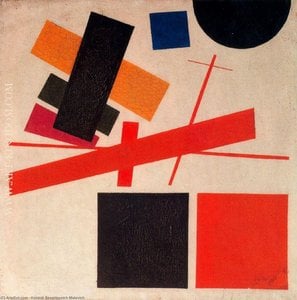
Explore the profound spiritual depth of geometric abstraction. From Malevich's Suprematism to modern masters, our expert guide reveals how pure form and color command presence in fine art collections.
 Preview
 Send
Send Share
Share
 Details
 Guide
Guide

 Download
 Similars
 X-Ray
X-Ray Diaporama
 Q&A
Q&A Stats
Stats

 Read More









 Glass option is only available in size under 110 CM