

 Acrylic On CanvasWallArtSurrealist Style
 1919Renaissance
 48.0 x 41.0 cm
Hand-painted oil on canvas in your size and frame, made to order by our artists. ( Switch to Print Switch to Digital Image)





























Pick from our preset sizes that match the artwork's original proportions.

Type the width and the height you need, to fit your frame or your wall. This is hand-painted, so for a size with a different shape the artist can paint a bit more around the picture, or cut a bit — you choose. We send you a digital mockup to approve before the painting starts. The picture shown on this page does not show the real result — only the mockup does.
Worldwide Delivery () in 3/4 weeks instead of standard 5 weeks. (25 October). No compromise on quality.
Cosmic Composition
Reproduction Size
Other names recorded for Paul Klee, creator of "Cosmic Composition", include Klee.
"Cosmic Composition" by Paul Klee is proportioned as a portrait work of 48 x 41 cm.
The colors of "Cosmic Composition" by Paul Klee show a balanced soft saturation with a monochromatic intensity.

Born in Münchenbuchsee, Switzerland, on December 18, 1879, Paul Klee entered a world shaped by the rhythms of music. His father, Hans Wilhelm Klee, was a German music teacher, and his mother, Ida Marie, was a Swiss singer. This early immersion in sound provided a foundation for a visual language that often mirrored musical arrangement. While he initially pursued the violin with great talent, eventually deciding that modern music lacked the creative pull he craved, he turned his focus toward the Academy of Fine Arts in Munich. His studies there between 1898 and 1901 were marked by an early mastery of drawing, though he famously struggled with color during those first cold winters.
The transition from a draftsman to an abstract thinker was not immediate. Klee’s early years involved exploring the boundaries of Symbolism and Art Nouveau, often working in black and white or through experimental techniques like needle drawing on blackened glass. A significant shift occurred in 1914 during a visit to Tunisia. The intense light of North Africa allowed him to detach color from physical description, using it instead as an independent force. This period provided the necessary push toward abstraction, moving his work away from mere representation and toward a more personal, symbolic vocabulary.
Klee’s career reached a period of intense theoretical and creative activity during his time at the Bauhaus. From 1920 to 1930, he joined the faculty of this influential school of design and architecture, working alongside figures like Wassily Kandinsky. It was here that much of his prolific output occurred, particularly small-scale watercolors and drawings on paper. His teaching allowed him to explore the relationship between color and form with scientific precision, a subject he documented extensively in his notebooks. These writings, which examined the mechanics of design, are now regarded as essential texts for understanding modern composition.
The stability of this era was abruptly interrupted by the rise of National Socialism. In 1933, Klee was dismissed from his position at the Academy of Fine Arts in Düsseldorf because the Nazi regime classified his work as “degenerate.” Forced to return to his native Bern, his later years were marked by a shift in tone. As political turmoil grew and his own health declined, his lines became heavier, turning into black bars, and his forms grew more generalized. The whimsicality of his earlier years gave way to a more somber, melancholic perspective, reflecting the gravity of the era.
The breadth of Klee’s output is immense, totaling some 10,000 works that range from delicate sketches to larger, more structured compositions. His ability to blend influences from Cubism, Expressionism, and Surrealism resulted in a style that felt both childlike and deeply intellectual. He utilized a variety of media, including:
His work remains a study in balance, where titles often provided the necessary context for his often cryptic imagery. Whether through the use of simple stick figures or complex, colorful grids, he sought to express the inner world of ideas rather than the surface of reality. He died on June 29, 1940, in Muralto, Switzerland, leaving behind a body of work that bridged the gap between the figurative and the abstract.

1879 - 1940 , Switzerland

Explore 10 defining Abstract Expressionism masterpieces by Pollock, Rothko & de Kooning. Discover the stories behind these iconic paintings and find museum-quality art reproductions to elevate your home decor on .

Journey through Paul Klee's 25 most iconic paintings & prints. Explore his abstract style, Bauhaus influence, and vibrant color palettes. Find museum-quality art reproductions & decor ideas at WahooArt.com. Discover all masterpieces online.

Explore the captivating world of Paul Klee! Discover his innovative art, Bauhaus influence, & unique symbolic language. Expert analysis & high-quality reproductions at WahooArt.

Explore the profound emotional depth of Color Field painting. Discover the history of mid-century abstraction, from Rothko to Newman, and learn how pure color transforms the viewer's experience through our expert art history guide.
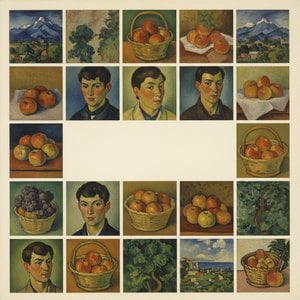
Journey through 25 iconic artworks by Paul Cézanne – a master of Impressionism and Post-Impressionism. Explore his landscapes, still lifes, and the stories behind these timeless masterpieces. Discover museum-quality reproductions & curated decor at WahooArt.com.

 Preview
 Send
Send Share
Share
 Details
 Guide
Guide

 Download
 Similars
 X-Ray
X-Ray Diaporama
 Stats
Stats Read More









 Glass option is only available in size under 110 CM


