

The artwork displayed on this page is protected by copyright law, which means we cannot legally create or sell an identical reproduction. This protection is enforced under international agreements such as the Berne Convention and by national laws, including those outlined by the U.S. Copyright Law - Title 17.
This method fully complies with copyright regulations because it does not involve copying or duplicating the protected artwork. Instead, it is a creative reinterpretation - a new painting that is influenced by the original but not identical to it.
Museum-quality giclée or canvas print with fast production and flexible finish options. ( Buy Hand Made Painting Switch to Digital Image)
Pick from our preset sizes that match the artwork's original proportions.

Type the width and the height you need, to fit your frame or your wall. A print can only be cut, never made bigger than the picture, so a size with a different shape loses a part of the image. We send you a digital mockup to approve before we print anything. The picture shown on this page does not show the real cut — only the mockup does.
Worldwide Delivery () in 2 weeks instead of standard 4/5 weeks. (28 October)
Phenomena sherman vortex
Reproduction Size

Paul Jenkins stands as a singular figure in the landscape of American abstract expressionism, a master who transformed the canvas into a stage for fluid motion and luminous discovery. Born in Kansas City, Missouri, in 1923, his artistic journey began with formal training at the Art Students League of New York under the guidance of Yasuo Kuniyoshi. This early mentorship was profound, fostering an appreciation for Japanese aesthetics that would later infuse his work with a sense of delicate balance and organic grace. Jenkins did not merely paint; he orchestrated a dance between pigment and gravity, creating a visual language that moved away from representational imagery toward a deeply emotive, lyrical abstraction.
The trajectory of his career was irrevocably altered in 1953 during a transformative journey through Europe. His time in Sicily, particularly within the vibrant atmosphere of Taormina, acted as a catalyst for a new way of seeing. This Mediterranean immersion broadened his horizons and solidified his commitment to experimentation, eventually propelling him toward Paris. In the intellectual and creative crucible of both New York and Paris, Jenkins navigated the dynamic currents of mid-century modernism, establishing a studio practice that would redefine the boundaries of the medium through his revolutionary "phenomena" technique.
At the heart of Jenkins’ contribution to art history lies his signature method, a process that bridged the gap between meticulous intention and the beautiful unpredictability of nature. By incorporating Goethe’s color theories into his practice, he began layering pigments in streams of varying thicknesses across the canvas. These were not mere random gestures; they were carefully considered pours designed to generate mesmerizing patterns and textures. This approach allowed him to capture a sense of "phenomena"—a term that served as both a conceptual anchor and a way to explore the very essence of observation.
In his works, such as the evocative Untitled (664) or the energetic Phenomena compass bearing, one can witness the breathtaking interplay of light and liquid. His technique involved:
The historical significance of Paul Jenkins lies in his ability to evolve the much-discussed drip techniques of his contemporaries into something more ethereal and atmospheric. While often compared to the raw energy of Jackson Pollock, Jenkins’ work possesses a unique, translucent quality that feels more like a celestial event than a physical struggle. His ability to capture dynamic energy through watercolor and oil alike—as seen in the vibrant Untitled (872)—ensured his place as a pioneer of lyrical abstraction.
Throughout his long and prolific career, which spanned from his early training in New York to his final years in 2012, Jenkins remained dedicated to the idea that art is an act of discovery. His legacy is found in every flowing line and every bleeding hue that invites the viewer to lose themselves in a world of pure color. He remains a vital figure for anyone seeking to understand the intersection of scientific theory, spontaneous movement, and the profound emotional power of the abstract form.

1923 - 2012 , United States of America

Journey through Paul Klee's 25 most iconic paintings & prints. Explore his abstract style, Bauhaus influence, and vibrant color palettes. Find museum-quality art reproductions & decor ideas at WahooArt.com. Discover all masterpieces online.

Explore 10 defining masterpieces of Geometric Abstraction! Discover Kandinsky, Mondrian & Malevich’s iconic works. Find museum-quality art reproductions and curated decor ideas to elevate your home at WahooArt.com.
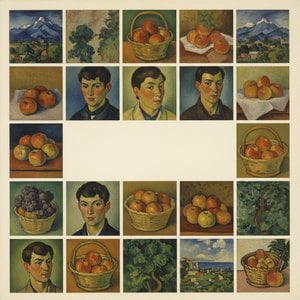
Journey through 25 iconic artworks by Paul Cézanne – a master of Impressionism and Post-Impressionism. Explore his landscapes, still lifes, and the stories behind these timeless masterpieces. Discover museum-quality reproductions & curated decor at WahooArt.com.

Explore the captivating world of Paul Jenkins, a pioneer of abstract expressionism & color field painting. Discover his unique ‘Phenomena’ series and investment potential for art collectors. Expert insights at WahooArt.

Explore 10 defining Abstract Expressionism masterpieces by Pollock, Rothko & de Kooning. Discover the stories behind these iconic paintings and find museum-quality art reproductions to elevate your home decor on .

 Preview
 Send
Send Share
Share
 Details
 Guide
Guide

 Download
 Similars
 X-Ray
X-Ray Diaporama
 Q&A
Q&A Stats
Stats
 Read More






































 Glass option is only available in size under 110 CM


