

Hand-painted oil on canvas in your size and frame, made to order by our artists. ( Switch to Print Switch to Digital Image)





























Pick from our preset sizes that match the artwork's original proportions.

You may enter your own dimensions to fit a specific frame or space. If your selected size does not match the original image's proportions, we will either crop the artwork or extend the painting with additional hand-painted elements. A digital mockup will be sent for your approval before production begins.
Please note that the on-screen preview does not reflect the actual cropping or extension. Only the mockup will accurately show the final composition.
While custom sizes are available, we recommend selecting a dimension from the predefined list to preserve the original proportions.
Worldwide Delivery () in 3/4 weeks instead of standard 5 weeks. (20 September). No compromise on quality.


The Fountain 1
Reproduction Size
In the quietude of Paul Cézanne's "The Fountain 1," we are invited into a world that transcends mere landscape painting, offering instead a profound meditation on the permanence of nature. Painted around 1877, this masterpiece serves as a vital bridge between the fleeting, light-drenched moments of Impressionism and the structured, geometric revolution of Cubism. At first glance, the scene presents an idyllic tableau of rural life: a woman stands with serene grace beside a fountain, her presence anchored amidst a gathering of cows, horses, and even a watchful dog. Yet, to look closer is to realize that Cézanne was not merely documenting a pastoral afternoon; he was attempting to capture the very architecture of existence.
The atmosphere of the piece is one of deep, rhythmic peace. The way the woman interacts with her animals suggests a harmonious coexistence, an era where the boundaries between humanity and the natural world felt porous and interconnected. For the collector or interior designer, this painting offers more than just aesthetic beauty; it provides a focal point of stability and contemplative calm, making it an exquisite addition to spaces designed for reflection and intellectual engagement.
Cézanne’s technical brilliance in "The Fountain 1" lies in his rejection of photographic realism in favor of a more tactile, structural truth. He famously employed impasto—the thick, deliberate application of paint—to build surfaces that possess a palpable, sculptural quality. This technique, influenced by the bold outlines found in Japanese prints, allows the viewer to feel the weight and texture of the scene. The brushstrokes do not simply represent light; they construct form, giving the animals and the fountain a sense of enduring solidity that Impressionist techniques often lacked.
This method of building up layers creates a fascinating interplay of light and shadow across the canvas. As light hits the raised ridges of paint, the artwork takes on a dynamic life of its own, changing subtly depending on the lighting of the room in which it hangs. This textural depth makes a high-quality reproduction particularly captivating, as it preserves the rugged, energetic spirit of Cézanne’s hand, allowing the "flesh" of the painting to breathe within a modern home or gallery setting.
Beyond its surface beauty, "The Fountain 1" is rich with symbolic resonance. The fountain itself acts as a powerful emblem of purification and renewal, perhaps mirroring Cézanne’s own internal struggles to find clarity amidst artistic uncertainty. The animals surrounding the central figure—the strength of the horses and the fertility represented by the cows—symbolize the cyclical rhythms of life and the unstoppable forces of nature. Some scholars even suggest that the woman in the painting serves as a surrogate for the artist himself, representing the intellect and the observant eye standing amidst the raw physicality of the world.
To possess a piece like this is to hold a fragment of art history’s most significant turning point. It is an invitation to view the world not as a series of disconnected objects, but as an interconnected web of forces. Whether you are drawn to its historical importance as a precursor to modernism or its ability to evoke a sense of timeless tranquility, "The Fountain 1" remains a profound testament to the beauty of seeing the eternal within the ephemeral.


1839 - 1906 , France
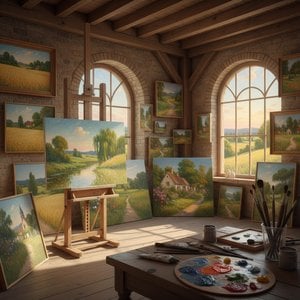
Discover the profound tranquility of rural art through an expert exploration of Impressionist landscapes. From pastoral scenes to textured oil masterpieces, learn how timeless nature-inspired artworks bring enduring elegance and serenity to sophisticated collectors.

 Preview
 Send
Send Share
Share
 Details
 Guide
Guide

 Download
 Similars
 X-Ray
X-Ray Diaporama
 Stats
Stats

 Read More







 Glass option is only available in size under 110 CM


