

Museum-quality giclée or canvas print with fast production and flexible finish options. ( Buy Hand Made Painting Switch to Digital Image)





























Pick from our preset sizes that match the artwork's original proportions.

Type the width and the height you need, to fit your frame or your wall. A print can only be cut, never made bigger than the picture, so a size with a different shape loses a part of the image. We send you a digital mockup to approve before we print anything. The picture shown on this page does not show the real cut — only the mockup does.
Worldwide Delivery () in 2 weeks instead of standard 4/5 weeks. (25 October)
Still Life with Commode
Reproduction Size
Paul Cézanne's Still Life with Commode, painted around 1887-1888, isn’t merely a depiction of objects arranged on a table; it’s a profound exploration of how we *see*. This pivotal work, housed within the esteemed collection of the Harvard Art Museums, represents a crucial bridge between the Impressionist movement and the burgeoning world of Cubism, marking a radical shift in artistic perspective. Cézanne wasn't interested in simply replicating reality as seen through fleeting light; instead, he sought to capture the underlying structure and essence of his subject – a deliberate act that profoundly influenced generations of artists to come.
The painting itself is deceptively simple at first glance. A modestly sized table, draped with a subtly textured fabric, anchors the composition. Upon it rests a commode—a piece of furniture typically associated with domesticity and order—alongside an assortment of carefully chosen objects: a bowl overflowing with fruit – apples and oranges dominate, their colors rendered in rich, earthy tones – a vase holding flowers, and several books. Yet, Cézanne’s genius lies not in the realistic portrayal of these items, but in his masterful manipulation of space and form. He abandons traditional perspective, creating an illusion of depth through a complex interplay of lines, planes, and color. The table itself seems to tilt slightly, the objects are rendered with varying degrees of detail, and the background is deliberately ambiguous, drawing the viewer’s eye directly into the heart of the scene.
Post-Impressionist InnovationBeyond its formal innovations, Still Life with Commode carries a subtle emotional resonance. The arrangement feels both familiar and slightly unsettling—a quiet tableau of everyday life imbued with a sense of contemplative stillness. The carefully chosen objects – fruit, books, a vase – evoke associations with domesticity, knowledge, and beauty. However, Cézanne’s deliberate distortions and unconventional perspective subtly disrupt this comfortable familiarity, prompting the viewer to question their own assumptions about how things *should* look. The painting invites us to engage in a process of active interpretation, recognizing that reality is not simply observed but constructed through our own perceptual filters.
If you’re captivated by Cézanne's revolutionary approach and wish to experience this masterpiece firsthand, consider commissioning a handmade oil painting reproduction from WahooArt.com. Our skilled artists meticulously recreate the nuances of Cézanne’s technique, capturing the subtle color variations, broken brushstrokes, and unique spatial relationships that define this iconic work. A reproduction offers an accessible way to bring this profound exploration of perception into your own home or office – a testament to Cézanne's enduring legacy as one of art history’s most influential figures. For further insight into Cézanne’s life and artistic journey, explore his artist page on WahooArt.com, or delve deeper into the broader context of Post-Impressionism and its key practitioners like Piet Mondrian and Wassily Kandinsky on our Cubist Art Movement page.
Within Paul Cézanne's career, "Still Life with Commode" falls in the Mature Period. The phase helps compare it with the artist's other works.
"Still Life with Commode" by Paul Cézanne uses an earthy palette, with espresso (#38221b) as the dominant color.
"Still Life with Commode" by Paul Cézanne is recorded with a balanced soft saturation and a balanced intensity.

Paul Cézanne was born in Aix-en-Provence, France, into a family with deep roots in the local banking industry. His father, Louis-Auguste Cézanne, helped found the Banque Cézanne et Cabassol, providing a level of financial stability that many of his contemporaries lacked. This security allowed Paul to move away from the legal studies his father had planned for him. Though he initially studied law at the University of Aix-en-Provence, he abandoned those studies in 1860 to focus entirely on painting. His early years were spent in the company of friends like Émile Zola, and together they shared a childhood of swimming and fishing along the banks of the Arc River.
The early works of Cézanne often carried the weight of Romanticism, utilizing dark palettes and heavy, expressive brushwork. He was influenced by the dramatic tonal contrasts found in the tradition of Eugène Delacroix. However, his approach began to shift as he moved toward Paris. He sought a way to move beyond the fleeting light captured by the Impressionists. Instead of merely recording a passing moment, he wanted to find the permanent structure within nature. He looked at a mountain or a piece of fruit and saw the underlying geometry—the cones, spheres, and cylinders that form the bones of the world.
Cézanne developed a technique characterized by small, repetitive, and constructive brushstrokes. He layered these patches of color to build up volume and texture, creating a sense of solidity. This method allowed him to explore spatial relationships without relying on traditional single-point perspective. In many of his compositions, objects appear independent within the space, often presented from multiple viewpoints at once. This rejection of classical perspective rules helped create a new pictorial language.
His subject matter was deeply tied to his surroundings in Provence. The Mont Sainte-Victoire became a recurring presence in his work, appearing in approximately eighty different paintings and watercolors over many years. He also found profound meaning in the simplest objects. His still lifes, featuring items like apples, jars, and cups, were not mere decorations but intense studies of light, shadow, and mass. Through these works, he demonstrated how color modulation could define shape without the need for traditional shading.
By the time of his death in 1906, Cézanne had fundamentally altered the direction of modern painting. His emphasis on geometric form and multiple perspectives provided a foundation for the Cubist movement. Artists such as Pablo Picasso and Georges Braque drew heavily from his analytical approach to nature. His use of bold, non-naturalistic color also left an impression on the Fauvists, including Henri Matisse. He moved art away from the imitation of reality toward a construction of visual experience based on perception and structure.

1839 - 1906 , France

Explore the profound evolution of Cubist still life, from Cézanne's structural foundations to the fragmented brilliance of Braque and Léger. Discover how geometric abstraction redefined reality through a sophisticated lens of form, color, and modern artistic mastery.

Embark on a sophisticated journey through art history with our exploration of still life masterpieces. Discover the profound symbolism behind classical paintings of drinks and fruit, curated for the true connoisseur seeking timeless elegance and academic depth.
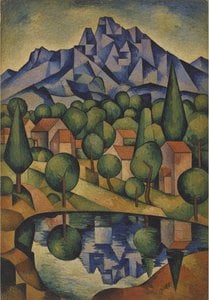
Explore the profound legacy of Paul Cézanne. Discover how his mastery of geometric forms and vibrant color bridged Impressionism and Cubism, offering timeless inspiration for fine art collectors and enthusiasts seeking to understand the foundations of modern art.

Explore the structural genius of Paul Cézanne. Discover how his mastery of geometric form and color bridged Impressionism and Cubism in this definitive guide for art enthusiasts and collectors.
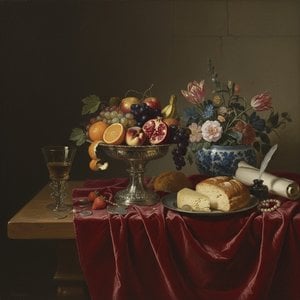
Embark on a sophisticated journey through the history of still life art. From Dutch Golden Age masterpieces to Baroque opulence, explore the profound symbolism and timeless beauty of the world's most exquisite table compositions.

 Preview
 Send
Send Share
Share
 Details
 Guide
Guide

 Download
 Similars
 X-Ray
X-Ray Diaporama
 Stats
Stats

 Read More









 Glass option is only available in size under 110 CM


