

 Oil On CanvasWallArtPost-Impressionism
 186519th Century
 59.0 x 76.0 cm
Museum-quality giclée or canvas print with fast production and flexible finish options. ( Buy Hand Made Painting Switch to Digital Image)





























Pick from our preset sizes that match the artwork's original proportions.

You may enter your own dimensions to fit a specific frame or space. If your selected size does not match the original image's proportions, we will either crop the artwork or extend the image with a mirrored or solid-fill edge. A digital mockup will be sent for your approval before production begins.
Please note that the on-screen preview does not reflect the actual cropping or extension. Only the mockup will accurately show the final composition.
While custom sizes are available, we recommend selecting a dimension from the predefined list to preserve the original proportions.
Worldwide Delivery () in 2 weeks instead of standard 4/5 weeks. (8 September)


Still Life with Bread and Eggs
Reproduction Size
Paul Cézanne’s “Still Life with Bread and Eggs,” painted in 1865, isn’t merely a depiction of everyday objects; it’s a pivotal moment in the evolution of modern art. More than just a charming arrangement of loaf, eggs, and simple vessels, this work embodies Cézanne's radical departure from academic tradition and his pioneering exploration of form and color – a quiet revolution captured on canvas. Housed within the Cincinnati Art Museum, it stands as a testament to an artist who fundamentally reshaped how we perceive and represent the world around us.
Cézanne’s early work reveals a fascination with the tangible realities of life—a departure from the idealized subjects favored by his predecessors. “Still Life with Bread and Eggs” exemplifies this shift, presenting familiar elements – a rustic loaf, delicate eggs, and humble cups – in a way that feels both intimate and profoundly considered. The composition isn’t about photographic accuracy; instead, Cézanne meticulously dissects each object, isolating its essential shapes and planes. Notice how the bread is rendered not as a single form but as a series of overlapping rectangles, suggesting volume and weight. Similarly, the eggs are depicted with a subtle sense of curvature, hinting at their delicate structure. This deliberate simplification, this rejection of illusionistic depth, was revolutionary for its time.
Cézanne's style in “Still Life with Bread and Eggs” firmly establishes him as a key figure in the transition from Impressionism to Post-Impressionism. While he initially absorbed elements of Impressionistic color theory – particularly the use of broken brushstrokes to capture fleeting light—he soon moved beyond mere observation, seeking instead to define the underlying structure of objects. The painting’s surface is alive with these exploratory brushstrokes, each one a deliberate mark that contributes to the overall sense of solidity and presence. Unlike Impressionists who aimed to capture an immediate impression, Cézanne was interested in capturing the *essence* of his subjects – their form, their weight, their spatial relationships.
Initially, Cézanne’s unconventional approach was met with skepticism and ridicule by contemporary critics who were accustomed to the polished realism of academic art. However, a small circle of fellow artists—including Camille Pissarro and Ambroise Vollard—recognized his genius and championed his work. In 1895, Vollard organized the first solo exhibition of Cézanne’s paintings in Paris, which dramatically shifted public perception. This event marked a turning point, establishing Cézanne as a major artistic innovator.
The influence of Cézanne on subsequent generations of artists is undeniable. Henri Matisse and Pablo Picasso both acknowledged him as “the father of us all,” recognizing his profound impact on their own artistic development. His emphasis on form, color, and spatial relationships laid the groundwork for Cubism, Fauvism, and countless other avant-garde movements. “Still Life with Bread and Eggs” isn’t just a beautiful painting; it's a foundational work that continues to inspire artists today.
At WahooArt, we are proud to offer meticulously crafted, hand-painted reproductions of Paul Cézanne’s “Still Life with Bread and Eggs.” These aren't simply prints; they are faithful recreations of the original painting, capturing its subtle nuances, rich textures, and emotional depth. Each reproduction is created by skilled artists who share a deep appreciation for Cézanne’s legacy. Owning a WahooArt reproduction allows you to bring this iconic work into your home or office, celebrating the enduring power of art and the genius of Paul Cézanne.
Explore our collection today and discover the perfect way to experience “Still Life with Bread and Eggs” – a timeless masterpiece that continues to resonate with viewers across generations. Browse the Collection


1839 - 1906 , France

Master the nuances of Impressionism vs. Post-Impressionism with our expert guide. Explore the revolutionary shift from Monet’s fleeting light to Van Gogh’s emotional depth. Discover how these iconic movements continue to inspire fine art collectors and modern interiors today.

Explore the transformative era of Post-Impressionism. Discover how masters like Cézanne and Matisse revolutionized color and form, moving beyond Impressionism to shape modern art history through structural innovation and expressive emotion.

Explore the vibrant evolution of Post-Impressionism. From Seurat's revolutionary Pointillism to the emotional depth of masters, discover how this movement redefined modern art history through color, structure, and unparalleled creative expression.

Unveil the profound revolution of Post-Impressionism. Explore how masters like Van Gogh and Cézanne utilized bold colors and emotional depth to transcend mere representation, laying the foundation for modern art. A sophisticated journey through history's most emotive brushstrokes.
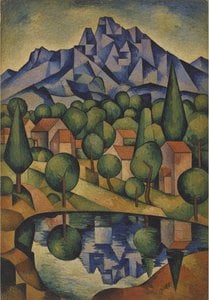
Explore the profound legacy of Paul Cézanne. Discover how his mastery of geometric forms and vibrant color bridged Impressionism and Cubism, offering timeless inspiration for fine art collectors and enthusiasts seeking to understand the foundations of modern art.

 Preview
 Send
Send Share
Share
 Details

 Download
 Similars
 X-Ray
X-Ray Diaporama
 Stats
Stats Read More







 Glass option is only available in size under 110 CM


