Oil On CanvasWallArtPost-Impressionism
 189919th Century
 61.0 x 81.0 cm
Museum-quality giclée or canvas print with fast production and flexible finish options. ( Buy Hand Made Painting Switch to Digital Image)





























Pick from our preset sizes that match the artwork's original proportions.

Type the width and the height you need, to fit your frame or your wall. A print can only be cut, never made bigger than the picture, so a size with a different shape loses a part of the image. We send you a digital mockup to approve before we print anything. The picture shown on this page does not show the real cut — only the mockup does.
Worldwide Delivery () in 2 weeks instead of standard 4/5 weeks. (23 October)
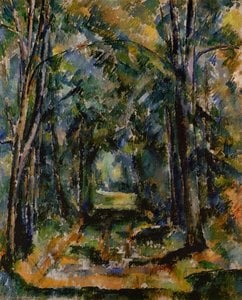
In the Forest
Reproduction Size
Paul Cézanne's "In the Forest," painted in 1899, isn’t merely a landscape; it’s an immersive experience, a deliberate attempt to capture the essence of nature rather than its literal representation. This pivotal work stands as a cornerstone of Post-Impressionism, a movement that arose as a reaction against the fleeting impressions favored by earlier Impressionists and sought instead to explore the underlying structure and emotional resonance of the natural world. Cézanne’s approach wasn't about replicating what the eye sees; it was about distilling the *feeling* of being within a forest – its stillness, its depth, and its vibrant energy – onto canvas.
The painting itself measures 61 x 81 cm and is executed in oil on canvas. Immediately striking are the bold, almost sculptural forms of the trees dominating the composition. Cézanne employs a technique that anticipates Cubism; he breaks down objects into their fundamental geometric shapes – cylinders, cones, and planes – and rearranges them to create an illusion of depth and volume. The orange leaves, particularly prominent in the foreground, aren’t rendered with delicate brushstrokes but rather as blocks of color, contributing significantly to the painting's dynamic and somewhat unsettling atmosphere. The rocks scattered throughout the scene add further textural complexity, grounding the composition while simultaneously hinting at the vastness of the forest.
Cézanne’s style represents a significant departure from the Impressionist preoccupation with capturing momentary effects of light. While Impressionists sought to depict the *impression* of light and color, Cézanne was interested in exploring the underlying structure of objects and their relationship to space. He famously stated, “I do not paint what I see, but what I feel.” This sentiment encapsulates his core artistic philosophy – he aimed to convey a sense of solidity and permanence, as if the trees themselves were imbued with an inner strength.
The influence of Japanese prints is evident in Cézanne’s flattened perspective and simplified forms. He admired the way Japanese artists rendered objects without relying on traditional linear perspective, creating a sense of depth through color and composition. Furthermore, his exploration of color – particularly the juxtaposition of warm oranges and greens – reflects the work of Paul Gauguin, another key figure in Post-Impressionism, who sought to express emotion through vibrant hues. However, Cézanne’s use of color is far more restrained and deliberate than Gauguin's, serving primarily to define form and create a sense of harmony within the composition.
“In the Forest” can be interpreted as a symbolic meditation on humanity’s relationship with nature. The dense foliage creates a feeling of enclosure, suggesting both protection and isolation. The vibrant colors evoke a sense of vitality and energy, while the muted tones in the background create a backdrop of tranquility. The painting isn't simply a depiction of a forest; it’s an evocation of the profound emotional experience of being immersed within one – a feeling of awe, wonder, and perhaps even a touch of melancholy.
Cézanne’s work profoundly influenced subsequent generations of artists, including Pablo Picasso and Henri Matisse. His emphasis on form, color, and subjective expression paved the way for movements like Cubism and Fauvism. His legacy continues to inspire artists today who seek to capture the essence of nature in a bold and innovative manner. For those seeking to bring this remarkable artwork into their homes, WahooArt offers meticulously crafted oil painting reproductions that faithfully recreate Cézanne’s vision with exceptional detail and vibrancy.
Cézanne’s journey from Impressionism to Post-Impressionism is a fascinating one, marked by a constant experimentation with form and color. His exploration of the “promontory” – a technique of depicting objects as viewed through a gap or opening – exemplifies his desire to break free from traditional perspective and create a more dynamic and expressive representation of space.
To further appreciate Cézanne’s contribution, consider examining works by Claude Monet, whose Impressionistic landscapes provide a valuable contrast to Cézanne's more structured approach. Alternatively, explore Henri Matisse’s Fauvist paintings for an example of how color was used to express emotion and create a sense of immediacy. Understanding these related movements provides a richer context for appreciating the unique qualities of “In the Forest.”
For those interested in delving deeper into Cézanne's life and work, we encourage you to visit Paul Cezanne’s "In the Forest" on WahooArt.com or explore our comprehensive collection of Cézanne reproductions at [WahooArt URL].
Additionally, you can learn more about Post-Impressionism through Post-Impressionism Art Movement on WahooArt.com and gain insights into Symbolist painting at Symbolist Painting.
The Guide page of "In the Forest" by Paul Cézanne offers a printable two-sheet factsheet: the artwork with its identity table, a decade band placing it in the artist's lifetime, other works by the artist, the measured color palette, and ready-to-copy citations in four styles.
"In the Forest" by Paul Cézanne is in the public domain - its copyright has expired. Copyright duration runs from the artist's death, which occurred in 1906.
"In the Forest" by Paul Cézanne depicts forest, trees, orange leaves, landscape, cezanne, composition, depth, texture, in a calm mood. Subject and atmosphere together describe the work.

Paul Cézanne was born in Aix-en-Provence, France, into a family with deep roots in the local banking industry. His father, Louis-Auguste Cézanne, helped found the Banque Cézanne et Cabassol, providing a level of financial stability that many of his contemporaries lacked. This security allowed Paul to move away from the legal studies his father had planned for him. Though he initially studied law at the University of Aix-en-Provence, he abandoned those studies in 1860 to focus entirely on painting. His early years were spent in the company of friends like Émile Zola, and together they shared a childhood of swimming and fishing along the banks of the Arc River.
The early works of Cézanne often carried the weight of Romanticism, utilizing dark palettes and heavy, expressive brushwork. He was influenced by the dramatic tonal contrasts found in the tradition of Eugène Delacroix. However, his approach began to shift as he moved toward Paris. He sought a way to move beyond the fleeting light captured by the Impressionists. Instead of merely recording a passing moment, he wanted to find the permanent structure within nature. He looked at a mountain or a piece of fruit and saw the underlying geometry—the cones, spheres, and cylinders that form the bones of the world.
Cézanne developed a technique characterized by small, repetitive, and constructive brushstrokes. He layered these patches of color to build up volume and texture, creating a sense of solidity. This method allowed him to explore spatial relationships without relying on traditional single-point perspective. In many of his compositions, objects appear independent within the space, often presented from multiple viewpoints at once. This rejection of classical perspective rules helped create a new pictorial language.
His subject matter was deeply tied to his surroundings in Provence. The Mont Sainte-Victoire became a recurring presence in his work, appearing in approximately eighty different paintings and watercolors over many years. He also found profound meaning in the simplest objects. His still lifes, featuring items like apples, jars, and cups, were not mere decorations but intense studies of light, shadow, and mass. Through these works, he demonstrated how color modulation could define shape without the need for traditional shading.
By the time of his death in 1906, Cézanne had fundamentally altered the direction of modern painting. His emphasis on geometric form and multiple perspectives provided a foundation for the Cubist movement. Artists such as Pablo Picasso and Georges Braque drew heavily from his analytical approach to nature. His use of bold, non-naturalistic color also left an impression on the Fauvists, including Henri Matisse. He moved art away from the imitation of reality toward a construction of visual experience based on perception and structure.

1839 - 1906 , France

Unveil the profound revolution of Post-Impressionism. Explore how masters like Van Gogh and Cézanne utilized bold colors and emotional depth to transcend mere representation, laying the foundation for modern art. A sophisticated journey through history's most emotive brushstrokes.

Explore the transformative era of Post-Impressionism. Discover how masters like Cézanne and Matisse revolutionized color and form, moving beyond Impressionism to shape modern art history through structural innovation and expressive emotion.
Explore the profound legacy of Paul Cézanne. Discover how his mastery of geometric forms and vibrant color bridged Impressionism and Cubism, offering timeless inspiration for fine art collectors and enthusiasts seeking to understand the foundations of modern art.

Explore the structural genius of Paul Cézanne. Discover how his mastery of geometric form and color bridged Impressionism and Cubism in this definitive guide for art enthusiasts and collectors.

Master the nuances of Impressionism vs. Post-Impressionism with our expert guide. Explore the revolutionary shift from Monet’s fleeting light to Van Gogh’s emotional depth. Discover how these iconic movements continue to inspire fine art collectors and modern interiors today.

 Preview
 Send
Send Share
Share
 Details
 Guide
Guide

 Download
 Similars
 X-Ray
X-Ray Diaporama
 Stats
Stats Read More









 Glass option is only available in size under 110 CM