

 Oil On CanvasWallArtPost-Impressionism
 187819th Century
 38.0 x 46.0 cm
Museum-quality giclée or canvas print with fast production and flexible finish options. ( Buy Hand Made Painting Switch to Digital Image)





























Pick from our preset sizes that match the artwork's original proportions.

Type the width and the height you need, to fit your frame or your wall. A print can only be cut, never made bigger than the picture, so a size with a different shape loses a part of the image. We send you a digital mockup to approve before we print anything. The picture shown on this page does not show the real cut — only the mockup does.
Worldwide Delivery () in 2 weeks instead of standard 4/5 weeks. (22 October)
Four Bathers
Reproduction Size
Paul Cézanne's "Four Bathers," painted in 1878, isn’t merely a depiction of nude figures enjoying the sun; it’s a pivotal moment in art history—a deliberate dismantling of established conventions and a bold assertion of a new visual language. This oil on canvas, measuring a modest 38 x 46 cm, embodies Cézanne's revolutionary approach to capturing the essence of nature and human connection, marking a crucial transition from the fleeting impressions of Impressionism towards the structured explorations of Cubism. The painting invites us into a world where form and color are not simply observed but actively constructed by the artist’s hand, revealing a profound shift in how we perceive and represent reality.
Cézanne's artistic journey began with an initial flirtation with Impressionist techniques – capturing the ephemeral effects of light and atmosphere. However, he quickly recognized the limitations of this approach, feeling that it lacked the underlying structure necessary to convey a sense of permanence and solidity. “Four Bathers” represents his decisive move away from mere representation towards a more conceptual understanding of form. The figures aren’t rendered with photographic accuracy; instead, they are fragmented into geometric planes of color, suggesting volume and mass through their arrangement within the composition. Notice how Cézanne uses overlapping forms to create depth—the bodies seem to emerge from and recede into the surrounding landscape, blurring the boundaries between subject and environment.
The painting’s composition is remarkably deliberate. Cézanne employs a technique he termed “alla prima,” working directly on the canvas with loose, expressive brushstrokes—a stark contrast to the meticulous layering of Impressionist paint. These strokes aren't blended; they retain their individual character, creating a textured surface that vibrates with energy. The figures are positioned at varying angles, some partially obscured by foliage, others emerging from the shadows. This dynamic arrangement creates a sense of movement and spontaneity, as if capturing a fleeting moment in time. Crucially, Cézanne isn’t interested in depicting a specific scene; he's exploring the fundamental building blocks of form—lines, planes, and volumes—that constitute the world around us.
The color palette is equally significant. Cézanne utilizes muted earth tones – ochres, browns, greens – to create a harmonious yet subtly unsettling atmosphere. He avoids bright, saturated hues, favoring instead subtle gradations of color that suggest light and shadow. The use of complementary colors—such as the blues and oranges—creates visual tension and adds depth to the composition. It’s important to note that Cézanne was deeply interested in the scientific study of color, believing that it could be used to create a more accurate representation of reality than traditional methods allowed.
“Four Bathers” emerged during a period of intense artistic ferment. The Impressionist movement, with its focus on capturing fleeting moments and atmospheric effects, was beginning to face criticism for its lack of structure and permanence. Cézanne’s work represented a direct response to this critique—a deliberate attempt to reintroduce order and form into the art world. Initially, his paintings were met with incomprehension and ridicule by contemporary critics who found them unsettling and unconventional. However, figures like Camille Pissarro and Ambroise Vollard recognized Cézanne's genius early on, championing his work and providing him with crucial support.
Vollard’s decision to organize the first solo exhibition of Cézanne’s work in 1895 proved transformative. This event brought Cézanne’s art to a wider audience and helped to establish his reputation as a major innovator. Remarkably, artists like Henri Matisse and Pablo Picasso later acknowledged Cézanne's profound influence on their own work, famously declaring him “the father of us all.” His emphasis on geometric form and the exploration of underlying structure paved the way for the development of Cubism—a revolutionary movement that shattered traditional notions of perspective and representation.
“Four Bathers” stands as a testament to Cézanne’s pioneering spirit and his enduring legacy. It's more than just a beautiful painting; it’s a foundational work in the history of modern art, bridging the gap between Impressionism and Cubism. Its influence can be seen in countless works by artists who followed in his footsteps—from Matisse to Picasso to Braque. Today, the painting is celebrated not only for its artistic merit but also for its historical significance as a pivotal moment in the evolution of Western art. It reminds us that art isn't simply about imitating reality; it’s about interpreting and transforming it according to the artist’s vision.
Experience the beauty of handmade oil painting reproductions at WahooArt.com.
The Similars page of "Four Bathers" by Paul Cézanne presents related artworks.
"Four Bathers" by Paul Cézanne is proportioned as a landscape work of 38 x 46 cm.
"Four Bathers" by Paul Cézanne is recorded as shadow, with a soft shadow luminance.

Paul Cézanne was born in Aix-en-Provence, France, into a family with deep roots in the local banking industry. His father, Louis-Auguste Cézanne, helped found the Banque Cézanne et Cabassol, providing a level of financial stability that many of his contemporaries lacked. This security allowed Paul to move away from the legal studies his father had planned for him. Though he initially studied law at the University of Aix-en-Provence, he abandoned those studies in 1860 to focus entirely on painting. His early years were spent in the company of friends like Émile Zola, and together they shared a childhood of swimming and fishing along the banks of the Arc River.
The early works of Cézanne often carried the weight of Romanticism, utilizing dark palettes and heavy, expressive brushwork. He was influenced by the dramatic tonal contrasts found in the tradition of Eugène Delacroix. However, his approach began to shift as he moved toward Paris. He sought a way to move beyond the fleeting light captured by the Impressionists. Instead of merely recording a passing moment, he wanted to find the permanent structure within nature. He looked at a mountain or a piece of fruit and saw the underlying geometry—the cones, spheres, and cylinders that form the bones of the world.
Cézanne developed a technique characterized by small, repetitive, and constructive brushstrokes. He layered these patches of color to build up volume and texture, creating a sense of solidity. This method allowed him to explore spatial relationships without relying on traditional single-point perspective. In many of his compositions, objects appear independent within the space, often presented from multiple viewpoints at once. This rejection of classical perspective rules helped create a new pictorial language.
His subject matter was deeply tied to his surroundings in Provence. The Mont Sainte-Victoire became a recurring presence in his work, appearing in approximately eighty different paintings and watercolors over many years. He also found profound meaning in the simplest objects. His still lifes, featuring items like apples, jars, and cups, were not mere decorations but intense studies of light, shadow, and mass. Through these works, he demonstrated how color modulation could define shape without the need for traditional shading.
By the time of his death in 1906, Cézanne had fundamentally altered the direction of modern painting. His emphasis on geometric form and multiple perspectives provided a foundation for the Cubist movement. Artists such as Pablo Picasso and Georges Braque drew heavily from his analytical approach to nature. His use of bold, non-naturalistic color also left an impression on the Fauvists, including Henri Matisse. He moved art away from the imitation of reality toward a construction of visual experience based on perception and structure.

1839 - 1906 , France

Unveil the profound revolution of Post-Impressionism. Explore how masters like Van Gogh and Cézanne utilized bold colors and emotional depth to transcend mere representation, laying the foundation for modern art. A sophisticated journey through history's most emotive brushstrokes.
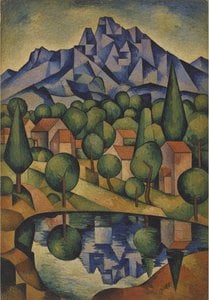
Explore the profound legacy of Paul Cézanne. Discover how his mastery of geometric forms and vibrant color bridged Impressionism and Cubism, offering timeless inspiration for fine art collectors and enthusiasts seeking to understand the foundations of modern art.

Master the nuances of Impressionism vs. Post-Impressionism with our expert guide. Explore the revolutionary shift from Monet’s fleeting light to Van Gogh’s emotional depth. Discover how these iconic movements continue to inspire fine art collectors and modern interiors today.

Explore the vibrant evolution of Post-Impressionism. From Seurat's revolutionary Pointillism to the emotional depth of masters, discover how this movement redefined modern art history through color, structure, and unparalleled creative expression.

Explore the transformative era of Post-Impressionism. Discover how masters like Cézanne and Matisse revolutionized color and form, moving beyond Impressionism to shape modern art history through structural innovation and expressive emotion.

 Preview
 Send
Send Share
Share
 Details
 Guide
Guide

 Download
 Similars
 X-Ray
X-Ray Diaporama
 Stats
Stats Read More









 Glass option is only available in size under 110 CM


