x


Museum-quality giclée or canvas print with fast production and flexible finish options. ( Buy Hand Made Painting Buy Image)





























Pick from our preset sizes that match the artwork's original proportions.

You may enter your own dimensions to fit a specific frame or space. If your selected size does not match the original image's proportions, we will either crop the artwork or extend the image with a mirrored or solid-fill edge. A digital mockup will be sent for your approval before production begins.
Please note that the on-screen preview does not reflect the actual cropping or extension. Only the mockup will accurately show the final composition.
While custom sizes are available, we recommend selecting a dimension from the predefined list to preserve the original proportions.
Worldwide Delivery () in 2 weeks instead of standard 4/5 weeks. (5 September)


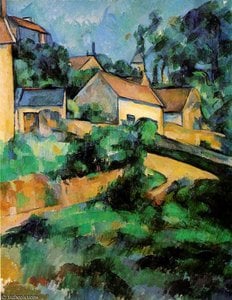
Chateau Noir
Reproduction Size
Paul Cézanne's *Château Noir*, painted in 1904, isn’t merely a depiction of a castle; it’s an invitation into the heart of a revolutionary artistic vision. This oil on canvas, currently residing within the hallowed halls of the Musée du Louvre in Paris, embodies the culmination of Cézanne's lifelong pursuit to capture not just what he saw, but *how* he perceived – a profound shift away from traditional representation and towards an exploration of form, color, and structure. The painting immediately draws the eye with its bold contrasts: the fiery red of the castle’s roof against the deep azure of the sky, creating a visual tension that speaks to both power and tranquility.
Cézanne's approach to landscape painting was profoundly influenced by the Impressionists, particularly their focus on capturing fleeting moments of light. However, he quickly moved beyond mere observation, seeking to distill the essence of his subjects into fundamental geometric shapes. *Château Noir* exemplifies this shift brilliantly. The castle itself isn’t rendered with meticulous detail; instead, it's broken down into a series of interlocking planes and angles – rectangles, triangles, and cylinders – that suggest volume and depth. This deliberate simplification wasn’t an abandonment of realism but rather a conscious decision to prioritize the underlying structure of the scene, anticipating the radical innovations of Cubism by decades.
Cézanne's masterful use of color is equally significant. He employs a palette of rich, saturated hues – deep blues, vibrant reds, earthy greens – not to mimic reality but to convey emotional resonance. The red roof, for instance, isn’t simply painted red; it pulsates with energy and warmth, dominating the composition and drawing the viewer's attention. Notice how Cézanne uses color to define space and create a sense of atmosphere. He employs broken brushstrokes, layering colors in small, distinct patches, rather than blending them smoothly – a technique that adds texture and dynamism to the surface of the canvas.
The surrounding landscape is rendered with equally expressive strokes. The trees, positioned strategically in the foreground and background, aren’t depicted as individual forms but as masses of color and shape, contributing to the overall sense of spatial ambiguity. Cézanne deliberately obscures precise details, inviting the viewer to actively participate in constructing the image – a hallmark of his unique style.
*Château Noir* stands as a pivotal work in art history, bridging the gap between Impressionism and Cubism. Cézanne’s exploration of geometric forms and flattened perspective paved the way for artists like Picasso and Braque, who would later dismantle objects into their constituent parts and reassemble them in radically new ways. The painting's influence extends far beyond its immediate stylistic context; it represents a fundamental shift in how artists approached representation – moving away from imitation towards abstraction.
Interestingly, Cézanne’s work was initially met with skepticism by the art establishment. Critics struggled to comprehend his unconventional techniques and perceived them as chaotic or unfinished. However, over time, his innovative approach gained recognition, largely thanks to the support of fellow artists like Camille Pissarro and the discerning eye of Ambroise Vollard, a prominent art dealer. The first solo exhibition of Cézanne’s work in 1895 marked a turning point, solidifying his place as a visionary artist whose legacy continues to inspire generations.
*Château Noir* is more than just a beautiful painting; it's a testament to Cézanne’s profound understanding of art and its potential. Its enduring appeal lies in its ability to evoke a sense of mystery, tranquility, and emotional depth. The painting invites contemplation, prompting viewers to consider the fundamental elements of form, color, and space. It remains a powerful reminder of Cézanne's revolutionary vision – a vision that continues to resonate with art lovers and collectors alike.
If you’re seeking a high-quality reproduction of this iconic masterpiece, WahooArt offers meticulously crafted oil painting reproductions that capture the essence of Cézanne’s artistic genius. Explore Paul Cézanne: Château Noir today and bring a piece of art history into your home.


1839 - 1906 , France

Explore the transformative era of Post-Impressionism. Discover how masters like Cézanne and Matisse revolutionized color and form, moving beyond Impressionism to shape modern art history through structural innovation and expressive emotion.

Master the nuances of Impressionism vs. Post-Impressionism with our expert guide. Explore the revolutionary shift from Monet’s fleeting light to Van Gogh’s emotional depth. Discover how these iconic movements continue to inspire fine art collectors and modern interiors today.

Discover the profound emotional depth of Post-Impressionist landscapes. Explore how masters like Van Gogh revolutionized art through vibrant color, textured impasto, and symbolic expression in this expert guide to the movement that redefined modern art history.


Stay updated with the latest art news, exclusive offers, and decoration ideas.
Tell us about your project and our art experts will provide you with 3 personalized art suggestions.
Let Us Curate 3 Options Just for You - Free!

 Preview
 Send
Send Share
Share
 Details

 Download
 Similars
 X-Ray
X-Ray Diaporama


 Read More







 Glass option is only available in size under 110 CM