

Museum-quality giclée or canvas print with fast production and flexible finish options. ( Buy Hand Made Painting Switch to Digital Image)





























Pick from our preset sizes that match the artwork's original proportions.

You may enter your own dimensions to fit a specific frame or space. If your selected size does not match the original image's proportions, we will either crop the artwork or extend the image with a mirrored or solid-fill edge. A digital mockup will be sent for your approval before production begins.
Please note that the on-screen preview does not reflect the actual cropping or extension. Only the mockup will accurately show the final composition.
While custom sizes are available, we recommend selecting a dimension from the predefined list to preserve the original proportions.
Worldwide Delivery () in 2 weeks instead of standard 4/5 weeks. (23 September)


Boy in a Red Vest
Reproduction Size
Paul Cézanne’s “Boy in the Red Vest,” painted between 1888 and 1890, stands as a cornerstone of Post-Impressionism—a movement that irrevocably challenged the conventions of its predecessor while simultaneously laying the groundwork for Cubism. More than just a depiction of a young boy, this artwork embodies Cézanne’s relentless pursuit of capturing not merely what is seen but how it feels to perceive the world, cementing his place as one of the most influential artists of the late 19th century.
Painted during Cézanne's formative years, “Boy in the Red Vest” aligns with his broader artistic project—a rejection of Impressionistic fleetingness and a move toward investigating underlying structures. It’s considered one of four portraits Cézanne undertook of this Italian boy, each serving as a study in posture and spatial relationships. These explorations were crucial to Cézanne's development of his revolutionary approach to painting.
The painting’s placement within the Fondation E.G. Bührle’s collection underscores its importance as an exemplar of Cézanne’s mature style—a style that profoundly impacted subsequent generations of artists. Critics initially dismissed Cézanne's work, labeling it “primitive” and “unfinished,” yet his unwavering conviction in his vision ultimately secured him a revered position within the canon of modern art.
Cézanne’s masterful use of color contributes significantly to the painting’s emotional impact. The dominant hues—deep greens and reds—create a harmonious balance between warmth and coolness, mirroring the boy's melancholic gaze and conveying a sense of quiet contemplation. Cézanne deliberately avoided blending colors seamlessly; instead, he layered them thickly onto the canvas, emphasizing their individual qualities and enhancing the painting’s textural richness.
Acquired by Ambroise Vollard in 1895, “Boy in the Red Vest” traversed several private collections before finding its home at the Fondation E.G. Bührle following a daring theft and subsequent recovery in Serbia. Its story serves as a testament to Cézanne’s enduring appeal—a painter who dared to challenge artistic conventions and paved the way for groundbreaking innovations that continue to inspire artists today.


1839 - 1906 , France

Unveil the profound revolution of Post-Impressionism. Explore how masters like Van Gogh and Cézanne utilized bold colors and emotional depth to transcend mere representation, laying the foundation for modern art. A sophisticated journey through history's most emotive brushstrokes.

Explore the transformative era of Post-Impressionism. Discover how masters like Cézanne and Matisse revolutionized color and form, moving beyond Impressionism to shape modern art history through structural innovation and expressive emotion.
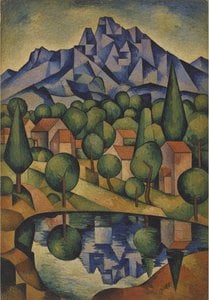
Explore the profound legacy of Paul Cézanne. Discover how his mastery of geometric forms and vibrant color bridged Impressionism and Cubism, offering timeless inspiration for fine art collectors and enthusiasts seeking to understand the foundations of modern art.

Master the nuances of Impressionism vs. Post-Impressionism with our expert guide. Explore the revolutionary shift from Monet’s fleeting light to Van Gogh’s emotional depth. Discover how these iconic movements continue to inspire fine art collectors and modern interiors today.

Explore the structural genius of Paul Cézanne. Discover how his mastery of geometric form and color bridged Impressionism and Cubism in this definitive guide for art enthusiasts and collectors.

 Preview
 Send
Send Share
Share
 Details
 Guide
Guide

 Download
 Similars
 X-Ray
X-Ray Diaporama
 Stats
Stats

 Read More







 Glass option is only available in size under 110 CM


