Preview AR preview Buy Hand Made Painting Switch to Digital Image Send
Details Guide Add to favorites Download Similars X-Ray Diaporama Stats

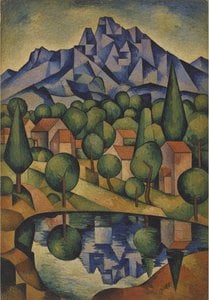
Bibemus Quarry

Experience Paul Cézanne’s ‘Bibemus Quarry,’ a pivotal Cubist landscape exploring geometric forms and multiple perspectives. A masterpiece bridging Impressionism & modern art, now available as a stunning hand-painted reproduction.

Post-Impressionist master Paul Cezanne bridged Impressionism and Cubism with Mont Sainte-Victoire. Explore his revolutionary works today.

Giclée / Art Print

Museum-quality giclée or canvas print with fast production and flexible finish options. ( Buy Hand Made Painting Switch to Digital Image)

Corner sample of the P118B picture frame: moulded polystyrene, 5 cm wide and 3 cm thick
P118B $10
Corner sample of the P118H picture frame: moulded polystyrene, 5 cm wide and 3 cm thick
P118H $10
Corner sample of the P118W picture frame: moulded polystyrene, 5 cm wide and 3 cm thick
P118W $10
Corner sample of the P438Z picture frame: moulded polystyrene, 5.5 cm wide and 3.5 cm thick
P438Z $10
Corner sample of the P508JH picture frame: moulded polystyrene, 7 cm wide and 3.5 cm thick
P508JH $12
Corner sample of the P508YH picture frame: moulded polystyrene, 7 cm wide and 3.5 cm thick
P508YH $12
Corner sample of the P805H picture frame: moulded polystyrene, 5 cm wide and 3.5 cm thick
P805H $10
Corner sample of the P805Z picture frame: moulded polystyrene, 5 cm wide and 3.5 cm thick
P805Z $10
Corner sample of the P919BZ picture frame: moulded polystyrene, 7 cm wide and 3.5 cm thick
P919BZ $10
Corner sample of the P919G picture frame: moulded polystyrene, 7 cm wide and 3.5 cm thick
P919G $10
Corner sample of the P919XJ picture frame: moulded polystyrene, 7 cm wide and 3.5 cm thick
P919XJ $10
Corner sample of the P959ZH picture frame: moulded polystyrene, 5 cm wide and 3 cm thick
P959ZH $10
Corner sample of the P968JZ picture frame: moulded polystyrene, 6 cm wide and 4 cm thick
P968JZ $12
Corner sample of the W106C picture frame: solid wood, 5 cm wide and 3 cm thick
W106C $8
Corner sample of the W218G picture frame: solid wood, 5 cm wide and 3 cm thick
W218G $10
Corner sample of the W218JH picture frame: solid wood, 5 cm wide and 3 cm thick
W218JH $8
Corner sample of the W218Y picture frame: solid wood, 5 cm wide and 3 cm thick
W218Y $10
Corner sample of the W307PJ picture frame: solid wood, 6 cm wide and 3 cm thick
W307PJ $10
Corner sample of the W316G picture frame: solid wood, 6 cm wide and 3 cm thick
W316G $10
Corner sample of the W316PJ picture frame: solid wood, 6 cm wide and 3 cm thick
W316PJ $8
Corner sample of the W316Y picture frame: solid wood, 6 cm wide and 3 cm thick
W316Y $10
Corner sample of the W398PJ picture frame: solid wood, 5 cm wide and 3 cm thick
W398PJ $8
Corner sample of the W4111J picture frame: solid wood, 6.5 cm wide and 3.5 cm thick
W4111J $10
Corner sample of the W500HY picture frame: solid wood, 7 cm wide and 5 cm thick
W500HY $15
Corner sample of the W500JH picture frame: solid wood, 7 cm wide and 5 cm thick
W500JH $15
Corner sample of the W692G picture frame: solid wood, 8 cm wide and 4 cm thick
W692G $12
Corner sample of the W849H picture frame: solid wood, 5 cm wide and 3 cm thick
W849H $8
Corner sample of the W940BG picture frame: solid wood, 7.5 cm wide and 4.5 cm thick
W940BG $15
Corner sample of the W953PJ picture frame: solid wood, 6 cm wide and 3.5 cm thick
W953PJ $8

Standard
custom
CM
INCH

Pick from our preset sizes that match the artwork's original proportions.

width
height

Type the width and the height you need, to fit your frame or your wall. A print can only be cut, never made bigger than the picture, so a size with a different shape loses a part of the image. We send you a digital mockup to approve before we print anything. The picture shown on this page does not show the real cut — only the mockup does.

Worldwide Delivery () in 2 weeks instead of standard 4/5 weeks. (23 October)

Free Worldwide Express Shipping
High-Quality Linen Canvas
Full Shipping Insurance
Customs Tax Refund Guarantee
True Color Matching Guarantee
100-Day Return Policy (Defects Only)
100% Money-Back Guarantee
Bulk Discount Offer

Total Price

$ 69

Bibemus Quarry

Giclée / Art Print

Reproduction Size

-

Total Price

$ 69

Quick Facts

  • Notable elements: Geometric forms
  • Title: Bibemus Quarry
  • Influences:
    • Cézanne
    • Picasso
  • Subject or theme: Landscape
  • Dimensions: 65 x 81 cm
  • Artist: Paul Cézanne

Art Quiz

There is only one correct answer for each question.

Question 1:
What art movement is Paul Cézanne most closely associated with?
Question 2:
The painting 'Bibemus Quarry' primarily focuses on:
Question 3:
Which artist is often credited with laying the groundwork for Cubism, as demonstrated in 'Bibemus Quarry'?
Question 4:
The painting utilizes a technique of breaking down objects into geometric shapes. What is this technique known as?
Question 5:
During which period did Cézanne primarily work on paintings like 'Bibemus Quarry', contributing to the development of Proto-Cubism?

Bibemus Quarry: A Pioneering Vision of Space and Form

Paul Cézanne’s *Bibemus Quarry*, painted in 1900, stands as a pivotal work bridging the Impressionistic world he inherited with the nascent explorations of Cubism that would reshape modern art. More than simply a landscape depiction, it's a profound investigation into the very nature of seeing and representation – a testament to Cézanne’s revolutionary approach to capturing the essence of natural forms through geometric simplification and multiple perspectives. The painting invites us not just to *look* at a scene, but to *experience* it, to feel its solidity and depth as if we were standing within that sun-drenched Provençal hillside. The composition immediately draws attention to the central tree, its robust trunk emerging dramatically from the rocky terrain. Cézanne doesn’t render this tree with photographic accuracy; instead, he dissects it – breaking down its complex volume into a series of interlocking planes and angles. The rough texture of the bark, the sharp edges of the branches, are all rendered with an almost sculptural quality. This deliberate fragmentation is key to understanding Cézanne's ambition: to move beyond merely imitating nature and instead to reveal its underlying structure, its essential geometry. The background, a tapestry of distant trees and bushes, isn’t simply painted in the distance; it recedes into space through careful manipulation of color and form, creating an illusion of atmospheric perspective that adds immense depth to the scene. A small building, hinting at human presence, is strategically placed – not as a focal point, but as a subtle element contributing to the overall sense of scale and spatial relationships.

Cubism’s Genesis: Cézanne's Groundbreaking Influence

Cézanne’s work served as a crucial catalyst for the development of Cubism, an art movement spearheaded by Pablo Picasso and Georges Braque. While these artists built upon Cézanne’s innovations, it was his relentless experimentation with perspective and form that laid the groundwork for their revolutionary approach. *Bibemus Quarry* exemplifies this transition perfectly. Unlike traditional landscape painting which typically presents a single, unified viewpoint, Cézanne offers us multiple perspectives simultaneously – as if we were shifting our position within the scene, constantly altering our perception of its spatial arrangement. This technique, anticipating Cubism’s deconstruction of form and fragmentation of space, was utterly groundbreaking at the time. It's no exaggeration to suggest that Cézanne’s work provided the conceptual framework for a complete reimagining of how artists could represent reality on canvas. The painting’s creation coincided with a period known as Proto-Cubism (1906-1910), characterized by an increasing emphasis on geometric abstraction and a reduction in color palettes. Artists like Juan Gris, Jean Metzinger, and Albert Gleizes were actively exploring these concepts, building upon Cézanne's legacy. This phase saw a gradual shift from the vibrant hues of Impressionism towards the more muted tones favored by the nascent Cubists – a move that mirrored Cézanne’s own evolving artistic language as he moved away from purely optical representation and toward a more conceptual approach to painting.

A Bridge Between Eras: Cézanne's Enduring Legacy

The impact of Cézanne’s work extended far beyond the confines of Cubism, influencing a wide range of subsequent art movements, including Futurism, Suprematism, Dada, Constructivism, De Stijl, and even Art Deco. His emphasis on form, color, and spatial relationships profoundly impacted the development of abstract art, demonstrating that painting could be more than just a representation of external reality; it could be an exploration of internal structures and perceptions. Remarkably, Cézanne himself acknowledged his debt to earlier masters, particularly Michelangelo, stating that he sought to “paint like Michelangelo.” However, it was through his own unique vision – one rooted in the observation of nature and driven by a desire to capture its underlying geometry – that he truly revolutionized the art world. The influence of *Bibemus Quarry* is palpable in the works of artists who followed, including Henri Matisse and, significantly, Pablo Picasso, who famously declared Cézanne “the father of us all.” Cézanne’s legacy continues to resonate today, reminding us of the power of abstraction and the enduring relevance of his pioneering approach to painting.

Bringing Cézanne's Vision Home: A WahooArt Reproduction

WahooArt offers meticulously crafted, hand-painted oil reproduction reproductions of *Bibemus Quarry*, allowing you to experience the depth and nuance of this iconic masterpiece in stunning detail. Each reproduction is created by skilled artists who painstakingly recreate Cézanne’s brushstrokes and color palette, ensuring an authentic representation of the original painting. Whether displayed in a contemporary setting or as part of a classic art collection, our *Bibemus Quarry* reproductions are a beautiful way to celebrate Cézanne's enduring legacy and bring his revolutionary vision into your home. Explore other paintings by Paul Cézanne at WahooArt.com.

Questions & Answers

Is there a guide for "Bibemus Quarry" by Paul Cézanne?

The guide to "Bibemus Quarry" is the artwork's Guide page - a printable factsheet showing the artwork with its caption, credit line and identity table (artist, dates, medium, original size, collection).

What is a reproduction of "Bibemus Quarry" by Paul Cézanne recommended for?

The suggested use for "Bibemus Quarry" by Paul Cézanne is statement. It can serve other purposes as well.

How does the style of "Bibemus Quarry" relate to its creator's era?

"Bibemus Quarry" belongs to the Cubism movement, and its creator worked in the 19th-Century era.


Artist Biography

The Architect of Form

Paul Cézanne was born in Aix-en-Provence, France, into a family with deep roots in the local banking industry. His father, Louis-Auguste Cézanne, helped found the Banque Cézanne et Cabassol, providing a level of financial stability that many of his contemporaries lacked. This security allowed Paul to move away from the legal studies his father had planned for him. Though he initially studied law at the University of Aix-en-Provence, he abandoned those studies in 1860 to focus entirely on painting. His early years were spent in the company of friends like Émile Zola, and together they shared a childhood of swimming and fishing along the banks of the Arc River.

The early works of Cézanne often carried the weight of Romanticism, utilizing dark palettes and heavy, expressive brushwork. He was influenced by the dramatic tonal contrasts found in the tradition of Eugène Delacroix. However, his approach began to shift as he moved toward Paris. He sought a way to move beyond the fleeting light captured by the Impressionists. Instead of merely recording a passing moment, he wanted to find the permanent structure within nature. He looked at a mountain or a piece of fruit and saw the underlying geometry—the cones, spheres, and cylinders that form the bones of the world.

A New Way of Seeing

Cézanne developed a technique characterized by small, repetitive, and constructive brushstrokes. He layered these patches of color to build up volume and texture, creating a sense of solidity. This method allowed him to explore spatial relationships without relying on traditional single-point perspective. In many of his compositions, objects appear independent within the space, often presented from multiple viewpoints at once. This rejection of classical perspective rules helped create a new pictorial language.

His subject matter was deeply tied to his surroundings in Provence. The Mont Sainte-Victoire became a recurring presence in his work, appearing in approximately eighty different paintings and watercolors over many years. He also found profound meaning in the simplest objects. His still lifes, featuring items like apples, jars, and cups, were not mere decorations but intense studies of light, shadow, and mass. Through these works, he demonstrated how color modulation could define shape without the need for traditional shading.

  • The Bathers (Les Grandes Baigneuses)
  • Mont Sainte-Victoire series
  • Still Life with Apples and a Pot of Primroses
  • Portrait of Émile Zola
  • The Card Players

A Lasting Influence

By the time of his death in 1906, Cézanne had fundamentally altered the direction of modern painting. His emphasis on geometric form and multiple perspectives provided a foundation for the Cubist movement. Artists such as Pablo Picasso and Georges Braque drew heavily from his analytical approach to nature. His use of bold, non-naturalistic color also left an impression on the Fauvists, including Henri Matisse. He moved art away from the imitation of reality toward a construction of visual experience based on perception and structure.

Paul Cézanne

Paul Cézanne

1839 - 1906 , France

Quick Facts

  • Artistic Movement Or Style: Post-Impressionism
  • Artists Or Movements Influenced By This Artist:
    • Cubism
    • Fauvism
    • Pablo Picasso
    • Henri Matisse
  • Artists Who Influenced This Artist:
    • Paul Gauguin
    • Georges Seurat
  • Full Name: Paul Cézanne
  • Nationality: French
  • Notable Artworks:
    • The Pond at Jas de Bouffan
    • Portrait of Émile Zola
    • Mont Sainte-Victoire series
    • Bathers
  • Place Of Birth: Aix-en-Provence, France
  • Date Of Birth: 1839
  • Date Of Death: 1906
Explore artworks organized by themes, styles, and characteristics.