

 Oil On CanvasWallArtPost-Impressionism
 187019th Century
 33.0 x 40.0 cm
Museum-quality giclée or canvas print with fast production and flexible finish options. ( Buy Hand Made Painting Switch to Digital Image)





























Pick from our preset sizes that match the artwork's original proportions.

Type the width and the height you need, to fit your frame or your wall. A print can only be cut, never made bigger than the picture, so a size with a different shape loses a part of the image. We send you a digital mockup to approve before we print anything. The picture shown on this page does not show the real cut — only the mockup does.
Worldwide Delivery () in 2 weeks instead of standard 4/5 weeks. (24 October)
Bathers (11)
Reproduction Size
Paul Cézanne's "Bathers (11)," painted around 1870-1873, isn’t merely a depiction of nude figures; it’s the genesis of an artistic revolution. Emerging from the fertile ground of late Impressionism, this work represents a pivotal shift in Cézanne’s approach to representation – a deliberate move away from fleeting impressions and towards a more structured, enduring vision of reality. The painting reflects his deep fascination with the human form within the embrace of nature, a theme he would relentlessly pursue throughout his career. Initially influenced by Romanticism's emphasis on emotional intensity and the Barbizon school’s focus on landscape, Cézanne sought to synthesize these influences into something uniquely his own. The choice of bathers—a subject steeped in classical tradition – provided a framework for exploring fundamental geometric forms and spatial relationships, laying the groundwork for what would later become Cubism. The serene atmosphere, achieved through a deliberate restraint of color and a focus on tonal values, invites contemplation and a sense of quietude, a stark contrast to the vibrant palettes often associated with Impressionism.
Cézanne’s mastery lies not in meticulous detail but in his innovative use of brushstrokes. He abandoned the short, broken strokes favored by Impressionists, opting instead for a technique he himself described as “planes of color.” Imagine each figure—the reclining woman on the left, the one reaching upwards, and the third seated—as constructed from these distinct planes, subtly overlapping and interweaving to create an illusion of depth and volume. His brushwork is remarkably small and precise, building up layers of pigment to achieve a textured surface that seems to shimmer with light. This deliberate manipulation of form isn’t about replicating reality; it's about distilling the essence of the subject – its structure, its weight, its relationship to space – into a simplified, enduring representation. The painting’s monochrome palette—a carefully orchestrated dance of blacks and whites—further emphasizes this structural approach, allowing Cézanne to focus entirely on the interplay of light and shadow and the underlying geometry of his subjects.
Beyond its formal innovations, "Bathers (11)" is rich with symbolic resonance. The presence of a bird soaring above the figures immediately elevates the scene, imbuing it with a sense of freedom and tranquility. It’s not simply a decorative element; it represents an aspiration towards a higher state of being, a connection to the boundless expanse of nature. The surrounding trees, rendered in broad, simplified strokes, act as anchors, firmly grounding the figures within their natural environment. They create a unified composition—a harmonious blend of human form and organic landscape—suggesting a profound sense of unity between humanity and the world around it. The arrangement of the bathers themselves – diagonally oriented and subtly overlapping – mirrors the branching patterns of trees, reinforcing this connection to nature. The painting isn’t about depicting a specific moment in time; it's about capturing an enduring state of equilibrium.
Initially met with skepticism and incomprehension by critics who were accustomed to the fleeting effects of Impressionism, Cézanne’s work gradually gained recognition through the efforts of fellow artists like Camille Pissarro and the discerning eye of art dealer Ambroise Vollard. His 1895 solo exhibition in Vollard's Paris gallery proved a watershed moment, establishing Cézanne as a key figure in the transition from Impressionism to modern art. He profoundly influenced generations of artists, including Henri Matisse and Pablo Picasso, who recognized in his work a radical departure from traditional representation. Cézanne’s emphasis on geometric form, flattened perspective, and the exploration of underlying structure paved the way for Cubism and other avant-garde movements of the early 20th century. “Bathers (11)” stands as a testament to Cézanne's visionary genius—a painting that not only captures a moment in time but also anticipates the future of art.
The Similars page of "Bathers (11)" by Paul Cézanne presents related artworks.
The AR Preview page of "Bathers (11)" by Paul Cézanne uses augmented reality to show the artwork in your own space, on a compatible device.
A reproduction of "Bathers (11)" by Paul Cézanne is recommended for harmony. This suggestion follows from the work's subject, mood and colors.

Paul Cézanne was born in Aix-en-Provence, France, into a family with deep roots in the local banking industry. His father, Louis-Auguste Cézanne, helped found the Banque Cézanne et Cabassol, providing a level of financial stability that many of his contemporaries lacked. This security allowed Paul to move away from the legal studies his father had planned for him. Though he initially studied law at the University of Aix-en-Provence, he abandoned those studies in 1860 to focus entirely on painting. His early years were spent in the company of friends like Émile Zola, and together they shared a childhood of swimming and fishing along the banks of the Arc River.
The early works of Cézanne often carried the weight of Romanticism, utilizing dark palettes and heavy, expressive brushwork. He was influenced by the dramatic tonal contrasts found in the tradition of Eugène Delacroix. However, his approach began to shift as he moved toward Paris. He sought a way to move beyond the fleeting light captured by the Impressionists. Instead of merely recording a passing moment, he wanted to find the permanent structure within nature. He looked at a mountain or a piece of fruit and saw the underlying geometry—the cones, spheres, and cylinders that form the bones of the world.
Cézanne developed a technique characterized by small, repetitive, and constructive brushstrokes. He layered these patches of color to build up volume and texture, creating a sense of solidity. This method allowed him to explore spatial relationships without relying on traditional single-point perspective. In many of his compositions, objects appear independent within the space, often presented from multiple viewpoints at once. This rejection of classical perspective rules helped create a new pictorial language.
His subject matter was deeply tied to his surroundings in Provence. The Mont Sainte-Victoire became a recurring presence in his work, appearing in approximately eighty different paintings and watercolors over many years. He also found profound meaning in the simplest objects. His still lifes, featuring items like apples, jars, and cups, were not mere decorations but intense studies of light, shadow, and mass. Through these works, he demonstrated how color modulation could define shape without the need for traditional shading.
By the time of his death in 1906, Cézanne had fundamentally altered the direction of modern painting. His emphasis on geometric form and multiple perspectives provided a foundation for the Cubist movement. Artists such as Pablo Picasso and Georges Braque drew heavily from his analytical approach to nature. His use of bold, non-naturalistic color also left an impression on the Fauvists, including Henri Matisse. He moved art away from the imitation of reality toward a construction of visual experience based on perception and structure.

1839 - 1906 , France

Master the nuances of Impressionism vs. Post-Impressionism with our expert guide. Explore the revolutionary shift from Monet’s fleeting light to Van Gogh’s emotional depth. Discover how these iconic movements continue to inspire fine art collectors and modern interiors today.

Explore the structural genius of Paul Cézanne. Discover how his mastery of geometric form and color bridged Impressionism and Cubism in this definitive guide for art enthusiasts and collectors.
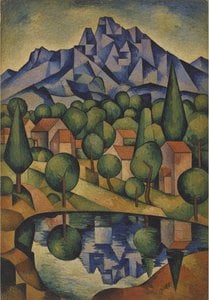
Explore the profound legacy of Paul Cézanne. Discover how his mastery of geometric forms and vibrant color bridged Impressionism and Cubism, offering timeless inspiration for fine art collectors and enthusiasts seeking to understand the foundations of modern art.

Unveil the profound revolution of Post-Impressionism. Explore how masters like Van Gogh and Cézanne utilized bold colors and emotional depth to transcend mere representation, laying the foundation for modern art. A sophisticated journey through history's most emotive brushstrokes.

Explore the transformative era of Post-Impressionism. Discover how masters like Cézanne and Matisse revolutionized color and form, moving beyond Impressionism to shape modern art history through structural innovation and expressive emotion.

 Preview
 Send
Send Share
Share
 Details
 Guide
Guide

 Download
 Similars
 X-Ray
X-Ray Diaporama
 Stats
Stats Read More









 Glass option is only available in size under 110 CM


