

 Oil On CanvasWallArtAnalytical Cubism
 1903Modern
 70.0 x 56.0 cm
The artwork displayed on this page is protected by copyright law, which means we cannot legally create or sell an identical reproduction. This protection is enforced under international agreements such as the Berne Convention and by national laws, including those outlined by the U.S. Copyright Law - Title 17.
This method fully complies with copyright regulations because it does not involve copying or duplicating the protected artwork. Instead, it is a creative reinterpretation - a new painting that is influenced by the original but not identical to it.
Museum-quality giclée or canvas print with fast production and flexible finish options. ( Buy Hand Made Painting Switch to Digital Image)





























Pick from our preset sizes that match the artwork's original proportions.

Type the width and the height you need, to fit your frame or your wall. A print can only be cut, never made bigger than the picture, so a size with a different shape loses a part of the image. We send you a digital mockup to approve before we print anything. The picture shown on this page does not show the real cut — only the mockup does.
Worldwide Delivery () in 2 weeks instead of standard 4/5 weeks. (26 October)
Untitled (D2X2HG)
Reproduction Size
In the quiet, melancholic depths of 1903, a young Pablo Picasso captured something far more profound than a mere domestic scene; he captured the very essence of human vulnerability. Untitled (D2X2HG) serves as a hauntingly beautiful window into the artist's formative years, a period where his brush was heavily influenced by the somber, monochromatic tones of his Blue Period. The painting presents an intimate encounter between two figures intertwined within the sanctuary of a bed, an image that transcends simple eroticism to explore the delicate tension between desire and solitude. As the viewer gazenter into this blue-toned world, they are not merely observing a moment in time, but are invited to feel the weight of the silence that hangs over the room.
The composition is masterfully orchestrated to draw the eye toward the emotional epicenter of the work. A man sits beside a woman, his hand resting tenderly upon her face, creating a focal point of profound connection amidst a sea of cool, shadowed hues. The bed itself dominates much of the canvas, acting as both a stage for this intimate drama and a structural element that anchors the scene. Subtle details—a chair tucked into the periphery, a clock watching from the wall, and even the suggestion of a cup nearby—lend a sense of lived-in reality to the piece, suggesting that this moment is but one heartbeat in a much larger, unfolding narrative of human existence.
While the emotional palette of this work remains rooted in the soulful melancholy of Picasso's early years, there is an unmistakable structural revolution occurring beneath the surface. This piece stands as a vital precursor to Proto-Cubism, showcasing Picasso’s burgeoning desire to dismantle the rigid constraints of academic realism. Rather than adhering to a perfect, photographic perspective, the artist begins to experiment with fractured planes and geometric distortions. The edges of the bed and the limbs of the figures are not merely drawn; they are constructed through interlocking shapes that disrupt linear space.
This stylistic departure is far from accidental. By deconstructing traditional representation, Picasso challenges the viewer to perceive reality not as a static image, but as a multifaceted experience. The way the planes of the bed overlap and intersect mirrors the psychological complexity of the subject matter itself—the blurring of boundaries between two souls in a moment of shared intimacy. For the collector or the interior designer, this provides a fascinating duality: the painting offers the soothing, atmospheric beauty of a classical scene while simultaneously providing the intellectual edge of modern, avant-garde experimentation.
The physical presence of Untitled (D2X2HG) is defined by Picasso’s masterful use of oil on canvas. He employs a technique characterized by thick impasto, where the paint is applied with enough vigor to create a tactile, sculptural surface. This texture does more than just catch the light; it amplifies the emotional resonance of the work. The ridges and valleys of the dried oil capture shadows and highlights in a way that breathes life into the blue tones, making the atmosphere feel heavy, humid, and deeply immersive.
This marriage of precision and impressionistic influence makes the piece an extraordinary choice for high-quality reproductions. A well-crafted hand-painted version of this work preserves that essential depth, allowing the interplay of light and shadow to transform any space it inhabits. Whether placed in a contemporary gallery setting or a classic study, the painting acts as a profound emotional anchor, offering a sense of historical weight and artistic mastery that continues to inspire awe more than a century after its creation.
"Untitled (D2X2HG)" has an augmented reality preview: the artwork's AR Preview page shows it in your own space on a compatible device.
You can order a hand-painted reproduction of "Untitled (D2X2HG)" by Pablo Picasso directly on its Hand-Painted Reproduction page: a hand-painted oil reproduction on linen canvas, made to order.
Within Pablo Picasso's career, "Untitled (D2X2HG)" falls in the Analytical Cubism. The phase helps compare it with the artist's other works.

A child's first words in Málaga were “piz, piz,” a small attempt at saying pencil. This early pull toward the lead and paper was nurtured by his father, José Ruiz y Blasco, who taught him the basics of figure drawing and oil painting. The boy learned to copy the masters and draw from plaster casts under a disciplined eye. As he grew, the family moved through A Coruña and Barcelona. These years were marked by the quiet weight of loss, particularly the death of his sister, Conchita, from diphtheria when she was only seven. Such shadows would later find their way into the heavy, blue-green tones of his early work.
By thirteen, he was already taking entrance exams for advanced classes in Barcelona, finishing in a week what took others a month. His hands moved with a precision that even his father noticed, once seeing him paint over an unfinished sketch of a pigeon with such accuracy that the instructor realized the student had surpassed him. He eventually moved to Paris, a city where he would spend much of his adult life, constantly shifting his focus from one way of seeing to another.
The early twentieth century saw his work move through distinct phases of color and mood. There was the Blue Period, where the canvases were filled with beggars, the blind, and the lonely, rendered in somber shades of blue. This gave way to the Rose Period, a time when pinks, oranges, and reds appeared, often featuring the figures of circus performers like harlequins and acrobats. These years showed a man reacting to his own life and the world around him through the temperature of his palette.
In 1907, the way he handled space changed fundamentally with Les Demoiselles d'Avignon. Influenced by African masks and Iberian sculpture, he began to break objects into geometric shapes. Alongside Georges Braque, he developed Cubism. This involved two main stages:
His work never settled into a single way of being. He explored Neoclassicism with large, monumental figures and later engaged with the imagery of Surrealism, using distorted perspectives to tap into the subconscious. The violence of the Spanish Civil War left its mark on his canvas in 1937 through Guernica. This large oil painting used a stark palette of black, white, and grey to show the suffering of a bombed town, featuring a gored horse, a bull, and screaming women. It remains a heavy, monochromatic response to the chaos of war.
In his later years, he continued to experiment with ceramics, sculpture, and printmaking. He even created large-scale public works, such as the 1967 steel sculpture in Chicago, which was inspired by the head of his Afghan Hound, Kabul. He died in Mougins, France, leaving behind a massive collection of work that spans over seventy-six years of experimentation.

1881 - 1973 , Spain

Transform your home with soulful blue art. From serene Monet impressions to modern textured sculptures, discover curated masterpieces designed to inspire calm. Explore expert art consultations and bespoke hand-painted reproductions to create your personal sanctuary.
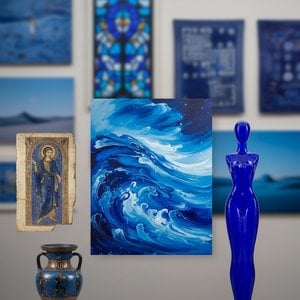
Explore the rich history of blue in art! Discover its symbolism, from ancient pigments to modern masterpieces by Kandinsky & Seurat. Uncover the psychological impact and cultural meanings behind this captivating hue.

Immerse yourself in the captivating world of slate blue! Explore 10 iconic paintings by Monet, Van Gogh & Renoir. Discover their stories, techniques & find museum-quality art reproductions for your home at .

Explore 10 iconic paintings with captivating 'mushroom' tones! Discover Van Gogh, Monet & Rembrandt’s masterpieces—earthy palettes, rich history & artistic techniques. Find museum-quality art reproductions and curated decor ideas at

Journey through 25 iconic artworks by Paul Cézanne – a master of Impressionism and Post-Impressionism. Explore his landscapes, still lifes, and the stories behind these timeless masterpieces. Discover museum-quality reproductions & curated decor at WahooArt.com.

 Preview
 Send
Send Share
Share
 Details
 Guide
Guide

 Download
 Similars
 X-Ray
X-Ray Diaporama
 Stats
Stats Read More









 Glass option is only available in size under 110 CM


