

The artwork displayed on this page is protected by copyright law, which means we cannot legally create or sell an identical reproduction. This protection is enforced under international agreements such as the Berne Convention and by national laws, including those outlined by the U.S. Copyright Law - Title 17.
As a respectful and legal alternative, we offer custom, hand-painted artworks inspired by the original. Our skilled and professional artists carefully study the original's style, mood, and artistic essence to create a new, unique piece that evokes the same feeling - while remaining an original creation in its own right.
This method fully complies with copyright regulations because it does not involve copying or duplicating the protected artwork. Instead, it is a creative reinterpretation - a new painting that is influenced by the original but not identical to it.
Hand-painted oil on canvas in your size and frame, made to order by our artists. ( Switch to Print Switch to Digital Image)





























Pick from our preset sizes that match the artwork's original proportions.

Type the width and the height you need, to fit your frame or your wall. This is hand-painted, so for a size with a different shape the artist can paint a bit more around the picture, or cut a bit — you choose. We send you a digital mockup to approve before the painting starts. The picture shown on this page does not show the real result — only the mockup does.
Worldwide Delivery () in 3/4 weeks instead of standard 5 weeks. (21 October). No compromise on quality.
Untitled
Reproduction Size
Pablo Picasso's "Untitled," a monochromatic etching or engraving from 1970, isn’t merely a depiction of the Nativity; it’s a visceral exploration of faith, vulnerability, and the unsettling potential lurking beneath the surface of tradition. This work, often categorized as leaning towards Expressionism, immediately commands attention with its stark contrasts – deep shadows that swallow figures whole against a sparse, cavernous space. It's a scene stripped bare of conventional iconography, replaced by a raw psychological drama that speaks volumes about the anxieties and uncertainties inherent in any profound event.
The composition is dominated by forceful diagonal lines, creating an immediate sense of unease and movement. These aren’t the gentle curves of a serene landscape; they are sharp, angular intrusions, pulling the viewer into the tightly clustered figures – Mary, Joseph, and three imposing, almost regal, figures who could be interpreted as shepherds or kings. Picasso masterfully utilizes hatching and cross-hatching to build volume and texture, simulating the rough surface of stone or weathered wood, grounding the ethereal subject matter in a tangible reality. The lighting, seemingly emanating from an unseen source, is deliberately dramatic, intensifying the shadows and amplifying the figures’ emotional weight.
What truly distinguishes this piece is Picasso's extraordinary command of line. It’s not simply a means of outlining forms; it’s an expressive tool in itself. The lines are incredibly detailed, yet simultaneously loose and gestural, conveying both precision and a sense of urgency. This meticulous execution, achieved through the painstaking process of etching or engraving – utilizing metal plates and acid to create the intricate lines – speaks volumes about Picasso's dedication to his craft. The varying density of the lines creates a remarkable textural effect, adding depth and richness to the image while simultaneously reinforcing its inherent tension.
Notice how the flattened perspective contributes to the overall feeling of unease. Picasso deliberately eschews realistic depth, prioritizing emotional impact over spatial accuracy. This stylistic choice forces us to confront the scene directly, amplifying its psychological intensity. The monochromatic palette further enhances this effect, stripping away any potential distractions and focusing our attention on the figures’ expressions and their interaction.
Beyond its immediate visual impact, “Untitled” is rich in symbolic meaning. The Nativity scene, a cornerstone of Christian faith, is presented not as a celebration of joyous birth, but as a moment fraught with vulnerability and uncertainty. The figures’ expressions are ambiguous – not overtly joyful or sorrowful, but imbued with a quiet intensity that suggests apprehension and perhaps even foreboding. These aren't idealized representations; they are deeply human, grappling with the weight of an extraordinary event.
The imposing figures flanking Mary and Joseph could be interpreted as representing the forces of fate or the challenges inherent in accepting divine will. The cavernous space itself suggests a sense of isolation and vulnerability, mirroring the precariousness of the situation. Picasso’s deliberate distortion of forms and his masterful use of line serve to heighten these symbolic resonances, transforming a familiar biblical narrative into a powerful meditation on human experience.
Created in 1970, towards the end of Picasso’s illustrious career, this work exemplifies his lifelong commitment to experimentation and pushing the boundaries of artistic expression. His exploration of themes like doubt, mortality, and the human condition resonates powerfully even today. Picasso's influence on 20th-century art is undeniable, having co-founded Cubism and pioneered techniques such as collage and constructed sculpture. Reproductions of “Untitled” offer a unique opportunity to experience firsthand the genius of one of history’s most transformative artists.
The dominant color of "Untitled" by Pablo Picasso is rosy brown (#a6a6a6).
The creation of "Untitled" by Pablo Picasso is dated 1970.
The recorded mood of "Untitled" by Pablo Picasso is dramatic, and its emotional tone is melancholic.

A child's first words in Málaga were “piz, piz,” a small attempt at saying pencil. This early pull toward the lead and paper was nurtured by his father, José Ruiz y Blasco, who taught him the basics of figure drawing and oil painting. The boy learned to copy the masters and draw from plaster casts under a disciplined eye. As he grew, the family moved through A Coruña and Barcelona. These years were marked by the quiet weight of loss, particularly the death of his sister, Conchita, from diphtheria when she was only seven. Such shadows would later find their way into the heavy, blue-green tones of his early work.
By thirteen, he was already taking entrance exams for advanced classes in Barcelona, finishing in a week what took others a month. His hands moved with a precision that even his father noticed, once seeing him paint over an unfinished sketch of a pigeon with such accuracy that the instructor realized the student had surpassed him. He eventually moved to Paris, a city where he would spend much of his adult life, constantly shifting his focus from one way of seeing to another.
The early twentieth century saw his work move through distinct phases of color and mood. There was the Blue Period, where the canvases were filled with beggars, the blind, and the lonely, rendered in somber shades of blue. This gave way to the Rose Period, a time when pinks, oranges, and reds appeared, often featuring the figures of circus performers like harlequins and acrobats. These years showed a man reacting to his own life and the world around him through the temperature of his palette.
In 1907, the way he handled space changed fundamentally with Les Demoiselles d'Avignon. Influenced by African masks and Iberian sculpture, he began to break objects into geometric shapes. Alongside Georges Braque, he developed Cubism. This involved two main stages:
His work never settled into a single way of being. He explored Neoclassicism with large, monumental figures and later engaged with the imagery of Surrealism, using distorted perspectives to tap into the subconscious. The violence of the Spanish Civil War left its mark on his canvas in 1937 through Guernica. This large oil painting used a stark palette of black, white, and grey to show the suffering of a bombed town, featuring a gored horse, a bull, and screaming women. It remains a heavy, monochromatic response to the chaos of war.
In his later years, he continued to experiment with ceramics, sculpture, and printmaking. He even created large-scale public works, such as the 1967 steel sculpture in Chicago, which was inspired by the head of his Afghan Hound, Kabul. He died in Mougins, France, leaving behind a massive collection of work that spans over seventy-six years of experimentation.

1881 - 1973 , Spain
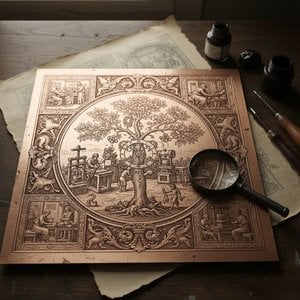
Explore the intricate world of etching and intaglio printmaking. Discover how masters use acid and metal to create profound textures and lines, from Romanticism to modern era, through an expert lens of art history and technical mastery.

Master the nuances of Giclée printing with our expert guide. Discover how pigment-based inks and museum-grade substrates create fade-resistant, high-fidelity art reproductions designed for discerning collectors seeking unparalleled quality and longevity.

 Preview
 Send
Send Share
Share
 Details
 Guide
Guide

 Download
 Similars
 X-Ray
X-Ray Diaporama
 Stats
Stats

 Read More









 Glass option is only available in size under 110 CM


