Preview AR preview Buy Hand Made Painting Switch to Digital Image Send
Details Guide Add to favorites Download Similars X-Ray Diaporama Stats

The violin

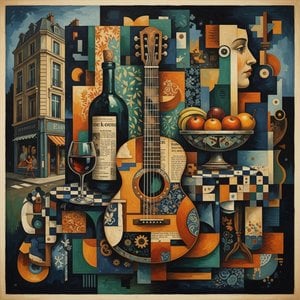
Dive into Picasso's 'The Violin'! This Synthetic Cubist masterpiece fragments the instrument with innovative collage & multiple perspectives, showcasing his revolutionary approach to modern art.

Co-founder of Cubism and creator of Guernica. Discover the revolutionary works of Pablo Picasso today.

The artwork displayed on this page is protected by copyright law, which means we cannot legally create or sell an identical reproduction. This protection is enforced under international agreements such as the Berne Convention and by national laws, including those outlined by the U.S. Copyright Law - Title 17.

This method fully complies with copyright regulations because it does not involve copying or duplicating the protected artwork. Instead, it is a creative reinterpretation - a new painting that is influenced by the original but not identical to it.

Giclée / Art Print

Museum-quality giclée or canvas print with fast production and flexible finish options. ( Buy Hand Made Painting Switch to Digital Image)

Corner sample of the P118B picture frame: moulded polystyrene, 5 cm wide and 3 cm thick
P118B $10
Corner sample of the P118H picture frame: moulded polystyrene, 5 cm wide and 3 cm thick
P118H $10
Corner sample of the P118W picture frame: moulded polystyrene, 5 cm wide and 3 cm thick
P118W $10
Corner sample of the P438Z picture frame: moulded polystyrene, 5.5 cm wide and 3.5 cm thick
P438Z $10
Corner sample of the P508JH picture frame: moulded polystyrene, 7 cm wide and 3.5 cm thick
P508JH $12
Corner sample of the P508YH picture frame: moulded polystyrene, 7 cm wide and 3.5 cm thick
P508YH $12
Corner sample of the P805H picture frame: moulded polystyrene, 5 cm wide and 3.5 cm thick
P805H $10
Corner sample of the P805Z picture frame: moulded polystyrene, 5 cm wide and 3.5 cm thick
P805Z $10
Corner sample of the P919BZ picture frame: moulded polystyrene, 7 cm wide and 3.5 cm thick
P919BZ $10
Corner sample of the P919G picture frame: moulded polystyrene, 7 cm wide and 3.5 cm thick
P919G $10
Corner sample of the P919XJ picture frame: moulded polystyrene, 7 cm wide and 3.5 cm thick
P919XJ $10
Corner sample of the P959ZH picture frame: moulded polystyrene, 5 cm wide and 3 cm thick
P959ZH $10
Corner sample of the P968JZ picture frame: moulded polystyrene, 6 cm wide and 4 cm thick
P968JZ $12
Corner sample of the W106C picture frame: solid wood, 5 cm wide and 3 cm thick
W106C $8
Corner sample of the W218G picture frame: solid wood, 5 cm wide and 3 cm thick
W218G $10
Corner sample of the W218JH picture frame: solid wood, 5 cm wide and 3 cm thick
W218JH $8
Corner sample of the W218Y picture frame: solid wood, 5 cm wide and 3 cm thick
W218Y $10
Corner sample of the W307PJ picture frame: solid wood, 6 cm wide and 3 cm thick
W307PJ $10
Corner sample of the W316G picture frame: solid wood, 6 cm wide and 3 cm thick
W316G $10
Corner sample of the W316PJ picture frame: solid wood, 6 cm wide and 3 cm thick
W316PJ $8
Corner sample of the W316Y picture frame: solid wood, 6 cm wide and 3 cm thick
W316Y $10
Corner sample of the W398PJ picture frame: solid wood, 5 cm wide and 3 cm thick
W398PJ $8
Corner sample of the W4111J picture frame: solid wood, 6.5 cm wide and 3.5 cm thick
W4111J $10
Corner sample of the W500HY picture frame: solid wood, 7 cm wide and 5 cm thick
W500HY $15
Corner sample of the W500JH picture frame: solid wood, 7 cm wide and 5 cm thick
W500JH $15
Corner sample of the W692G picture frame: solid wood, 8 cm wide and 4 cm thick
W692G $12
Corner sample of the W849H picture frame: solid wood, 5 cm wide and 3 cm thick
W849H $8
Corner sample of the W940BG picture frame: solid wood, 7.5 cm wide and 4.5 cm thick
W940BG $15
Corner sample of the W953PJ picture frame: solid wood, 6 cm wide and 3.5 cm thick
W953PJ $8

Standard
custom
CM
INCH

Pick from our preset sizes that match the artwork's original proportions.

width
height

Type the width and the height you need, to fit your frame or your wall. A print can only be cut, never made bigger than the picture, so a size with a different shape loses a part of the image. We send you a digital mockup to approve before we print anything. The picture shown on this page does not show the real cut — only the mockup does.

Worldwide Delivery () in 2 weeks instead of standard 4/5 weeks. (27 October)

Free Worldwide Express Shipping
High-Quality Linen Canvas
Full Shipping Insurance
Customs Tax Refund Guarantee
True Color Matching Guarantee
100-Day Return Policy (Defects Only)
100% Money-Back Guarantee
Bulk Discount Offer

Total Price

$ 69

The violin

Giclée / Art Print

Reproduction Size

-

Total Price

$ 69

Quick Facts

  • Notable elements: Fragmented forms
  • Year: 1912
  • Dimensions: 62 x 46 cm
  • Location: Georges Pompidou
  • Artist: Pablo Picasso
  • Movement: Synthetic Cubism

Art Quiz

There is only one correct answer for each question.

Question 1:
What artistic movement is Pablo Picasso’s ‘The Violin’ primarily associated with?
Question 2:
Which of the following best describes the technique used in ‘The Violin’?
Question 3:
The presence of books in the painting suggests what element?
Question 4:
What is the primary purpose of the multiple perspectives shown in ‘The Violin’?
Question 5:
Based on Picasso’s known work, what is a common theme explored in his still life paintings?

A Fragmented Melody: Picasso’s ‘The Violin’

Pablo Picasso's “The Violin,” painted in 1912 during his pivotal period of Synthetic Cubism, isn’t merely a depiction of an instrument; it’s a radical exploration of perception and the very nature of representation. This work, often overlooked amidst the grandeur of his later masterpieces like "Guernica," offers a surprisingly intimate glimpse into Picasso's evolving artistic language – a language driven by deconstruction and a profound fascination with the interplay between form and surface. The painting immediately confronts the viewer with an unsettling yet captivating scene: a violin dominates the composition, but it’s far from a straightforward portrayal. Instead, it’s fragmented, dissected, and reassembled in a manner that challenges our conventional understanding of how we see and interpret objects. The violin itself is not rendered as a unified whole; rather, it's presented as a collection of interlocking planes, sharp angles, and overlapping geometric shapes – a visual embodiment of the Cubist principle of showing multiple viewpoints simultaneously.

Synthetic Cubism: Collage and the Rejection of Illusion

“The Violin” is a quintessential example of Synthetic Cubism, a phase that moved beyond the analytical investigations of Picasso and Braque’s earlier work. Analytical Cubism focused on breaking down objects into their constituent forms, often using monochromatic palettes to emphasize this process. Synthetic Cubism, however, introduced new elements – collage, as seen here with the inclusion of newspaper fragments and other printed materials – to create a more layered and textured surface. These additions weren’t simply decorative; they actively disrupted the illusion of depth and space, forcing the viewer to engage with the painting on a purely visual level. The use of newsprint, in particular, carries a subtle commentary on the modern world—a world increasingly saturated with information and fragmented by rapid communication. Picasso deliberately rejects traditional perspective, opting instead for a dynamic arrangement where elements seem to float and overlap, creating a sense of instability and movement.

Symbolism and Emotional Resonance

Beyond its purely formal innovations, “The Violin” is rich in symbolic potential. The violin itself has long been associated with passion, beauty, and the power of music – emotions that Picasso seems to be grappling with here. The fragmented nature of the instrument could represent a broken or distorted sense of self, mirroring perhaps the artist’s own turbulent personal life during this period. The presence of the books scattered around the scene adds another layer of complexity. They suggest intellectual pursuits, contemplation, and perhaps even a yearning for order amidst the chaos of the composition. The figures in the background, though partially obscured, contribute to the overall sense of unease and ambiguity, hinting at human interaction within this fragmented world. The muted color palette – primarily browns, ochres, and grays – reinforces this mood of melancholy and introspection.

Technique and Materials: A Study in Texture

Picasso’s technique in “The Violin” is remarkably tactile. He employs a combination of charcoal, graphite, and collage elements to create a surface that is both visually arresting and physically engaging. The sharp lines of the charcoal and graphite contrast sharply with the softer textures of the paper fragments, generating a dynamic interplay between smoothness and roughness. Notice how he meticulously renders the edges of each element, emphasizing their geometric forms and creating a sense of depth through subtle variations in shading. The use of collage isn’t merely an afterthought; it's integral to the painting’s overall design, adding visual interest and disrupting the illusion of a single, unified surface. The layering of materials—the board itself, the charcoal, the paper—contributes to the painting’s complex texture and invites close examination.

A Legacy of Innovation

“The Violin” stands as a pivotal work in Picasso's artistic development and a cornerstone of 20th-century art. It exemplifies Synthetic Cubism’s radical departure from traditional representation, paving the way for subsequent movements such as Futurism and Constructivism. Reproductions of this captivating artwork offer a unique opportunity to experience Picasso’s revolutionary vision firsthand, bringing his fragmented world into your own space. Whether displayed in a modern gallery or a carefully curated interior, “The Violin” continues to challenge our perceptions and inspire contemplation about the nature of art and reality.

Questions & Answers

What color intensity does "The violin" by Pablo Picasso have?

The color intensity of "The violin" is balanced. Intensity describes how strong the colors appear.

What emotion does "The violin" by Pablo Picasso convey?

"The violin" is associated with a melancholic feeling. The emotional tone describes the impression the work gives.

How strong is the contrast in "The violin" by Pablo Picasso?

The contrast level of "The violin" by Pablo Picasso is gentle.


Artist Biography

The boy from Málaga

A child's first words in Málaga were “piz, piz,” a small attempt at saying pencil. This early pull toward the lead and paper was nurtured by his father, José Ruiz y Blasco, who taught him the basics of figure drawing and oil painting. The boy learned to copy the masters and draw from plaster casts under a disciplined eye. As he grew, the family moved through A Coruña and Barcelona. These years were marked by the quiet weight of loss, particularly the death of his sister, Conchita, from diphtheria when she was only seven. Such shadows would later find their way into the heavy, blue-green tones of his early work.

By thirteen, he was already taking entrance exams for advanced classes in Barcelona, finishing in a week what took others a month. His hands moved with a precision that even his father noticed, once seeing him paint over an unfinished sketch of a pigeon with such accuracy that the instructor realized the student had surpassed him. He eventually moved to Paris, a city where he would spend much of his adult life, constantly shifting his focus from one way of seeing to another.

Shifting palettes and fractured forms

The early twentieth century saw his work move through distinct phases of color and mood. There was the Blue Period, where the canvases were filled with beggars, the blind, and the lonely, rendered in somber shades of blue. This gave way to the Rose Period, a time when pinks, oranges, and reds appeared, often featuring the figures of circus performers like harlequins and acrobats. These years showed a man reacting to his own life and the world around him through the temperature of his palette.

In 1907, the way he handled space changed fundamentally with Les Demoiselles d'Avignon. Influenced by African masks and Iberian sculpture, he began to break objects into geometric shapes. Alongside Georges Braque, he developed Cubism. This involved two main stages:

  • Analytic Cubism: A method of fragmenting objects into muted, geometric pieces as if dissecting the form itself.
  • Synthetic Cubism: An approach that brought in collage elements like newspaper clippings and fabric scraps to add texture and new layers.

A life of constant change

His work never settled into a single way of being. He explored Neoclassicism with large, monumental figures and later engaged with the imagery of Surrealism, using distorted perspectives to tap into the subconscious. The violence of the Spanish Civil War left its mark on his canvas in 1937 through Guernica. This large oil painting used a stark palette of black, white, and grey to show the suffering of a bombed town, featuring a gored horse, a bull, and screaming women. It remains a heavy, monochromatic response to the chaos of war.

In his later years, he continued to experiment with ceramics, sculpture, and printmaking. He even created large-scale public works, such as the 1967 steel sculpture in Chicago, which was inspired by the head of his Afghan Hound, Kabul. He died in Mougins, France, leaving behind a massive collection of work that spans over seventy-six years of experimentation.

Pablo Picasso

Pablo Picasso

1881 - 1973 , Spain

Quick Facts

  • Full Name: Pablo Diego José Ruiz Picasso
  • Nationality: Spanish
  • Date Of Birth: 1881
  • Date Of Death: 1973
  • Place Of Birth: Malaga, Spain
  • Notable Artworks:
    • Les Demoiselles d'Avignon
    • Guernica
    • The Old Guitarist
    • La Vie
    • Family of Saltimbanques
  • Artistic Movement Or Style: Cubism, Surrealism
  • Artists Who Influenced This Artist:
    • Velázquez
    • Goya
    • Matisse
  • Artists Or Movements Influenced By This Artist:
    • Cubism
    • Modern art
Explore artworks organized by themes, styles, and characteristics.