
Get a print-ready file that goes far beyond the web preview. Every digital image we sell comes from a high-resolution master in our stock database — usually 5,000 to 15,000 pixels wide — so you can print large, crop tightly, or reproduce fine detail with confidence.
No file leaves our studio untouched. A digital expert checks the colors against the original painting and corrects them if needed, then improves clarity and detail with professional retouching tools — always staying faithful to the artist's brushwork and style. The result is an image that looks like the painting, not like a filtered scan.
You approve before you're done: our expert sends the image by e-mail within 72 hours for your review. Not satisfied? Ask for improvements or corrections, or request a refund if the quality falls short.
This is the quality relied on by publishers, design studios, galleries and print shops.
Download a high-resolution file for personal display, printing, and creative projects. ( Switch to Print Buy Hand Made Painting)
When you choose WahooArt.com, you're not just getting an image - you're receiving a professionally enhanced digital artwork, crafted with precision and backed by a satisfaction guarantee. Here's everything that comes with your order, automatically:
Your high-resolution digital image file will be emailed to you within 72 hours of ordering - ready for immediate use.
Your artwork is professionally optimized using advanced AI tools and manual editing, ensuring maximum detail, clarity, and color accuracy.
Accidentally deleted or lost your file? No worries - we'll resend it to you anytime, free of charge.
Enjoy your artwork instantly with zero customs, duties, or delivery fees - digital downloads are always tax-free.
We ensure your digital image reflects the original colors as closely as possible using professional tools and color management.
If you're not satisfied with your digital image, we'll revise it or refund 100% within 100 days - no questions asked.
Not satisfied? Get a full refund within 100 days of receiving your digital file - no questions asked.
Buy 3 images, save 10% - Buy 5, save 15% - Buy 10+, save 20%. Great for creative projects, galleries, and agencies.
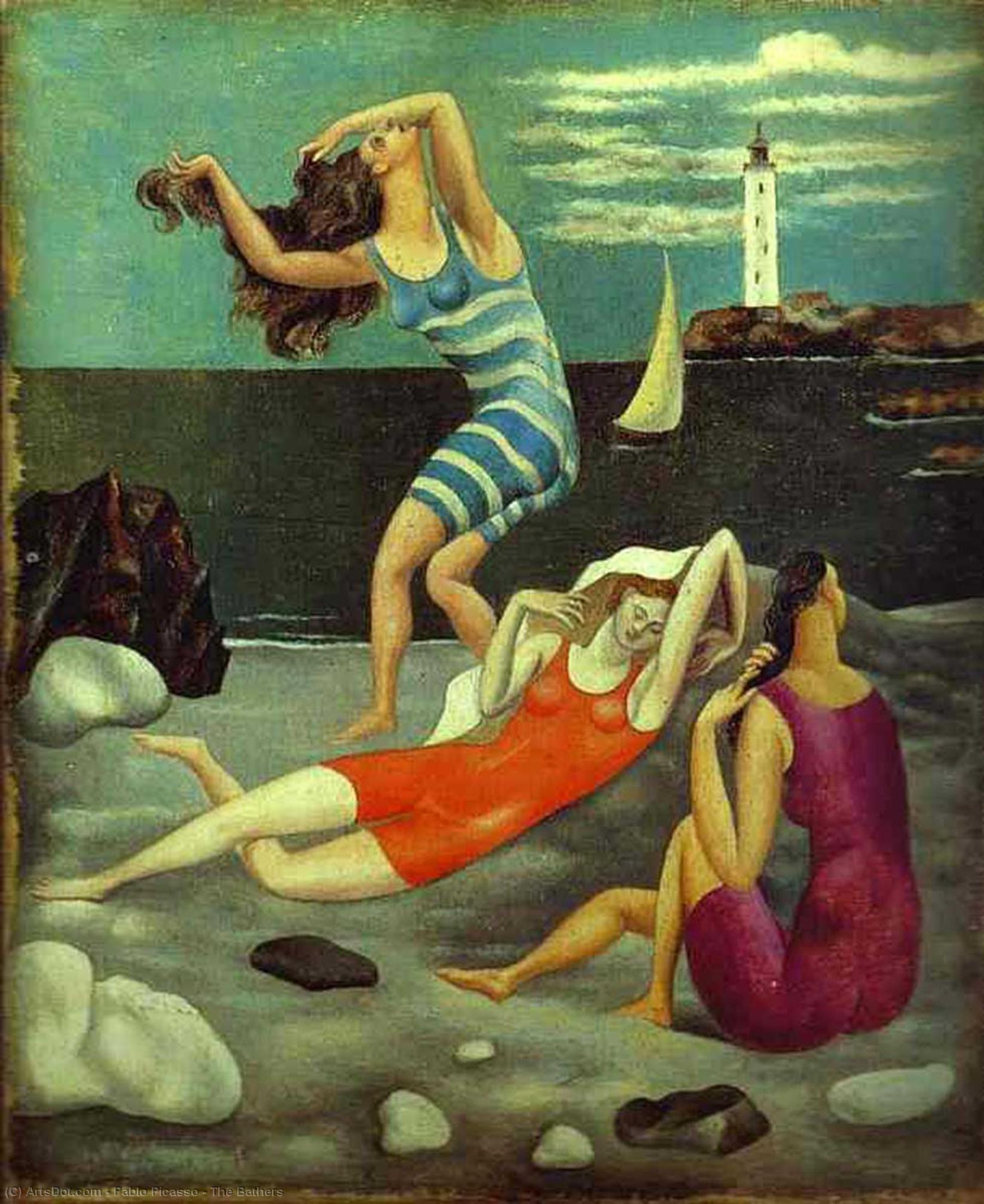
In the pantheon of modern art, few works capture the transformative power of the Cubist revolution as vividly as Pablo Picasso’s “The Bathers.” Completed in 1928, this masterpiece serves as a profound window into a period where the artist was actively dismantling the traditional boundaries of sight. At first glance, the canvas presents a serene coastal scene: three women lounging by the sea, accompanied by the quiet presence of boats and a distant lighthouse. Yet, beneath this tranquil subject matter lies a radical reconstruction of reality. Picasso does not merely paint what is seen; he paints how the mind perceives, breaking the human form into a rhythmic dance of interlocking planes and geometric shapes. This technique allows the viewer to experience multiple perspectives simultaneously, creating a sense of depth that defies the flat surface of the canvas and invites a deeper, more intellectual engagement with the beauty of the figures.
The emotional resonance of the piece is found in its delicate balance between tension and tranquility. While the subject matter—women enjoying the sun-drenched shores—suggests leisure and peace, the fragmented technique introduces a subtle, vibrating energy. There is a certain melancholy woven into the geometry, perhaps a reflection of Picasso’s personal life during this era, following his divorce from Olga Khokhlova. The way the figures overlap and intersect creates a visual language of connection and isolation, making the painting an evocative choice for those who appreciate art that speaks to the complexity of the human experience. For the discerning collector or interior designer, "The Bathers" offers more than just aesthetic appeal; it provides a focal point of intellectual depth that can anchor a room with both sophistication and narrative weight.
To truly appreciate “The Bathers,” one must look back at the shoulders upon which Picasso stood. The painting is a brilliant synthesis of various artistic legacies, most notably the structural innovations of Paul Cézanne and the expressive simplicity found in African sculpture. Picasso took Cézanne’s concept of treating nature through the cylinder, the sphere, and the cone and pushed it toward its logical, fragmented conclusion. This dialogue with the past allowed him to move beyond mere imitation, instead creating a new way of seeing that would define the 20th century. The influence of African art is also palpable in the simplified, almost mask-like features of the figures, which lend the work an elemental, timeless quality.
This era of Picasso's career was marked by an unwavering commitment to innovation, a period where he sought to redefine the very essence of visual representation. By rejecting the idealized realism of the Renaissance in favor of a more conceptual truth, he paved the way for future generations of artists to explore abstraction. For those looking to bring a piece of art history into their personal spaces, a high-quality reproduction of this work serves as a tribute to this era of profound change. It is an invitation to contemplate the intersection of tradition and rebellion, making it an enduring icon for any curated collection.
Integrating a piece as significant as “The Bathers” into a contemporary interior requires an eye for balance and texture. Because the painting utilizes a complex arrangement of shapes and a sophisticated palette, it functions beautifully in various design settings—from the minimalist elegance of a modern loft to the rich, layered textures of a classic study. The interplay of light and shadow within the geometric planes provides a dynamic visual interest that changes as the light in a room shifts throughout the day.
For interior designers, this artwork offers a unique opportunity to introduce a sense of movement and structural rhythm. It acts as a conversation starter, drawing guests into its intricate layers of meaning. Whether displayed as a large-scale centerpiece or part of a curated gallery wall, a reproduction of Picasso’s “The Bathers” brings an air of cultured prestige and an unmistakable aura of avant-garde spirit to any environment. It is not merely a decoration; it is an enduring testament to the beauty of fragmented truth.
The colors of "The Bathers" show a soft shadow luminance.
gray (#6c885f) is the leading color of "The Bathers" by Pablo Picasso.
"The Bathers" by Pablo Picasso is a portrait composition. The proportions are worth checking before choosing a print size.
A child's first words in Málaga were “piz, piz,” a small attempt at saying pencil. This early pull toward the lead and paper was nurtured by his father, José Ruiz y Blasco, who taught him the basics of figure drawing and oil painting. The boy learned to copy the masters and draw from plaster casts under a disciplined eye. As he grew, the family moved through A Coruña and Barcelona. These years were marked by the quiet weight of loss, particularly the death of his sister, Conchita, from diphtheria when she was only seven. Such shadows would later find their way into the heavy, blue-green tones of his early work.
By thirteen, he was already taking entrance exams for advanced classes in Barcelona, finishing in a week what took others a month. His hands moved with a precision that even his father noticed, once seeing him paint over an unfinished sketch of a pigeon with such accuracy that the instructor realized the student had surpassed him. He eventually moved to Paris, a city where he would spend much of his adult life, constantly shifting his focus from one way of seeing to another.
The early twentieth century saw his work move through distinct phases of color and mood. There was the Blue Period, where the canvases were filled with beggars, the blind, and the lonely, rendered in somber shades of blue. This gave way to the Rose Period, a time when pinks, oranges, and reds appeared, often featuring the figures of circus performers like harlequins and acrobats. These years showed a man reacting to his own life and the world around him through the temperature of his palette.
In 1907, the way he handled space changed fundamentally with Les Demoiselles d'Avignon. Influenced by African masks and Iberian sculpture, he began to break objects into geometric shapes. Alongside Georges Braque, he developed Cubism. This involved two main stages:
His work never settled into a single way of being. He explored Neoclassicism with large, monumental figures and later engaged with the imagery of Surrealism, using distorted perspectives to tap into the subconscious. The violence of the Spanish Civil War left its mark on his canvas in 1937 through Guernica. This large oil painting used a stark palette of black, white, and grey to show the suffering of a bombed town, featuring a gored horse, a bull, and screaming women. It remains a heavy, monochromatic response to the chaos of war.
In his later years, he continued to experiment with ceramics, sculpture, and printmaking. He even created large-scale public works, such as the 1967 steel sculpture in Chicago, which was inspired by the head of his Afghan Hound, Kabul. He died in Mougins, France, leaving behind a massive collection of work that spans over seventy-six years of experimentation.

1881 - 1973 , Spain
 Preview
 Send
Send Share
Share
 Details
 Guide
Guide

 Download
 Similars
 X-Ray
X-Ray Diaporama
 Q&A
Q&A Stats
Stats

 Read More


