

The artwork displayed on this page is protected by copyright law, which means we cannot legally create or sell an identical reproduction. This protection is enforced under international agreements such as the Berne Convention and by national laws, including those outlined by the U.S. Copyright Law - Title 17.
This method fully complies with copyright regulations because it does not involve copying or duplicating the protected artwork. Instead, it is a creative reinterpretation - a new painting that is influenced by the original but not identical to it.
Museum-quality giclée or canvas print with fast production and flexible finish options. ( Buy Hand Made Painting Switch to Digital Image)





























Pick from our preset sizes that match the artwork's original proportions.

Type the width and the height you need, to fit your frame or your wall. A print can only be cut, never made bigger than the picture, so a size with a different shape loses a part of the image. We send you a digital mockup to approve before we print anything. The picture shown on this page does not show the real cut — only the mockup does.
Worldwide Delivery () in 2 weeks instead of standard 4/5 weeks. (8 November)
Still-Life
Reproduction Size
Pablo Picasso's “Still Life,” painted circa 1931, stands as a testament to the artist’s masterful command of Cubist principles while simultaneously conveying a profound sense of quiet contemplation. This deceptively simple composition—a tabletop adorned with apples, oranges, bananas, vases, and a potted plant draped beneath a crimson cloth—is far more than just an arrangement of objects; it is a deliberate investigation into the nature of perception and representation itself. Picasso’s approach aligns closely with the burgeoning Naive Art movement of his time, yet distinguishes itself through the subtle complexities inherent in its geometric dissection.
The painting presents a captivating scene where the organic meets the structured. The table holds two bowls filled with fruit, including apples and oranges, alongside three bananas placed thoughtfully across the surface. Interspersed among these natural elements are two vases, one positioned near the center and another towards the right, while a potted plant sits behind the table to add a touch of greenery. A bold red cloth is draped over the table, providing a striking visual anchor that injects warmth and passion into a palette otherwise dominated by muted greens and browns.
In this work, Picasso’s signature Cubist style is evident in the fractured planes that define each element within the scene. Rather than striving for realistic depiction, he dismantles objects into their constituent parts and reconstructs them simultaneously from multiple viewpoints, challenging traditional artistic conventions to prioritize conceptual exploration over visual accuracy. To achieve this, the artist employed oil paint on canvas with meticulous attention to detail, utilizing a layering process of thin glazes upon thicker undercoats to create remarkable tonal depth and luminosity. The careful manipulation of light creates shadows that accentuate the contours of each fruit and vase, contributing significantly to the overall visual impact.
Beyond its purely aesthetic qualities, “Still Life” carries profound symbolic weight. The fruit itself serves as a meditation on themes of life and decay: apples represent knowledge and temptation, while oranges symbolize optimism and vitality. These elements intertwine with the geometric precision of the composition to evoke a mood of serene introspection, inviting viewers to contemplate the beauty inherent in everyday objects. This mastery of color and form transcends mere representation; it aims to elicit an emotional response, using subdued hues to foster a sense of stillness and tranquility regarding the passage of time and the fragility of existence.
For the contemporary collector or interior designer, this piece offers unparalleled inspiration. The muted color palette and geometric composition serve as a valuable source for creating spaces characterized by understated elegance and intellectual curiosity. Whether viewed as a window into Picasso’s Surrealist phase or as a masterclass in structural rigor, this painting remains a powerful reminder that art can communicate profound ideas through deceptively simple visual language.
In "Still-Life" by Pablo Picasso, the Cubist Still Life movement meets the Modern era.
"Still-Life" by Pablo Picasso is still protected by copyright. This status governs how the image of the work may be reproduced.
The color composition of "Still-Life" by Pablo Picasso combines a statement contrast with a softly mixed palette harmony.

A child's first words in Málaga were “piz, piz,” a small attempt at saying pencil. This early pull toward the lead and paper was nurtured by his father, José Ruiz y Blasco, who taught him the basics of figure drawing and oil painting. The boy learned to copy the masters and draw from plaster casts under a disciplined eye. As he grew, the family moved through A Coruña and Barcelona. These years were marked by the quiet weight of loss, particularly the death of his sister, Conchita, from diphtheria when she was only seven. Such shadows would later find their way into the heavy, blue-green tones of his early work.
By thirteen, he was already taking entrance exams for advanced classes in Barcelona, finishing in a week what took others a month. His hands moved with a precision that even his father noticed, once seeing him paint over an unfinished sketch of a pigeon with such accuracy that the instructor realized the student had surpassed him. He eventually moved to Paris, a city where he would spend much of his adult life, constantly shifting his focus from one way of seeing to another.
The early twentieth century saw his work move through distinct phases of color and mood. There was the Blue Period, where the canvases were filled with beggars, the blind, and the lonely, rendered in somber shades of blue. This gave way to the Rose Period, a time when pinks, oranges, and reds appeared, often featuring the figures of circus performers like harlequins and acrobats. These years showed a man reacting to his own life and the world around him through the temperature of his palette.
In 1907, the way he handled space changed fundamentally with Les Demoiselles d'Avignon. Influenced by African masks and Iberian sculpture, he began to break objects into geometric shapes. Alongside Georges Braque, he developed Cubism. This involved two main stages:
His work never settled into a single way of being. He explored Neoclassicism with large, monumental figures and later engaged with the imagery of Surrealism, using distorted perspectives to tap into the subconscious. The violence of the Spanish Civil War left its mark on his canvas in 1937 through Guernica. This large oil painting used a stark palette of black, white, and grey to show the suffering of a bombed town, featuring a gored horse, a bull, and screaming women. It remains a heavy, monochromatic response to the chaos of war.
In his later years, he continued to experiment with ceramics, sculpture, and printmaking. He even created large-scale public works, such as the 1967 steel sculpture in Chicago, which was inspired by the head of his Afghan Hound, Kabul. He died in Mougins, France, leaving behind a massive collection of work that spans over seventy-six years of experimentation.

1881 - 1973 , Spain
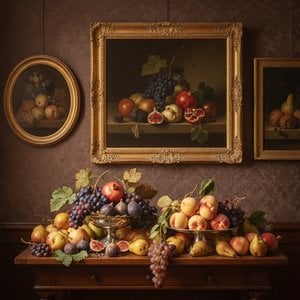
Discover the profound beauty of fruit still life paintings. Explore the rich symbolism, Baroque mastery, and timeless allure of nature's bounty through an art-historical lens, perfect for collectors and enthusiasts of classical fine art.

Explore the profound beauty of fruit arrangement masterpieces. From Dutch Golden Age opulence to Baroque chiaroscuro, discover the art history, symbolism, and timeless elegance of classical still life paintings for the discerning collector.

Explore the profound evolution of Cubist still life, from Cézanne's structural foundations to the fragmented brilliance of Braque and Léger. Discover how geometric abstraction redefined reality through a sophisticated lens of form, color, and modern artistic mastery.
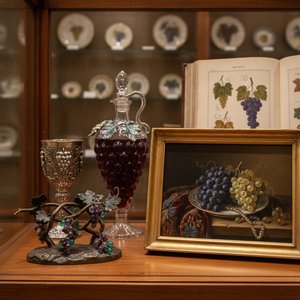
Embark on a visual journey through the world's most exquisite grape-themed masterpieces. Discover the technical brilliance of Baroque masters and learn how to curate timeless, hand-painted oil reproductions for your luxury collection with WahooArt.com.
 Preview
 Send
Send Share
Share
 Details
 Guide
Guide

 Download
 Similars
 X-Ray
X-Ray Diaporama
 Q&A
Q&A
 Stats
Stats

 Read More









 Glass option is only available in size under 110 CM


