

 Acrylic On CanvasWallArtNaive Art / Primitivism
 1901Modern
 17.0 x 13.0 cm
The artwork displayed on this page is protected by copyright law, which means we cannot legally create or sell an identical reproduction. This protection is enforced under international agreements such as the Berne Convention and by national laws, including those outlined by the U.S. Copyright Law - Title 17.
This method fully complies with copyright regulations because it does not involve copying or duplicating the protected artwork. Instead, it is a creative reinterpretation - a new painting that is influenced by the original but not identical to it.
Museum-quality giclée or canvas print with fast production and flexible finish options. ( Buy Hand Made Painting Switch to Digital Image)





























Pick from our preset sizes that match the artwork's original proportions.

Type the width and the height you need, to fit your frame or your wall. A print can only be cut, never made bigger than the picture, so a size with a different shape loses a part of the image. We send you a digital mockup to approve before we print anything. The picture shown on this page does not show the real cut — only the mockup does.
Worldwide Delivery () in 2 weeks instead of standard 4/5 weeks. (27 October)
Picasso with partner
Reproduction Size
Pablo Ruiz Picasso (1881–1973), a name synonymous with artistic innovation, was born in Málaga, Spain, into a world poised on the brink of dramatic change. His life, spanning nearly a century, became an extraordinary reflection of that transformation—a relentless exploration of form, perspective, and the very essence of human experience. From his earliest academic training under his father José Ruiz y Blasco, a painter and art teacher, Picasso displayed a precocious talent that quickly surpassed even his mentor’s abilities. This early mastery wasn't merely technical; it hinted at an insatiable curiosity and a willingness to challenge convention—qualities that would define his entire career.
The painting “Picasso with Partner,” measuring 17 x 13 cm, exemplifies the stylistic hallmarks of Naive Art / Primitivism. Executed in ink on paper, it captures a moment frozen in time—a simple yet profoundly evocative depiction of two figures standing side by side. The artist’s deliberate choice of medium contributes to the artwork's understated elegance and immediacy.
The naive art style is evident in the straightforward depiction of two figures standing side by side. The man on the right, adorned with a top hat and mustache, appears engrossed in an object he holds, while the woman on the left looks away from him. Both figures are dressed in attire reminiscent of the Victorian era. Picasso’s technique relies heavily on linear contour lines—bold strokes that define the forms without resorting to shading or blending—a characteristic feature of this movement. The artist's careful observation of detail and his ability to convey emotion through minimal means underscore the power of simplicity.
Naive Art, also known as Primitivism, is a style of visual art created by self-taught artists who lack formal education and training in the arts. This aesthetic is often emulated by trained artists, resulting in what is called primitivism, pseudo-naïve art, or faux naïve art The Naïve Art (Primitivism) Art Movement. Artists like Picasso sought inspiration in folk traditions and primitive cultures—imagery characterized by flatness, bold colors, and a lack of illusionistic perspective. This deliberate rejection of academic conventions reflects a broader cultural shift toward valuing authenticity and spontaneity.
Picasso’s exploration of naive art is also seen in other works such as Claude with a ball, which shares similar characteristics. This piece, measuring 100 x 81 cm and painted in oil on canvas, further exemplifies Picasso’s experimentation with the naive style. The juxtaposition of these two artworks reveals Picasso's versatility—his ability to adapt his technique and vision across diverse mediums and periods.
"Picasso with Partner" is a significant work that showcases Picasso’s versatility and his interest in exploring different artistic styles. The painting’s simplicity and directness are hallmarks of the naive art movement, making it an intriguing piece for art enthusiasts. For those interested in acquiring high-quality reproductions of such masterpieces, WahooArt offers handmade oil paintings that capture the essence of original works.
WahooArt provides a platform for art lovers to explore and own reproductions of iconic paintings like “Picasso with Partner.”
"Picasso with partner" has an elegant atmosphere.
The perceived brightness of "Picasso with partner" by Pablo Picasso is brilliant. It can be matched to the light of the intended space.
Hand-painted copies of "Picasso with partner" by Pablo Picasso are sold on this website: a hand-painted oil reproduction on linen canvas, ordered from its Hand-Painted Reproduction page.

A child's first words in Málaga were “piz, piz,” a small attempt at saying pencil. This early pull toward the lead and paper was nurtured by his father, José Ruiz y Blasco, who taught him the basics of figure drawing and oil painting. The boy learned to copy the masters and draw from plaster casts under a disciplined eye. As he grew, the family moved through A Coruña and Barcelona. These years were marked by the quiet weight of loss, particularly the death of his sister, Conchita, from diphtheria when she was only seven. Such shadows would later find their way into the heavy, blue-green tones of his early work.
By thirteen, he was already taking entrance exams for advanced classes in Barcelona, finishing in a week what took others a month. His hands moved with a precision that even his father noticed, once seeing him paint over an unfinished sketch of a pigeon with such accuracy that the instructor realized the student had surpassed him. He eventually moved to Paris, a city where he would spend much of his adult life, constantly shifting his focus from one way of seeing to another.
The early twentieth century saw his work move through distinct phases of color and mood. There was the Blue Period, where the canvases were filled with beggars, the blind, and the lonely, rendered in somber shades of blue. This gave way to the Rose Period, a time when pinks, oranges, and reds appeared, often featuring the figures of circus performers like harlequins and acrobats. These years showed a man reacting to his own life and the world around him through the temperature of his palette.
In 1907, the way he handled space changed fundamentally with Les Demoiselles d'Avignon. Influenced by African masks and Iberian sculpture, he began to break objects into geometric shapes. Alongside Georges Braque, he developed Cubism. This involved two main stages:
His work never settled into a single way of being. He explored Neoclassicism with large, monumental figures and later engaged with the imagery of Surrealism, using distorted perspectives to tap into the subconscious. The violence of the Spanish Civil War left its mark on his canvas in 1937 through Guernica. This large oil painting used a stark palette of black, white, and grey to show the suffering of a bombed town, featuring a gored horse, a bull, and screaming women. It remains a heavy, monochromatic response to the chaos of war.
In his later years, he continued to experiment with ceramics, sculpture, and printmaking. He even created large-scale public works, such as the 1967 steel sculpture in Chicago, which was inspired by the head of his Afghan Hound, Kabul. He died in Mougins, France, leaving behind a massive collection of work that spans over seventy-six years of experimentation.

1881 - 1973 , Spain
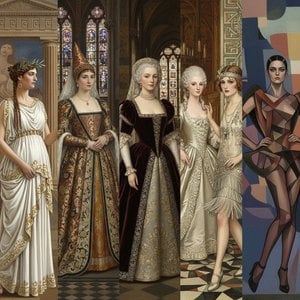
Explore the breathtaking intersection of fine art and high fashion. Discover how iconic masterpieces from Art Deco to Impressionism have shaped the world of luxury couture and timeless design in this curated visual journey.

Explore the profound impact of Primitivism on modern art. Delve into how masters like Gauguin and Picasso utilized raw emotion and non-Western aesthetics to redefine artistic form, breaking from academic tradition to shape the course of 20th-century expressionism.

Explore the profound elegance of minimalist art. Discover how the precision of a single line transforms simple geometry into timeless masterpieces for the discerning collector seeking sophistication and depth in fine art acquisitions.
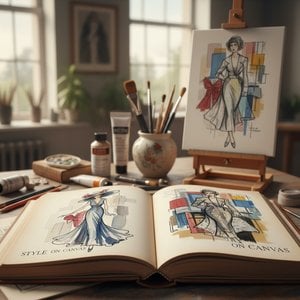
Discover the exquisite world of fashion illustration art. From Art Deco elegance to bespoke oil reproductions, explore how timeless sartorial beauty transforms luxury interiors through masterfully crafted canvas works and curated historical masterpieces.

Embark on a visual journey through the evolution of fashion photography. Discover how masters like Gianfranco Ferré blended geometry, surrealism, and texture to redefine high-fashion art for collectors and connoisseurs of luxury imagery.

 Preview
 Send
Send Share
Share
 Details
 Guide
Guide

 Download
 Similars
 X-Ray
X-Ray Diaporama
 Stats
Stats Read More









 Glass option is only available in size under 110 CM


