Preview AR preview Buy Hand Made Painting Switch to Digital Image Send
Details Guide Add to favorites Download Similars X-Ray Diaporama Stats

Pedestal

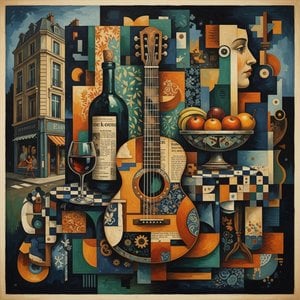
Explore Pablo Picasso's 'Pedestal,' a key work of Synthetic Cubism. Deconstructed forms, vibrant blues & reds, and a revolutionary approach to representation – a must-see masterpiece.

Co-founder of Cubism and creator of Guernica. Discover the revolutionary works of Pablo Picasso today.

The artwork displayed on this page is protected by copyright law, which means we cannot legally create or sell an identical reproduction. This protection is enforced under international agreements such as the Berne Convention and by national laws, including those outlined by the U.S. Copyright Law - Title 17.

This method fully complies with copyright regulations because it does not involve copying or duplicating the protected artwork. Instead, it is a creative reinterpretation - a new painting that is influenced by the original but not identical to it.

Giclée / Art Print

Museum-quality giclée or canvas print with fast production and flexible finish options. ( Buy Hand Made Painting Switch to Digital Image)

Corner sample of the P118B picture frame: moulded polystyrene, 5 cm wide and 3 cm thick
P118B $10
Corner sample of the P118H picture frame: moulded polystyrene, 5 cm wide and 3 cm thick
P118H $10
Corner sample of the P118W picture frame: moulded polystyrene, 5 cm wide and 3 cm thick
P118W $10
Corner sample of the P438Z picture frame: moulded polystyrene, 5.5 cm wide and 3.5 cm thick
P438Z $10
Corner sample of the P508JH picture frame: moulded polystyrene, 7 cm wide and 3.5 cm thick
P508JH $12
Corner sample of the P508YH picture frame: moulded polystyrene, 7 cm wide and 3.5 cm thick
P508YH $12
Corner sample of the P805H picture frame: moulded polystyrene, 5 cm wide and 3.5 cm thick
P805H $10
Corner sample of the P805Z picture frame: moulded polystyrene, 5 cm wide and 3.5 cm thick
P805Z $10
Corner sample of the P919BZ picture frame: moulded polystyrene, 7 cm wide and 3.5 cm thick
P919BZ $10
Corner sample of the P919G picture frame: moulded polystyrene, 7 cm wide and 3.5 cm thick
P919G $10
Corner sample of the P919XJ picture frame: moulded polystyrene, 7 cm wide and 3.5 cm thick
P919XJ $10
Corner sample of the P959ZH picture frame: moulded polystyrene, 5 cm wide and 3 cm thick
P959ZH $10
Corner sample of the P968JZ picture frame: moulded polystyrene, 6 cm wide and 4 cm thick
P968JZ $12
Corner sample of the W106C picture frame: solid wood, 5 cm wide and 3 cm thick
W106C $8
Corner sample of the W218G picture frame: solid wood, 5 cm wide and 3 cm thick
W218G $10
Corner sample of the W218JH picture frame: solid wood, 5 cm wide and 3 cm thick
W218JH $8
Corner sample of the W218Y picture frame: solid wood, 5 cm wide and 3 cm thick
W218Y $10
Corner sample of the W307PJ picture frame: solid wood, 6 cm wide and 3 cm thick
W307PJ $10
Corner sample of the W316G picture frame: solid wood, 6 cm wide and 3 cm thick
W316G $10
Corner sample of the W316PJ picture frame: solid wood, 6 cm wide and 3 cm thick
W316PJ $8
Corner sample of the W316Y picture frame: solid wood, 6 cm wide and 3 cm thick
W316Y $10
Corner sample of the W398PJ picture frame: solid wood, 5 cm wide and 3 cm thick
W398PJ $8
Corner sample of the W4111J picture frame: solid wood, 6.5 cm wide and 3.5 cm thick
W4111J $10
Corner sample of the W500HY picture frame: solid wood, 7 cm wide and 5 cm thick
W500HY $15
Corner sample of the W500JH picture frame: solid wood, 7 cm wide and 5 cm thick
W500JH $15
Corner sample of the W692G picture frame: solid wood, 8 cm wide and 4 cm thick
W692G $12
Corner sample of the W849H picture frame: solid wood, 5 cm wide and 3 cm thick
W849H $8
Corner sample of the W940BG picture frame: solid wood, 7.5 cm wide and 4.5 cm thick
W940BG $15
Corner sample of the W953PJ picture frame: solid wood, 6 cm wide and 3.5 cm thick
W953PJ $8

Standard
custom
CM
INCH

Pick from our preset sizes that match the artwork's original proportions.

width
height

Type the width and the height you need, to fit your frame or your wall. A print can only be cut, never made bigger than the picture, so a size with a different shape loses a part of the image. We send you a digital mockup to approve before we print anything. The picture shown on this page does not show the real cut — only the mockup does.

Worldwide Delivery () in 2 weeks instead of standard 4/5 weeks. (27 October)

Free Worldwide Express Shipping
High-Quality Linen Canvas
Full Shipping Insurance
Customs Tax Refund Guarantee
True Color Matching Guarantee
100-Day Return Policy (Defects Only)
100% Money-Back Guarantee
Bulk Discount Offer

Total Price

$ 69

Pedestal

Giclée / Art Print

Reproduction Size

-

Total Price

$ 69

Quick Facts

  • Year: 1920
  • Medium: Gouache
  • Artistic style: Abstract, Cubist
  • Artist: Pablo Picasso
  • Influences:
    • Raynal
    • Gris
    • Gleizes

Art Quiz

There is only one correct answer for each question.

Question 1:
What artistic movement is ‘Pedestal’ primarily associated with?
Question 2:
Which of the following best describes the color palette predominantly used in ‘Pedestal’?
Question 3:
What is the significance of ‘Crystal Cubism’ as it relates to Picasso's work during this period?
Question 4:
According to the description, what is depicted in ‘Pedestal’?
Question 5:
Who coined the term 'Crystal Cubism'?

A Fragmented Portrait: Unpacking Picasso’s “Pedestal”

Pablo Picasso's "Pedestal," painted in 1920 during his pivotal Synthetic Cubist period, isn’t merely a depiction of a musician; it’s an invitation to deconstruct reality and rediscover its essence. This small gouache painting—measuring just 26 x 21 centimeters—bursts with a vibrant energy born from the collision of multiple viewpoints and a radical simplification of form. It's a key piece in understanding Picasso’s exploration of abstraction, his embrace of new artistic techniques, and his profound influence on the trajectory of modern art. The work immediately draws the eye to the figure of the musician, positioned slightly off-center yet commanding attention despite his fragmented representation. He holds a guitar, its contours dissolving into geometric planes, while a guitar case rests at his feet—a grounding element amidst the swirling chaos. A prominent hat sits near the center, adding another layer of visual interest and subtly directing the viewer’s gaze.

The Genesis of Synthetic Cubism

“Pedestal” is deeply rooted in the revolutionary movement known as Synthetic Cubism. Emerging between 1915 and 1920, this phase represented a dramatic departure from its Analytical predecessor. While Analytical Cubism focused on dissecting objects into their constituent parts and presenting them simultaneously from multiple angles—often resulting in a muted, almost monochrome palette—Synthetic Cubism embraced a more assertive approach. Artists like Picasso, Juan Gris, and Albert Gleizes sought to create a flatter, more decorative style, prioritizing the surface of the canvas and employing brighter colors and bolder shapes. The goal wasn’t simply to analyze form but to rebuild it in an abstracted, often dreamlike manner. Picasso himself described this period as a “return to order,” a deliberate move away from the perceived complexity of Analytical Cubism towards a more controlled and harmonious composition.

Crystal Cubism: Clarity and Order

Within Synthetic Cubism, Picasso further developed what is known as Crystal Cubism, named by art critic Maurice Raynal. This sub-style emphasized clarity, geometric precision, and a sense of contained energy. “Pedestal” exemplifies these qualities perfectly. The painting’s palette—dominated by striking blues, reds, and touches of green—is carefully considered to create visual harmony despite the fragmented forms. The overlapping planes aren't randomly arranged; they are strategically positioned to guide the viewer’s eye across the canvas, suggesting movement and dynamism. Raynal likened these works to “crystals,” reflecting a desire for order and structure within the abstract realm. The deliberate use of color further enhances this sense of clarity, preventing the composition from feeling overly chaotic or confusing.

Deconstructing Reality: A Symbol of Multiple Perspectives

At its core, "Pedestal" is an exploration of representation itself. Picasso doesn’t aim to create a realistic portrait; instead, he presents us with a series of fractured perspectives—a musician viewed simultaneously from various angles. This technique, central to Cubism, challenges the viewer to actively participate in constructing meaning. We must piece together the fragmented elements—the guitar, the case, the hat—to recognize the subject and understand his posture and activity. The painting becomes a visual puzzle, inviting us to consider how we perceive reality and how art can represent it in innovative ways. It’s a powerful statement about the limitations of single viewpoints and the richness that emerges from multiple perspectives.

Legacy and Influence

“Pedestal” stands as a pivotal work in Picasso's oeuvre and a cornerstone of Synthetic Cubism. Its influence extends far beyond its immediate historical context, shaping subsequent art movements like Surrealism and Expressionism. The techniques pioneered during this period—the use of flattened planes, multiple viewpoints, and bold color palettes—became hallmarks of modern art. Reproductions of “Pedestal,” such as those offered by WahooArt.com, allow us to appreciate the intricacies of Picasso’s vision and experience the enduring power of his revolutionary approach to art. It remains a testament to the artist's genius and a captivating example of how abstraction can be both intellectually stimulating and emotionally resonant.

Questions & Answers

How many people view "Pedestal"?

A Stats page exists for "Pedestal". It charts the monthly visits of the artwork and of the artist's other works, with country and language breakdowns.

Which print setup is suggested for "Pedestal" by Pablo Picasso?

medium size, portrait orientation: that is the print setup suggested for "Pedestal" by Pablo Picasso.

What is the art-historical place of "Pedestal" by Pablo Picasso?

The art-historical classification of "Pedestal" by Pablo Picasso is Synthetic Cubism, in the Modern period.


Artist Biography

The boy from Málaga

A child's first words in Málaga were “piz, piz,” a small attempt at saying pencil. This early pull toward the lead and paper was nurtured by his father, José Ruiz y Blasco, who taught him the basics of figure drawing and oil painting. The boy learned to copy the masters and draw from plaster casts under a disciplined eye. As he grew, the family moved through A Coruña and Barcelona. These years were marked by the quiet weight of loss, particularly the death of his sister, Conchita, from diphtheria when she was only seven. Such shadows would later find their way into the heavy, blue-green tones of his early work.

By thirteen, he was already taking entrance exams for advanced classes in Barcelona, finishing in a week what took others a month. His hands moved with a precision that even his father noticed, once seeing him paint over an unfinished sketch of a pigeon with such accuracy that the instructor realized the student had surpassed him. He eventually moved to Paris, a city where he would spend much of his adult life, constantly shifting his focus from one way of seeing to another.

Shifting palettes and fractured forms

The early twentieth century saw his work move through distinct phases of color and mood. There was the Blue Period, where the canvases were filled with beggars, the blind, and the lonely, rendered in somber shades of blue. This gave way to the Rose Period, a time when pinks, oranges, and reds appeared, often featuring the figures of circus performers like harlequins and acrobats. These years showed a man reacting to his own life and the world around him through the temperature of his palette.

In 1907, the way he handled space changed fundamentally with Les Demoiselles d'Avignon. Influenced by African masks and Iberian sculpture, he began to break objects into geometric shapes. Alongside Georges Braque, he developed Cubism. This involved two main stages:

  • Analytic Cubism: A method of fragmenting objects into muted, geometric pieces as if dissecting the form itself.
  • Synthetic Cubism: An approach that brought in collage elements like newspaper clippings and fabric scraps to add texture and new layers.

A life of constant change

His work never settled into a single way of being. He explored Neoclassicism with large, monumental figures and later engaged with the imagery of Surrealism, using distorted perspectives to tap into the subconscious. The violence of the Spanish Civil War left its mark on his canvas in 1937 through Guernica. This large oil painting used a stark palette of black, white, and grey to show the suffering of a bombed town, featuring a gored horse, a bull, and screaming women. It remains a heavy, monochromatic response to the chaos of war.

In his later years, he continued to experiment with ceramics, sculpture, and printmaking. He even created large-scale public works, such as the 1967 steel sculpture in Chicago, which was inspired by the head of his Afghan Hound, Kabul. He died in Mougins, France, leaving behind a massive collection of work that spans over seventy-six years of experimentation.

Pablo Picasso

Pablo Picasso

1881 - 1973 , Spain

Quick Facts

  • Full Name: Pablo Diego José Ruiz Picasso
  • Nationality: Spanish
  • Date Of Birth: 1881
  • Date Of Death: 1973
  • Place Of Birth: Malaga, Spain
  • Notable Artworks:
    • Les Demoiselles d'Avignon
    • Guernica
    • The Old Guitarist
    • La Vie
    • Family of Saltimbanques
  • Artistic Movement Or Style: Cubism, Surrealism
  • Artists Who Influenced This Artist:
    • Velázquez
    • Goya
    • Matisse
  • Artists Or Movements Influenced By This Artist:
    • Cubism
    • Modern art
Explore artworks organized by themes, styles, and characteristics.