

The artwork displayed on this page is protected by copyright law, which means we cannot legally create or sell an identical reproduction. This protection is enforced under international agreements such as the Berne Convention and by national laws, including those outlined by the U.S. Copyright Law - Title 17.
This method fully complies with copyright regulations because it does not involve copying or duplicating the protected artwork. Instead, it is a creative reinterpretation - a new painting that is influenced by the original but not identical to it.
Museum-quality giclée or canvas print with fast production and flexible finish options. ( Buy Hand Made Painting Switch to Digital Image)





























Pick from our preset sizes that match the artwork's original proportions.

Type the width and the height you need, to fit your frame or your wall. A print can only be cut, never made bigger than the picture, so a size with a different shape loses a part of the image. We send you a digital mockup to approve before we print anything. The picture shown on this page does not show the real cut — only the mockup does.
Worldwide Delivery () in 2 weeks instead of standard 4/5 weeks. (7 November)
Man with a Guitar 1
Reproduction Size
In the transformative landscape of early twentieth-century modernism, few works capture the radical restructuring of reality quite like Pablo Picasso’s “Man with a Guitar.” Painted in 1913, this masterpiece serves as a profound cornerstone of Synthetic Cubism, marking a decisive departure from the more analytical, monochromatic explorations that had previously defined the movement. The painting presents us with a man seated in profile, his form intertwined with the instrument he holds across his shoulder. Yet, this is no mere portrait; it is an intricate tableau where the boundaries between the human figure and the surrounding space begin to dissolve. Alongside the central subject, two indistinct figures linger in the background, creating an atmosphere that feels simultaneously intimate and unsettling, as if we are peering into a fractured dream of social interaction.
The technique employed by Picasso in this period was nothing short of revolutionary. Moving away from the shattered, glass-like shards of his earlier work, he embraced the concept of layering and superimposition. In “Man with a Guitar,” we see fractured planes of color stacked upon one another to present multiple perspectives at once. The palette is masterfully restrained, dominated by earthy, grounded tones that are suddenly interrupted by deliberate splashes of vibrant blues and reds. This contrast is not merely decorative; it is a structural tool used to heighten the visual impact and guide the eye through the geometric labyrinth of the composition. The guitar itself is stripped of its realistic curves, instead being reimagined through a series of essential geometric shapes that mirror the fragmentation of the man’s own form.
To gaze upon this work is to confront the anxieties of a world in flux. Created during an era of rapid industrialization and urban expansion, the painting reflects Picasso's engagement with the disintegration of traditional values. The guitar serves as a potent symbol of musical expression—a sanctuary of rhythm and melody amidst the chaos of modernity. However, because the instrument is rendered in a broken, deconstructed state, it suggests that even our most cherished forms of refuge are being reshaped by the pressures of a changing society. There is a palpable sense of isolation within the piece; the man’s enigmatic gaze invites deep introspection, suggesting a soul caught between the internal world of thought and the external world of observation.
For the discerning collector or interior designer, this artwork offers more than just aesthetic brilliance; it provides a profound emotional anchor. The blurred figures in the background represent an external reality that feels distant and incomprehensible, emphasizing the solitary nature of the human experience. Whether displayed in a contemporary gallery setting or as a focal point in a sophisticated residential space, a high-quality reproduction of this piece brings with it a sense of intellectual depth and historical gravity. It is a conversation starter that bridges the gap between the turbulent history of the 1910s and the refined elegance of modern decor, making it an essential acquisition for those who appreciate art that challenges the eye and stirs the spirit.
The medium of "Man with a Guitar 1" by Pablo Picasso is oil. Reproductions aim to render the appearance of this technique.
The themes present in "Man with a Guitar 1" by Pablo Picasso include guitar, portraiture, cubism, fragmented forms, geometric shapes, musical instrument, multiple perspectives, spanish painter. Together they summarize the artwork's subject matter.
The Preview page of "Man with a Guitar 1" lets you preview the artwork before ordering.
A child's first words in Málaga were “piz, piz,” a small attempt at saying pencil. This early pull toward the lead and paper was nurtured by his father, José Ruiz y Blasco, who taught him the basics of figure drawing and oil painting. The boy learned to copy the masters and draw from plaster casts under a disciplined eye. As he grew, the family moved through A Coruña and Barcelona. These years were marked by the quiet weight of loss, particularly the death of his sister, Conchita, from diphtheria when she was only seven. Such shadows would later find their way into the heavy, blue-green tones of his early work.
By thirteen, he was already taking entrance exams for advanced classes in Barcelona, finishing in a week what took others a month. His hands moved with a precision that even his father noticed, once seeing him paint over an unfinished sketch of a pigeon with such accuracy that the instructor realized the student had surpassed him. He eventually moved to Paris, a city where he would spend much of his adult life, constantly shifting his focus from one way of seeing to another.
The early twentieth century saw his work move through distinct phases of color and mood. There was the Blue Period, where the canvases were filled with beggars, the blind, and the lonely, rendered in somber shades of blue. This gave way to the Rose Period, a time when pinks, oranges, and reds appeared, often featuring the figures of circus performers like harlequins and acrobats. These years showed a man reacting to his own life and the world around him through the temperature of his palette.
In 1907, the way he handled space changed fundamentally with Les Demoiselles d'Avignon. Influenced by African masks and Iberian sculpture, he began to break objects into geometric shapes. Alongside Georges Braque, he developed Cubism. This involved two main stages:
His work never settled into a single way of being. He explored Neoclassicism with large, monumental figures and later engaged with the imagery of Surrealism, using distorted perspectives to tap into the subconscious. The violence of the Spanish Civil War left its mark on his canvas in 1937 through Guernica. This large oil painting used a stark palette of black, white, and grey to show the suffering of a bombed town, featuring a gored horse, a bull, and screaming women. It remains a heavy, monochromatic response to the chaos of war.
In his later years, he continued to experiment with ceramics, sculpture, and printmaking. He even created large-scale public works, such as the 1967 steel sculpture in Chicago, which was inspired by the head of his Afghan Hound, Kabul. He died in Mougins, France, leaving behind a massive collection of work that spans over seventy-six years of experimentation.

1881 - 1973 , Spain

Embark on a journey through the revolutionary world of Cubism. Discover how masters like Picasso redefined perspective through Analytical and Synthetic techniques in this expert-led guide for art enthusiasts and collectors.

Explore the profound evolution of Cubism through an expert analysis of Pablo Picasso's revolutionary works. From Analytical to Synthetic Cubism, discover the techniques that redefined modern art and learn how to curate these iconic masterpieces for your private collection.
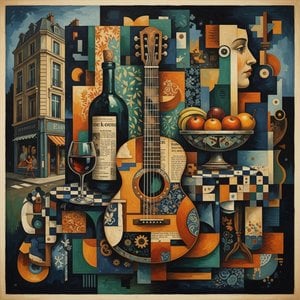
Master the vibrant world of Synthetic Cubism with our expert guide. Explore the revolutionary techniques of Picasso and Braque, from collage to color, and discover how this movement redefined modern art for collectors and connoisseurs alike.
 Preview
 Send
Send Share
Share
 Details
 Guide
Guide

 Download
 Similars
 X-Ray
X-Ray Diaporama
 Q&A
Q&A
 Stats
Stats

 Read More









 Glass option is only available in size under 110 CM


