Preview AR preview Buy Hand Made Painting Switch to Digital Image Send
Details Guide Add to favorites Download Similars X-Ray Diaporama Stats

Guitar 5

A striking black & white sculpture by Picasso – Guitar 5 exemplifies Cubist fragmentation & geometric abstraction. Explore its raw texture & powerful form.

Co-founder of Cubism and creator of Guernica. Discover the revolutionary works of Pablo Picasso today.

The artwork displayed on this page is protected by copyright law, which means we cannot legally create or sell an identical reproduction. This protection is enforced under international agreements such as the Berne Convention and by national laws, including those outlined by the U.S. Copyright Law - Title 17.

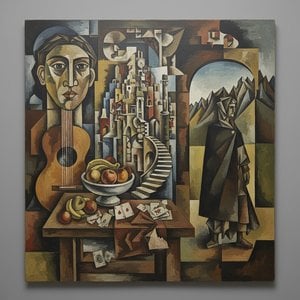
This method fully complies with copyright regulations because it does not involve copying or duplicating the protected artwork. Instead, it is a creative reinterpretation - a new painting that is influenced by the original but not identical to it.

Giclée / Art Print

Museum-quality giclée or canvas print with fast production and flexible finish options. ( Buy Hand Made Painting Switch to Digital Image)

Corner sample of the P118B picture frame: moulded polystyrene, 5 cm wide and 3 cm thick
P118B $10
Corner sample of the P118H picture frame: moulded polystyrene, 5 cm wide and 3 cm thick
P118H $10
Corner sample of the P118W picture frame: moulded polystyrene, 5 cm wide and 3 cm thick
P118W $10
Corner sample of the P438Z picture frame: moulded polystyrene, 5.5 cm wide and 3.5 cm thick
P438Z $10
Corner sample of the P508JH picture frame: moulded polystyrene, 7 cm wide and 3.5 cm thick
P508JH $12
Corner sample of the P508YH picture frame: moulded polystyrene, 7 cm wide and 3.5 cm thick
P508YH $12
Corner sample of the P805H picture frame: moulded polystyrene, 5 cm wide and 3.5 cm thick
P805H $10
Corner sample of the P805Z picture frame: moulded polystyrene, 5 cm wide and 3.5 cm thick
P805Z $10
Corner sample of the P919BZ picture frame: moulded polystyrene, 7 cm wide and 3.5 cm thick
P919BZ $10
Corner sample of the P919G picture frame: moulded polystyrene, 7 cm wide and 3.5 cm thick
P919G $10
Corner sample of the P919XJ picture frame: moulded polystyrene, 7 cm wide and 3.5 cm thick
P919XJ $10
Corner sample of the P959ZH picture frame: moulded polystyrene, 5 cm wide and 3 cm thick
P959ZH $10
Corner sample of the P968JZ picture frame: moulded polystyrene, 6 cm wide and 4 cm thick
P968JZ $12
Corner sample of the W106C picture frame: solid wood, 5 cm wide and 3 cm thick
W106C $8
Corner sample of the W218G picture frame: solid wood, 5 cm wide and 3 cm thick
W218G $10
Corner sample of the W218JH picture frame: solid wood, 5 cm wide and 3 cm thick
W218JH $8
Corner sample of the W218Y picture frame: solid wood, 5 cm wide and 3 cm thick
W218Y $10
Corner sample of the W307PJ picture frame: solid wood, 6 cm wide and 3 cm thick
W307PJ $10
Corner sample of the W316G picture frame: solid wood, 6 cm wide and 3 cm thick
W316G $10
Corner sample of the W316PJ picture frame: solid wood, 6 cm wide and 3 cm thick
W316PJ $8
Corner sample of the W316Y picture frame: solid wood, 6 cm wide and 3 cm thick
W316Y $10
Corner sample of the W398PJ picture frame: solid wood, 5 cm wide and 3 cm thick
W398PJ $8
Corner sample of the W4111J picture frame: solid wood, 6.5 cm wide and 3.5 cm thick
W4111J $10
Corner sample of the W500HY picture frame: solid wood, 7 cm wide and 5 cm thick
W500HY $15
Corner sample of the W500JH picture frame: solid wood, 7 cm wide and 5 cm thick
W500JH $15
Corner sample of the W692G picture frame: solid wood, 8 cm wide and 4 cm thick
W692G $12
Corner sample of the W849H picture frame: solid wood, 5 cm wide and 3 cm thick
W849H $8
Corner sample of the W940BG picture frame: solid wood, 7.5 cm wide and 4.5 cm thick
W940BG $15
Corner sample of the W953PJ picture frame: solid wood, 6 cm wide and 3.5 cm thick
W953PJ $8

Standard
custom
CM
INCH

Pick from our preset sizes that match the artwork's original proportions.

width
height

Type the width and the height you need, to fit your frame or your wall. A print can only be cut, never made bigger than the picture, so a size with a different shape loses a part of the image. We send you a digital mockup to approve before we print anything. The picture shown on this page does not show the real cut — only the mockup does.

Worldwide Delivery () in 2 weeks instead of standard 4/5 weeks. (26 October)

Free Worldwide Express Shipping
High-Quality Linen Canvas
Full Shipping Insurance
Customs Tax Refund Guarantee
True Color Matching Guarantee
100-Day Return Policy (Defects Only)
100% Money-Back Guarantee
Bulk Discount Offer

Total Price

$ 69

Guitar 5

Giclée / Art Print

Reproduction Size

-

Total Price

$ 69

Quick Facts

  • Notable elements or techniques: Geometric abstraction; Fragmented forms
  • Title: Guitar
  • Location: Musee Picasso, Paris
  • Subject or theme: Musical instrument
  • Artistic style: Synthetic Cubism
  • Influences: Georges Braque

A Fragmented Vision of Form: Analyzing Picasso’s “Guitar”

Pablo Picasso's "Guitar" (1920), a deceptively simple yet profoundly complex sculpture, stands as a pivotal emblem of Synthetic Cubism—a movement that irrevocably altered the trajectory of artistic expression. Captured in stark black and white photography, this piece transcends mere representation, delving into the realm of geometric abstraction and challenging conventional notions of visual perception. The photograph itself is meticulously crafted, prioritizing textural detail and capturing the sculpture’s raw materiality with remarkable precision. Its shallow perspective emphasizes the immediate surface, minimizing atmospheric haze and concentrating attention on the interplay between light and shadow—elements crucial to conveying the sculpture's sculptural essence.
  • Subject Matter: The sculpture depicts a stylized guitar figure, rendered in angular planes that disrupt any illusion of naturalistic form. Its deliberate fragmentation speaks to the Cubist preoccupation with dissecting objects into constituent parts and reconstructing them anew from multiple viewpoints.
  • Style & Technique: Synthetic Cubism marks a decisive break from Analytical Cubism’s earlier focus on simultaneous perspectives. Picasso abandons meticulous shading and employs bold, geometric shapes—primarily rectilinear blocks—to construct the guitar's form. The rough surface texture suggests a material like stone or similar durable substance, reflecting the movement’s commitment to materiality and rejecting illusionistic techniques.
  • Historical Context: Created during Picasso’s prolific period of experimentation following World War I, “Guitar” embodies the anxieties and intellectual ferment of the era. Synthetic Cubism responded to the devastation of the conflict by rejecting sentimentalism and embracing a more austere aesthetic—a deliberate rejection of bourgeois values and an assertion of artistic autonomy.
  • Symbolism: While devoid of overt narrative content, "Guitar" carries subtle symbolic resonance. The guitar itself has historically represented musical expression and passion; its fractured form may symbolize the fragmentation of experience and the difficulty of achieving wholeness in a turbulent world.
  • Emotional Impact: Despite its geometric austerity, the sculpture evokes a palpable sense of unease—a reflection of the psychological landscape prevalent during Picasso’s time. The stark contrast between light and shadow amplifies the sculptural form's dimensionality, creating an unsettling visual experience that compels contemplation.

Exploring Picasso’s Synthetic Cubist Approach

Picasso’s masterful manipulation of geometric abstraction exemplifies the core tenets of Synthetic Cubism. Unlike Analytical Cubism’s painstaking layering of planes to create multiple viewpoints simultaneously, Synthetic Cubists prioritized simplified forms and bold colors—though in this monochrome reproduction, color is absent—to convey essential visual information. The photograph expertly highlights the sculpture's textural qualities, demonstrating Picasso’s dedication to capturing the materiality of his subject matter. This deliberate choice underscores the movement’s rejection of illusionistic representation and its embrace of a more intellectually stimulating aesthetic.

Connections to Other Works & Artistic Influences

“Guitar” stands alongside other seminal Cubist sculptures, such as “Head” (1921) and “Man with Guitar” (1924), demonstrating Picasso’s unwavering commitment to exploring the possibilities of geometric abstraction. These works share a common preoccupation with dissecting form and reconstructing it from multiple perspectives—a technique pioneered by artists like Georges Braque and Juan Gris. The sculpture's influence extends beyond Cubism itself, informing subsequent artistic movements and inspiring generations of sculptors to experiment with unconventional materials and compositional strategies.

A Legacy of Innovation

Pablo Picasso’s “Guitar” remains a testament to the transformative power of artistic innovation. Its enduring appeal lies in its ability to provoke contemplation and challenge viewers' preconceptions about visual representation—a feat achieved through masterful technique, astute stylistic choices, and a profound engagement with the intellectual currents of its time. Reproductions like this allow art enthusiasts worldwide to appreciate Picasso’s genius and experience firsthand the impact of Synthetic Cubism on modern art history.

Questions & Answers

Which artistic current is "Guitar 5" by Pablo Picasso part of?

"Guitar 5" is a work of Cubism. The movement indicates the artistic tradition the work is part of.

At what size is "Guitar 5" recommended to be printed?

The recommended print size for "Guitar 5" by Pablo Picasso is large.

Where can I buy a digital image of "Guitar 5" by Pablo Picasso?

A digital image of "Guitar 5" by Pablo Picasso can be purchased on its Digital Image page: a high-resolution digital image download.


Artist Biography

The boy from Málaga

A child's first words in Málaga were “piz, piz,” a small attempt at saying pencil. This early pull toward the lead and paper was nurtured by his father, José Ruiz y Blasco, who taught him the basics of figure drawing and oil painting. The boy learned to copy the masters and draw from plaster casts under a disciplined eye. As he grew, the family moved through A Coruña and Barcelona. These years were marked by the quiet weight of loss, particularly the death of his sister, Conchita, from diphtheria when she was only seven. Such shadows would later find their way into the heavy, blue-green tones of his early work.

By thirteen, he was already taking entrance exams for advanced classes in Barcelona, finishing in a week what took others a month. His hands moved with a precision that even his father noticed, once seeing him paint over an unfinished sketch of a pigeon with such accuracy that the instructor realized the student had surpassed him. He eventually moved to Paris, a city where he would spend much of his adult life, constantly shifting his focus from one way of seeing to another.

Shifting palettes and fractured forms

The early twentieth century saw his work move through distinct phases of color and mood. There was the Blue Period, where the canvases were filled with beggars, the blind, and the lonely, rendered in somber shades of blue. This gave way to the Rose Period, a time when pinks, oranges, and reds appeared, often featuring the figures of circus performers like harlequins and acrobats. These years showed a man reacting to his own life and the world around him through the temperature of his palette.

In 1907, the way he handled space changed fundamentally with Les Demoiselles d'Avignon. Influenced by African masks and Iberian sculpture, he began to break objects into geometric shapes. Alongside Georges Braque, he developed Cubism. This involved two main stages:

  • Analytic Cubism: A method of fragmenting objects into muted, geometric pieces as if dissecting the form itself.
  • Synthetic Cubism: An approach that brought in collage elements like newspaper clippings and fabric scraps to add texture and new layers.

A life of constant change

His work never settled into a single way of being. He explored Neoclassicism with large, monumental figures and later engaged with the imagery of Surrealism, using distorted perspectives to tap into the subconscious. The violence of the Spanish Civil War left its mark on his canvas in 1937 through Guernica. This large oil painting used a stark palette of black, white, and grey to show the suffering of a bombed town, featuring a gored horse, a bull, and screaming women. It remains a heavy, monochromatic response to the chaos of war.

In his later years, he continued to experiment with ceramics, sculpture, and printmaking. He even created large-scale public works, such as the 1967 steel sculpture in Chicago, which was inspired by the head of his Afghan Hound, Kabul. He died in Mougins, France, leaving behind a massive collection of work that spans over seventy-six years of experimentation.

Pablo Picasso

Pablo Picasso

1881 - 1973 , Spain

Quick Facts

  • Full Name: Pablo Diego José Ruiz Picasso
  • Nationality: Spanish
  • Date Of Birth: 1881
  • Date Of Death: 1973
  • Place Of Birth: Malaga, Spain
  • Notable Artworks:
    • Les Demoiselles d'Avignon
    • Guernica
    • The Old Guitarist
    • La Vie
    • Family of Saltimbanques
  • Artistic Movement Or Style: Cubism, Surrealism
  • Artists Who Influenced This Artist:
    • Velázquez
    • Goya
    • Matisse
  • Artists Or Movements Influenced By This Artist:
    • Cubism
    • Modern art
Explore artworks organized by themes, styles, and characteristics.