
The artwork displayed on this page is protected by copyright law, which means we cannot legally create or sell an identical reproduction. This protection is enforced under international agreements such as the Berne Convention and by national laws, including those outlined by the U.S. Copyright Law - Title 17.
This method fully complies with copyright regulations because it does not involve copying or duplicating the protected artwork. Instead, it is a creative reinterpretation - a new painting that is influenced by the original but not identical to it.
Museum-quality giclée or canvas print with fast production and flexible finish options. ( Buy Hand Made Painting Switch to Digital Image)





























Pick from our preset sizes that match the artwork's original proportions.

Type the width and the height you need, to fit your frame or your wall. A print can only be cut, never made bigger than the picture, so a size with a different shape loses a part of the image. We send you a digital mockup to approve before we print anything. The picture shown on this page does not show the real cut — only the mockup does.
Worldwide Delivery () in 2 weeks instead of standard 4/5 weeks. (7 November)
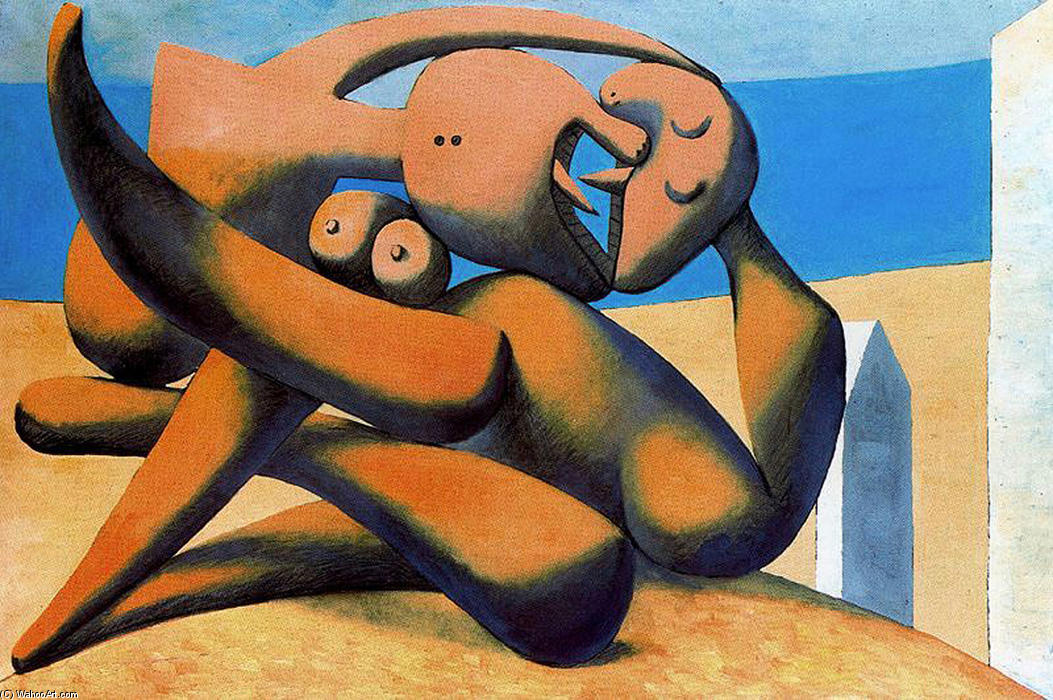
Figures at the seaside
Reproduction Size
Pablo Picasso's "Figures at the Seaside," painted in 1931, isn’t merely a depiction of a beach scene; it’s a profound meditation on human connection, isolation, and the unsettling undercurrents of the modern world. This work, rendered in oil on canvas, exemplifies Picasso’s evolving Cubist sensibilities while simultaneously retaining a haunting emotional resonance that transcends stylistic categorization. The painting immediately draws the viewer into a carefully constructed tableau – two nude figures, ambiguously male and female, occupy the foreground, their bodies intertwined yet separated by an almost impenetrable distance. They are not embracing in a conventional sense; rather, they seem to be caught in a silent, weighty exchange, their gazes averted, creating a palpable atmosphere of melancholy and unspoken tension.
Picasso’s masterful use of fractured forms and flattened perspective is central to the painting's impact. The figures are not presented with anatomical accuracy but rather as geometric shapes – blocks of color and angular lines that suggest volume and presence without resorting to traditional representation. This deliberate distortion mirrors the fragmentation of modern life, where individuals often feel disconnected despite being physically proximate. The background, a hazy expanse of sand and sea, further contributes to this sense of disorientation, blurring the boundaries between reality and dream.
To fully appreciate “Figures at the Seaside,” it’s crucial to understand the historical context in which it was created. 1931 marked a period of significant political and social upheaval across Europe, with rising tensions leading up to the imminent outbreak of World War II. Picasso himself was living in Paris during this time, navigating a complex personal life and grappling with the anxieties of his era. The painting can be interpreted as a reflection of these broader societal concerns – a visual representation of the loneliness and uncertainty that permeated the collective consciousness.
Furthermore, the work emerged from Picasso’s exploration of Surrealist ideas, though he resisted being strictly categorized within the movement. He was deeply influenced by the works of Giorgio de Chirico, whose paintings often featured enigmatic figures in desolate landscapes, evoking a sense of unease and psychological depth. “Figures at the Seaside” shares this unsettling quality, inviting viewers to contemplate the hidden emotions beneath the surface of seemingly ordinary scenes.
The symbolism within "Figures at the Seaside" is deliberately ambiguous, encouraging multiple interpretations. The intertwined bodies suggest a potential connection, yet their averted gazes and the spatial distance between them highlight a fundamental lack of communication. Some art historians believe that the figures represent Picasso himself and his muse, Fernande Olivier, whose relationship was often fraught with tension and emotional complexity. Others see them as archetypal representations of humanity – individuals struggling to connect in an increasingly impersonal world.
The presence of several smaller, partially obscured figures scattered throughout the scene adds another layer of intrigue. These secondary characters seem to be caught in their own private dramas, further emphasizing the theme of isolation and detachment. The single, solitary figure on the beach in the background could represent a lost soul, yearning for connection but unable to bridge the gap between himself and others.
“Figures at the Seaside” remains a powerfully evocative work of art, captivating viewers with its haunting beauty and profound emotional depth. Picasso’s innovative use of Cubist techniques, combined with his masterful command of color and composition, creates an image that is both visually arresting and psychologically complex. It's a testament to the artist's ability to capture the essence of human experience – the longing for connection, the pain of isolation, and the unsettling realities of modern life.
Reproductions of this iconic painting offer a remarkable opportunity to bring Picasso’s vision into any space, inviting contemplation and sparking dialogue. The enduring appeal of “Figures at the Seaside” lies in its ability to resonate with viewers on a deeply personal level, reminding us of our shared humanity and the universal challenges of navigating an increasingly fragmented world.
"Figures at the seaside" by Pablo Picasso can be viewed as a slideshow on the artwork's Diaporama page.
"Figures at the seaside" carries a melancholic emotional tone within the Surrealism movement.
"Figures at the seaside", created in 1931, belongs to the Surrealist Period of Pablo Picasso's career.

A child's first words in Málaga were “piz, piz,” a small attempt at saying pencil. This early pull toward the lead and paper was nurtured by his father, José Ruiz y Blasco, who taught him the basics of figure drawing and oil painting. The boy learned to copy the masters and draw from plaster casts under a disciplined eye. As he grew, the family moved through A Coruña and Barcelona. These years were marked by the quiet weight of loss, particularly the death of his sister, Conchita, from diphtheria when she was only seven. Such shadows would later find their way into the heavy, blue-green tones of his early work.
By thirteen, he was already taking entrance exams for advanced classes in Barcelona, finishing in a week what took others a month. His hands moved with a precision that even his father noticed, once seeing him paint over an unfinished sketch of a pigeon with such accuracy that the instructor realized the student had surpassed him. He eventually moved to Paris, a city where he would spend much of his adult life, constantly shifting his focus from one way of seeing to another.
The early twentieth century saw his work move through distinct phases of color and mood. There was the Blue Period, where the canvases were filled with beggars, the blind, and the lonely, rendered in somber shades of blue. This gave way to the Rose Period, a time when pinks, oranges, and reds appeared, often featuring the figures of circus performers like harlequins and acrobats. These years showed a man reacting to his own life and the world around him through the temperature of his palette.
In 1907, the way he handled space changed fundamentally with Les Demoiselles d'Avignon. Influenced by African masks and Iberian sculpture, he began to break objects into geometric shapes. Alongside Georges Braque, he developed Cubism. This involved two main stages:
His work never settled into a single way of being. He explored Neoclassicism with large, monumental figures and later engaged with the imagery of Surrealism, using distorted perspectives to tap into the subconscious. The violence of the Spanish Civil War left its mark on his canvas in 1937 through Guernica. This large oil painting used a stark palette of black, white, and grey to show the suffering of a bombed town, featuring a gored horse, a bull, and screaming women. It remains a heavy, monochromatic response to the chaos of war.
In his later years, he continued to experiment with ceramics, sculpture, and printmaking. He even created large-scale public works, such as the 1967 steel sculpture in Chicago, which was inspired by the head of his Afghan Hound, Kabul. He died in Mougins, France, leaving behind a massive collection of work that spans over seventy-six years of experimentation.

1881 - 1973 , Spain

Embark on a journey through the revolutionary world of Cubism. Discover how masters like Picasso redefined perspective through Analytical and Synthetic techniques in this expert-led guide for art enthusiasts and collectors.

Unveil the radical revolution of Cubism. Explore how masters like Picasso and Braque redefined modern art through fragmented forms and geometric abstraction, offering profound insights for discerning collectors of fine art history and masterpieces.
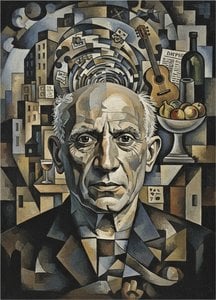
Explore the profound evolution of Cubism through an expert analysis of Pablo Picasso's revolutionary works. From Analytical to Synthetic Cubism, discover the techniques that redefined modern art and learn how to curate these iconic masterpieces for your private collection.
 Preview
 Send
Send Share
Share
 Details
 Guide
Guide

 Download
 Similars
 X-Ray
X-Ray Diaporama
 Q&A
Q&A
 Stats
Stats

 Read More









 Glass option is only available in size under 110 CM


