The artwork displayed on this page is protected by copyright law, which means we cannot legally create or sell an identical reproduction. This protection is enforced under international agreements such as the Berne Convention and by national laws, including those outlined by the U.S. Copyright Law - Title 17.
This method fully complies with copyright regulations because it does not involve copying or duplicating the protected artwork. Instead, it is a creative reinterpretation - a new painting that is influenced by the original but not identical to it.
Museum-quality giclée or canvas print with fast production and flexible finish options. ( Buy Hand Made Painting Switch to Digital Image)





























Pick from our preset sizes that match the artwork's original proportions.

Type the width and the height you need, to fit your frame or your wall. A print can only be cut, never made bigger than the picture, so a size with a different shape loses a part of the image. We send you a digital mockup to approve before we print anything. The picture shown on this page does not show the real cut — only the mockup does.
Worldwide Delivery () in 2 weeks instead of standard 4/5 weeks. (24 October)
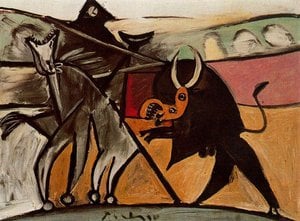
Corrida de toros 4
Reproduction Size
Pablo Picasso’s “Corrida de toros 4,” a striking black and white drawing executed in 1961, isn't merely a depiction of a bullfight; it’s a visceral exploration of human drama, primal instinct, and the unsettling beauty of violence. This work, part of Picasso’s late-career series exploring bullfighting, transcends simple illustration, becoming a potent meditation on courage, fear, and the precarious balance between life and death. The drawing captures a pivotal moment within the spectacle – a man perched precariously atop a horse, holding aloft a vibrant red cape, directly confronting the looming threat of the bull.
Picasso’s masterful use of line and shadow immediately establishes an atmosphere of heightened tension. The figures are rendered with a deliberate lack of detail, emphasizing their essential forms rather than precise representation. The horse, a powerful, almost skeletal presence, dominates the left side of the composition, its musculature taut with anticipation. The man on horseback is similarly simplified, his posture conveying both determination and vulnerability. Notice how Picasso uses jagged lines to define the bull’s horns and charging form – these aren't gentle curves; they are sharp, aggressive indicators of impending attack. The background is largely obscured, drawing all attention to this central confrontation.
“Corrida de toros 4” firmly anchors itself within Picasso’s late Cubist style, though it departs from the geometric fragmentation of his earlier works. Here, the subject matter is broken down into fundamental shapes – planes and angles – yet these elements are interwoven with a remarkable sense of dynamism. The drawing isn't about recreating reality; it’s about capturing the *feeling* of the event—the energy, the chaos, the underlying brutality. The influence of his earlier explorations with African masks and Iberian sculpture is evident in the stylized forms and the deliberate distortion of perspective. This approach allows Picasso to convey multiple viewpoints simultaneously, mirroring the experience of a spectator caught within the swirling drama of the bullfight.
The monochromatic palette – primarily shades of black, white, and grey – further amplifies the drawing’s emotional impact. It evokes the starkness of newsprint photographs, lending the scene an air of documentary realism while simultaneously stripping it of sentimentality. The absence of color forces the viewer to focus on form, line, and composition, intensifying the sense of urgency and danger.
Beyond its formal qualities, “Corrida de toros 4” is rich in symbolic meaning. The bull itself represents not just brute force but also primal instinct, aggression, and perhaps even a confrontation with mortality. The red cape, a traditional element of the bullfight, becomes a beacon of both courage and vulnerability – a desperate attempt to control the uncontrollable. The man on horseback embodies the human spirit’s willingness to face danger, albeit with a palpable sense of risk.
Interestingly, Picasso included other figures within the scene—a dog observing the action, and a lone individual positioned near the top left corner. These additions suggest a broader commentary on humanity's fascination with spectacle and violence. The dog’s presence hints at the animalistic nature of the event, while the solitary observer underscores the detached yet deeply engaged perspective of the audience.
“Corrida de toros 4” remains a powerfully evocative work, demonstrating Picasso's ability to distill complex emotions and dramatic narratives into deceptively simple forms. It’s a testament to his enduring fascination with human behavior and his willingness to confront uncomfortable truths through art. Reproductions of this drawing offer a unique opportunity to experience the intensity of Picasso’s vision – a glimpse into the heart of a spectacle that continues to captivate and disturb audiences worldwide. Its stark beauty and profound symbolism make it a compelling addition to any collection, offering both aesthetic pleasure and intellectual stimulation.
"Corrida de toros 4" shows bullfight, spain, picasso, toros, violence, horse, crowd, action, and its recorded mood is dramatic.
"Corrida de toros 4" carries a melancholic emotional tone within the Cubist Expression movement.
To preview a reproduction of "Corrida de toros 4" by Pablo Picasso, open the artwork's Preview page.

A child's first words in Málaga were “piz, piz,” a small attempt at saying pencil. This early pull toward the lead and paper was nurtured by his father, José Ruiz y Blasco, who taught him the basics of figure drawing and oil painting. The boy learned to copy the masters and draw from plaster casts under a disciplined eye. As he grew, the family moved through A Coruña and Barcelona. These years were marked by the quiet weight of loss, particularly the death of his sister, Conchita, from diphtheria when she was only seven. Such shadows would later find their way into the heavy, blue-green tones of his early work.
By thirteen, he was already taking entrance exams for advanced classes in Barcelona, finishing in a week what took others a month. His hands moved with a precision that even his father noticed, once seeing him paint over an unfinished sketch of a pigeon with such accuracy that the instructor realized the student had surpassed him. He eventually moved to Paris, a city where he would spend much of his adult life, constantly shifting his focus from one way of seeing to another.
The early twentieth century saw his work move through distinct phases of color and mood. There was the Blue Period, where the canvases were filled with beggars, the blind, and the lonely, rendered in somber shades of blue. This gave way to the Rose Period, a time when pinks, oranges, and reds appeared, often featuring the figures of circus performers like harlequins and acrobats. These years showed a man reacting to his own life and the world around him through the temperature of his palette.
In 1907, the way he handled space changed fundamentally with Les Demoiselles d'Avignon. Influenced by African masks and Iberian sculpture, he began to break objects into geometric shapes. Alongside Georges Braque, he developed Cubism. This involved two main stages:
His work never settled into a single way of being. He explored Neoclassicism with large, monumental figures and later engaged with the imagery of Surrealism, using distorted perspectives to tap into the subconscious. The violence of the Spanish Civil War left its mark on his canvas in 1937 through Guernica. This large oil painting used a stark palette of black, white, and grey to show the suffering of a bombed town, featuring a gored horse, a bull, and screaming women. It remains a heavy, monochromatic response to the chaos of war.
In his later years, he continued to experiment with ceramics, sculpture, and printmaking. He even created large-scale public works, such as the 1967 steel sculpture in Chicago, which was inspired by the head of his Afghan Hound, Kabul. He died in Mougins, France, leaving behind a massive collection of work that spans over seventy-six years of experimentation.

1881 - 1973 , Spain

Explore the profound evolution of Cubism through an expert analysis of Pablo Picasso's revolutionary works. From Analytical to Synthetic Cubism, discover the techniques that redefined modern art and learn how to curate these iconic masterpieces for your private collection.

Embark on a journey through the revolutionary world of Cubism. Discover how masters like Picasso redefined perspective through Analytical and Synthetic techniques in this expert-led guide for art enthusiasts and collectors.

 Preview
 Send
Send Share
Share
 Details
 Guide
Guide

 Download
 Similars
 X-Ray
X-Ray Diaporama
 Stats
Stats

 Read More









 Glass option is only available in size under 110 CM