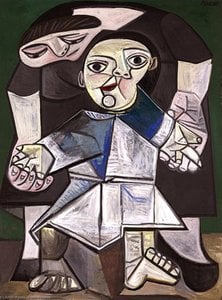
Oil On CanvasWallArtNaive Art / Primitivism
 1941Modern
 130.0 x 97.0 cm
Museum-quality giclée or canvas print with fast production and flexible finish options. ( Buy Hand Made Painting Switch to Digital Image)





























Pick from our preset sizes that match the artwork's original proportions.

You may enter your own dimensions to fit a specific frame or space. If your selected size does not match the original image's proportions, we will either crop the artwork or extend the image with a mirrored or solid-fill edge. A digital mockup will be sent for your approval before production begins.
Please note that the on-screen preview does not reflect the actual cropping or extension. Only the mockup will accurately show the final composition.
While custom sizes are available, we recommend selecting a dimension from the predefined list to preserve the original proportions.
Worldwide Delivery () in 2 weeks instead of standard 4/5 weeks. (22 September)


Boy with a langosta
Reproduction Size

Pablo Ruiz y Picasso, a name synonymous with artistic revolution, was born in Málaga, Spain, on October 25, 1881. His very existence seemed destined for creative expression; legend has it his first uttered words were “piz, piz,” an attempt to say ‘pencil’. This early inclination was nurtured by his father, José Ruiz y Blasco, a painter and art teacher who provided young Pablo with foundational training. However, the student quickly surpassed the instructor, demonstrating a remarkable aptitude for naturalistic depiction that hinted at the prodigious talent within. The family’s subsequent moves – first to A Coruña, then Barcelona – were punctuated by personal tragedy, notably the loss of Picasso's sister, experiences which would subtly infuse his later work with themes of melancholy and mortality. Even during formal studies at the School of Fine Arts in Barcelona and a brief stint at the Royal Academy of San Fernando in Madrid, Picasso chafed against rigid academic constraints, preferring instead to immerse himself in the works of masters like Velázquez and Goya, forging his own path toward artistic innovation.
The early years of the 20th century witnessed the emergence of two distinct periods in Picasso’s oeuvre: the Blue Period (roughly 1901-1904) and the Rose Period (1904-1906). The Blue Period, born from personal hardship and a keen awareness of social suffering, is characterized by paintings steeped in somber shades of blue and blue-green. These works are populated by marginalized figures – beggars, the blind, prostitutes – rendered with a haunting empathy that speaks to themes of isolation and despair. La Vie (1903) and The Old Guitarist (1903-1904) stand as poignant examples of this emotionally charged phase. A shift in Picasso’s personal life, coupled with a move to Paris, heralded the arrival of the Rose Period. The palette warmed considerably, embracing pinks, oranges, and reds, reflecting a more optimistic outlook. This period saw a fascination with circus performers – harlequins, acrobats, and family troupes – figures who embodied both fragility and resilience. Family of Saltimbanques (1905) beautifully encapsulates this transition, hinting at the stylistic explorations that lay ahead.
The year 1907 marked a pivotal moment in art history with the creation of Les Demoiselles d'Avignon. Influenced by Iberian sculpture and African masks, this groundbreaking painting shattered traditional notions of perspective and representation. It was a radical departure, a deliberate rejection of centuries-old conventions that paved the way for Cubism. Working in close collaboration with Georges Braque, Picasso co-founded this revolutionary movement, fundamentally altering how artists perceived and depicted reality. Analytical Cubism (1909-1912) involved the fragmentation of objects into geometric shapes, rendered in muted colors, as if dissecting form itself. This evolved into Synthetic Cubism (1912-1919), which incorporated collage elements – newspaper clippings, fabric scraps – adding texture and new layers of visual complexity. Picasso wasn’t content to simply represent the world; he sought to deconstruct it and reconstruct it on his own terms.
The 1920s saw Picasso briefly explore Neoclassical styles, creating monumental figures that echoed classical forms while retaining a distinctly modern sensibility. Simultaneously, he engaged with the burgeoning Surrealist movement, though never fully aligning himself with its principles. His work during this period blended earlier stylistic influences with surreal imagery and distorted perspectives, demonstrating his relentless experimentation. The horrors of the Spanish Civil War profoundly impacted Picasso, culminating in the creation of Guernica (1937), a visceral and emotionally devastating response to the bombing of Guernica. This monumental work became an enduring symbol of the atrocities of war, solidifying Picasso’s role as not just an artist but also a powerful voice for peace and social justice. Throughout the 1950s and 60s, he continued to push boundaries, exploring ceramics, sculpture, and printmaking with unwavering curiosity and skill. His marriage to Jacqueline Roque in 1961 brought a new dimension to his personal life and artistic expression.
Pablo Picasso died on April 8, 1973, in Mougins, France, leaving behind an astonishing body of work – estimated at over 50,000 pieces – that continues to captivate and inspire. His artistic development was shaped by a diverse range of influences, from Spanish masters like Velázquez and Goya to Iberian sculpture, African art, and the vibrant color palettes of Henri Matisse. His impact on 20th-century art is immeasurable. He co-founded Cubism, pioneered collage and constructed sculpture, and consistently challenged artistic conventions. Picasso’s relentless experimentation redefined modern art, leaving an indelible mark on generations of artists and solidifying his position as one of the most important and influential figures in history. His legacy extends beyond the canvas, resonating in countless aspects of contemporary culture and reminding us of the transformative power of artistic vision.

1881 - 1973 , Spain

Discover the enchanting world of Naive Art. Explore the profound beauty of self-taught masters like Henri Rousseau through an art-history lens, uncovering how simple forms and vibrant colors create timeless, soulful masterpieces for the discerning collector.

Explore the profound evolution of Cubism through an expert analysis of Pablo Picasso's revolutionary works. From Analytical to Synthetic Cubism, discover the techniques that redefined modern art and learn how to curate these iconic masterpieces for your private collection.

Explore the profound impact of Primitivism on modern art. Delve into how masters like Gauguin and Picasso utilized raw emotion and non-Western aesthetics to redefine artistic form, breaking from academic tradition to shape the course of 20th-century expressionism.

 Preview
 Send
Send Share
Share
 Details
 Guide
Guide

 Download
 Similars
 X-Ray
X-Ray Diaporama
 Stats
Stats Read More







 Glass option is only available in size under 110 CM